Thyroid blood tests: what each one measures
Normal ranges differ between labs and in pregnancy; only your doctor can interpret your results.
When Yolanda, 45 (a fictitious patient), opened her lab portal, she saw a page of abbreviations: TSH, FT4, TPO. One was marked in red. “I spent the whole night searching online,” she said. This chapter explains what those letters mean, so your appointment can be about your questions, not decoding.
TSH: the first test
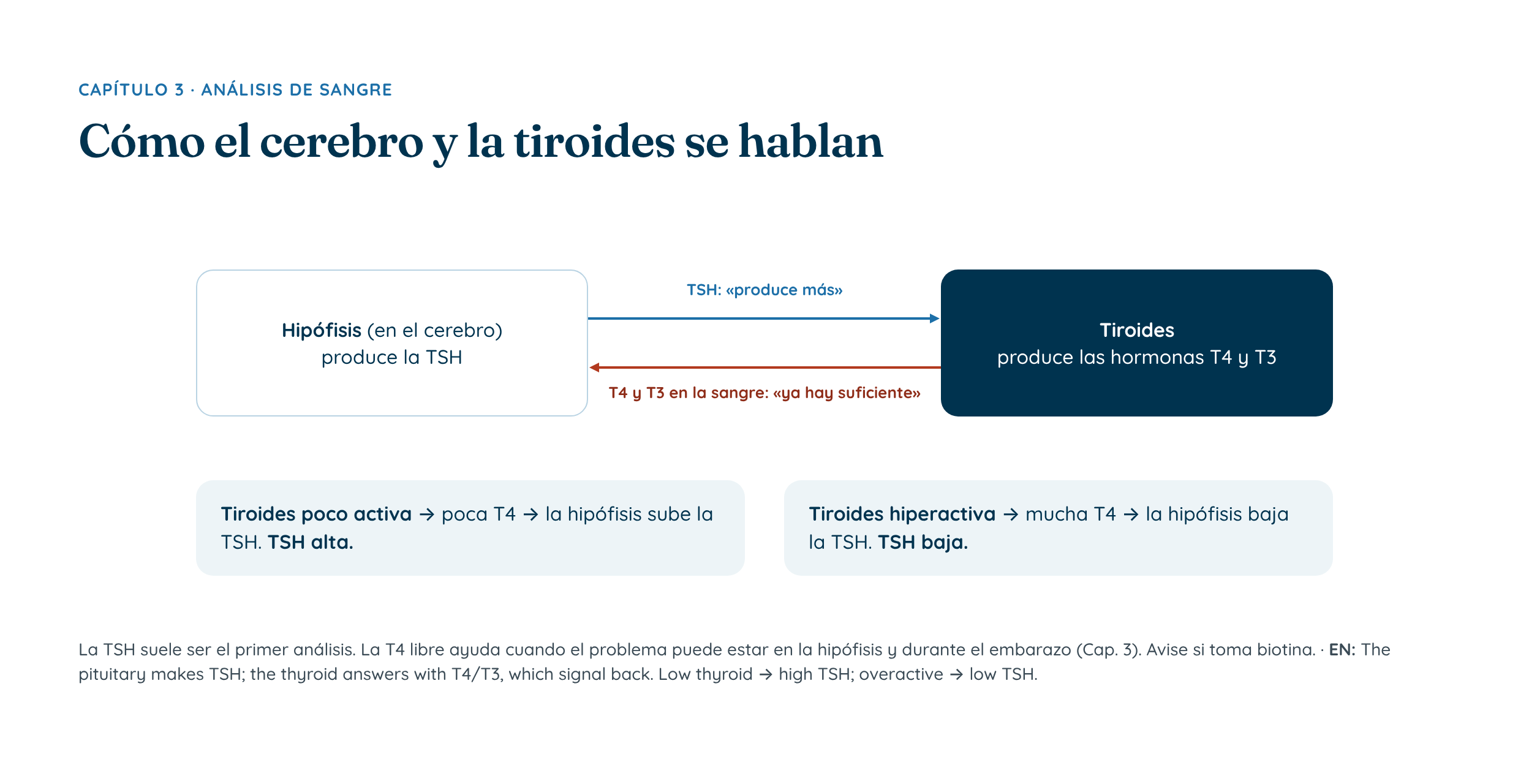
TSH (thyroid-stimulating hormone) comes from the pituitary gland and tells the thyroid how hard to work (Chapter 1). It is usually the first test when a doctor suspects a problem in the thyroid gland itself [1]. Because it works like a thermostat, the logic is reversed from what many people expect: a high TSH usually means the thyroid is underactive, and a low TSH usually means it is overactive.
Free T4 and T3
These measure the thyroid hormones themselves. Free T4 is often ordered with TSH, or when TSH is abnormal. Free T4 matters most when a pituitary problem is suspected, because then TSH can be misleading, and its interpretation differs during pregnancy (Chapter 6). T3 is mainly useful when an overactive thyroid is suspected. Together with TSH, they show whether a problem is mild (“subclinical”) or more pronounced. Where exactly “normal” ends is partly a matter of statistical ranges and is debated [3].
Antibodies
- TPO antibodies and thyroglobulin antibodies: suggest autoimmune thyroid disease, such as Hashimoto’s (Chapter 4). Many people have them with normal thyroid function.
- TSH receptor antibodies (TRAb or TSI): help confirm Graves’ disease as the cause of an overactive thyroid [4]. See Chapter 5.
Thyroglobulin (Tg): can it detect thyroid cancer?
Thyroglobulin (Tg) is a protein made by the thyroid. It can be elevated in benign thyroid conditions. If you have a nodule, a high Tg result cannot confirm cancer, and a normal result cannot rule it out. The American Thyroid Association (ATA) recommends against routine Tg testing when a thyroid nodule is first evaluated (Recommendation 3). Ultrasound and, when indicated, a fine-needle biopsy help evaluate the nodule [5].
Tg serves a different purpose after total thyroidectomy for differentiated thyroid cancer. In that setting, your care team can measure it alongside thyroglobulin antibodies (TgAb) to monitor the response to treatment and look for signs that the cancer has returned. See the 2025 ATA guideline (Recommendation 47) and Chapter 27 on follow-up [6].
Calcitonin
Calcitonin is made by different cells in the thyroid and is a marker for medullary thyroid cancer. Some doctors check it in specific situations, such as a family history of medullary cancer; whether to test it routinely in every nodule is debated. See Chapter 28.
Things that can throw results off
- Biotin (vitamin B7, common in hair, skin and nail supplements) can interfere with some lab methods and produce falsely abnormal thyroid results, even mimicking an overactive thyroid [1][2]. Whether it matters depends on the dose you take and the lab method used. Tell the lab and the doctor who ordered the test if you take it, and follow their instructions about whether and when to pause it.
- Some medicines, such as amiodarone, lithium, steroids and certain cancer drugs, can change thyroid function, and others affect how levothyroxine is absorbed [1].
- Timing: if you take levothyroxine, ask whether to take it before or after your blood draw.
- Pregnancy changes normal ranges (Chapter 6).
If your results do not match how you feel, your doctor may repeat the test or use a different lab method [1].
Yolanda’s result
Yolanda’s red flag was a slightly high TSH with a normal free T4 and positive TPO antibodies. Her doctor explained it was an early, mild pattern, and they agreed to recheck in a few months. “I wish I’d known what TSH meant before I spent the night worrying,” she said.
A head and neck surgeon experienced in thyroid and voice care can help.
Sources
- Al-Bahadili H, et al. The Complex Web of Interferences With Thyroid Function Tests. Endocr Pract. 2025;31(1):92-101. doi:10.1016/j.eprac.2024.10.007 PubMed PMID 39477092
- Chiu KC, et al. Biotin interference in routine clinical immunoassays. Pract Lab Med. 2025;45:e00472. doi:10.1016/j.plabm.2025.e00472 PubMed PMID 40417451
- Chaker L, et al. Hypothyroidism. Lancet. 2017;390:1550-1562. doi:10.1016/S0140-6736(17)30703-1 PubMed PMID 28336049
- Ross DS, et al. 2016 American Thyroid Association Guidelines for Hyperthyroidism and Other Causes of Thyrotoxicosis. Thyroid. 2016;26(10):1343-1421. doi:10.1089/thy.2016.0229 PubMed PMID 27521067
- Haugen BR, et al. 2015 American Thyroid Association Guidelines for Thyroid Nodules and Differentiated Thyroid Cancer. Thyroid. 2016;26(1):1-133. doi:10.1089/thy.2015.0020 PubMed PMID 26462967
- Ringel MD, Sosa JA, et al. 2025 American Thyroid Association Management Guidelines for Adult Patients with Differentiated Thyroid Cancer. Thyroid. 2025;35(8):841–985. PubMed PMID 40844370
This guide is for general education only. It does not diagnose conditions or replace a medical evaluation. Talk with your own doctor about your situation. In an emergency, call 911 now (in Puerto Rico or the United States; elsewhere, your local emergency number).