Recovering from thyroid surgery
Most people recover from thyroid surgery faster than they expect. Pain is usually mild, many people are back to light activities within days, and the scar fades over months. This chapter explains what is normal, what helps, and a realistic timeline.
Pain
Thyroid surgery is usually less painful than people fear. Most of the discomfort is a sore throat from the breathing tube and tightness in the neck. Many people manage with non-opioid pain medicine alone, and when a stronger medicine is prescribed, often little of it is needed.
For most people, regular acetaminophen (Tylenol), with or without an anti-inflammatory if your surgeon approves, is enough. If you are given a stronger medicine and do not use it, dispose of it safely.
Swallowing and voice in the first weeks
It is common to feel a lump in the throat, tightness when swallowing, or a voice that tires easily in the first two weeks, even when the voice nerves are perfectly fine [1][2]. These symptoms improve steadily and are usually gone by three to six months [1][3].
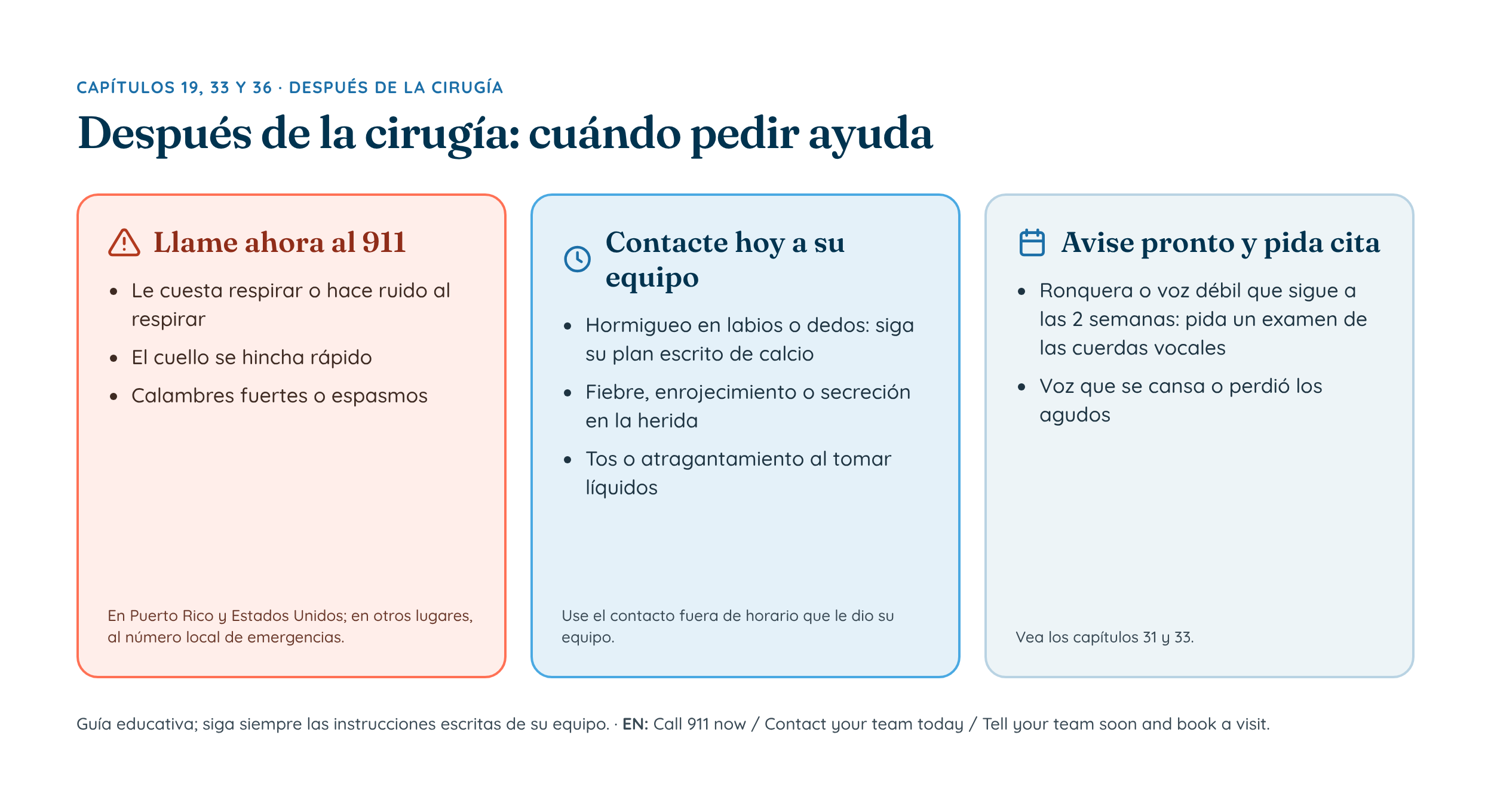
Soft foods for the first few days, small sips and resting your voice when it feels tired all help. If your voice is still hoarse after two weeks, tell your surgeon. If you cough or choke when drinking, contact your surgical team the same day. Guidelines recommend checking the voice in that window [5]. Chapter 32 explains voice changes in more detail.
Your incision and scar
- Keep the incision clean and dry as instructed. Most people can shower within a day or two, unless your surgeon tells you otherwise.
- Skin glue or tapes usually fall off by themselves within about two weeks.
- Mild swelling and a firm ridge under the scar are normal and soften over weeks to months.
- Protecting the scar from the sun in the first months is commonly advised to help it fade.
- Ask your surgeon when to start gentle scar massage or silicone products.
Wound infection is uncommon; in one large registry, superficial infections were found at a median of about nine days after surgery [4]. It can appear at any time, so report warning signs whenever they arise. Call your surgeon if the incision becomes red, hot, more painful or drains pus.
Activity, work and driving
These are typical timelines; your surgeon may advise differently for you.
| When | What most people can do |
|---|---|
| First days | Walk around the house and outside; gentle neck movement; light meals |
| End of week 1 | Desk work or studying, if you feel ready; short drives once you can turn your head comfortably and are off strong pain medicine |
| Weeks 2–3 | Most normal daily activities; light exercise |
| After about 2–3 weeks | Heavy lifting, intense workouts and contact sports, if your surgeon agrees |
Thyroid hormone and follow-up
If your whole thyroid was removed, you will start a thyroid hormone pill, usually right after surgery. If half was removed, your doctor will check your thyroid levels a few weeks later. Chapter 21 explains both. Your first follow-up visit is usually within one to three weeks, when your surgeon reviews the final pathology report with you.
A head and neck surgeon experienced in thyroid and voice care can help.
Sources
- Mahmoud NF, et al. Time-Related Voice and Swallowing Symptoms in Patients With Uncomplicated Thyroidectomy Versus Those With Other Laryngeal Disorders. J Voice. 2024 (online ahead of print). doi:10.1016/j.jvoice.2024.11.045 PubMed PMID 39709306
- Sõber L, et al. Voice and Swallowing Disorders After Thyroid Surgery. J Voice. 2024;38(5):1254.e11-1254.e20. doi:10.1016/j.jvoice.2022.03.013 PubMed PMID 35410778
- Aygun N, et al. The effect of strap muscle transection on voice and swallowing changes after thyroidectomy in patients without laryngeal nerve injury. Ann R Coll Surg Engl. 2022;104(7):517-524. doi:10.1308/rcsann.2021.0225 PubMed PMID 34846194
- Fassas S, et al. Postoperative Complications After Thyroidectomy: Time Course and Incidence Before Discharge. J Surg Res. 2021;260:210-219. doi:10.1016/j.jss.2020.11.008 PubMed PMID 33360304
- Chandrasekhar SS, et al. Clinical practice guideline: improving voice outcomes after thyroid surgery. Otolaryngol Head Neck Surg. 2013;148(6 Suppl):S1-S37. doi:10.1177/0194599813487301 PubMed PMID 23733893
This guide is for general education only. It does not diagnose conditions or replace a medical evaluation. Talk with your own doctor about your situation. In an emergency, call 911 now (in Puerto Rico or the United States; elsewhere, your local emergency number).