Hyperthyroidism and Graves' disease: when the thyroid speeds up
Javier, 33 (a fictitious patient), had lost 15 pounds without trying, his heart raced when he climbed stairs, and his hands shook holding a coffee cup. His wife noticed his eyes looked “surprised” all the time. Tests showed Graves’ disease.
What it is
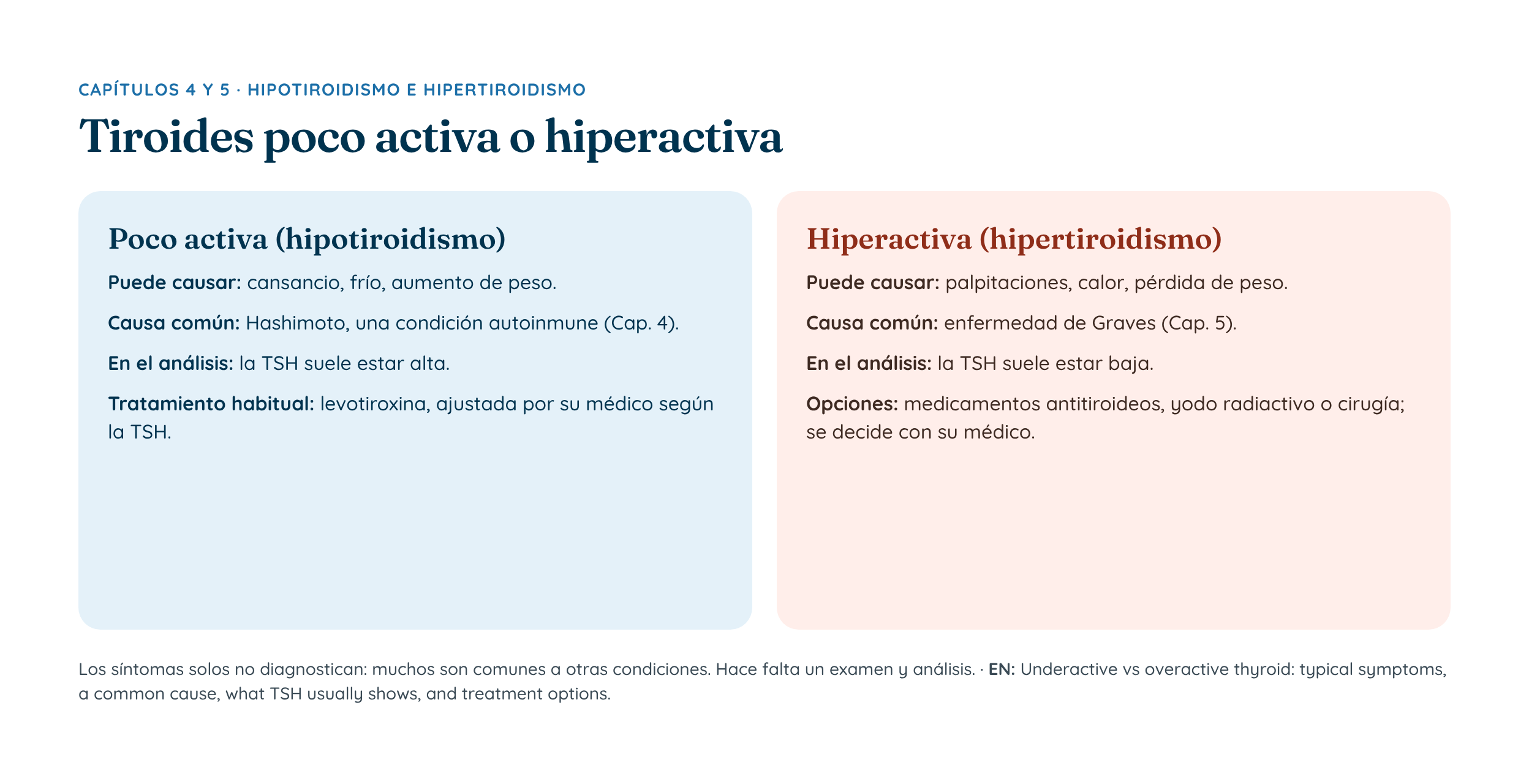
Hyperthyroidism means the thyroid is making too much hormone. The broader term “thyrotoxicosis” covers any situation with too much thyroid hormone in the body, and it has several possible causes, so getting the cause right is the first step [1]. Common symptoms are a fast heartbeat, feeling hot, weight loss, shakiness, anxiety and poor sleep (Chapter 2).
The main causes
- Graves’ disease: an autoimmune condition in which antibodies (TRAb/TSI, Chapter 3) switch the thyroid “on” [1].
- Toxic nodules: one or more nodules that make hormone on their own (toxic adenoma or toxic multinodular goiter) [1].
- Thyroiditis: inflammation that temporarily leaks stored hormone; it often settles by itself [1].
- Too much thyroid medicine or iodine (Chapter 7).
Three treatment paths for Graves’
The ATA describes three effective options: antithyroid medicines, radioactive iodine and surgery [1]. The best choice depends on your situation, other health conditions and your preferences [1].
- Antithyroid medicine (pills that slow hormone production). Some people go into lasting remission after a course of treatment; others relapse. Rare but serious side effects exist. If you develop fever, sore throat or mouth sores, stop the medicine and get same-day guidance from your doctor; you will need a blood count. If you develop yellow skin or eyes, dark urine or pain in the upper right belly, stop the medicine and seek prompt assessment for possible liver injury.
- Radioactive iodine: a capsule or drink that the thyroid absorbs and that gradually shuts it down. Most people then need lifelong levothyroxine (Chapter 4). It is not used in pregnancy or while breastfeeding (Chapters 6 and 26), and it may not be the best choice if you have active thyroid eye disease [1][2].
- Surgery (thyroidectomy): removes the thyroid and gives a fast, definitive result. Your team first brings your thyroid levels under control to make surgery safe [1]. Afterward you take levothyroxine for life (Chapter 21).
For toxic nodules, the main options are radioactive iodine or surgery [1].
Thyroid eye disease
Some people with Graves’ develop eye changes: bulging, redness, grittiness, swelling, or double vision. Most cases appear while the hyperthyroidism is being treated, and endocrinologists play a key role in recognizing them and referring to eye specialists [2]. Treatments range from eye drops and protecting the eyes to steroids, newer targeted medicines and eye surgery [2]. Smoking is linked to worse eye disease, so quitting is strongly advised.
Javier’s choice
Javier started antithyroid medicine, which calmed his heart rate within weeks. His eye symptoms were mild and were followed by an eye specialist. After discussing relapse risk and his plans, he chose surgery. “I wanted one decision and done,” he said. “Now I take one pill a day.” His eye specialist continues to follow his eyes, because eye disease runs its own course whatever treatment is chosen for the thyroid.
A head and neck surgeon experienced in thyroid and voice care can help.
Sources
- Ross DS, et al. 2016 American Thyroid Association Guidelines for Diagnosis and Management of Hyperthyroidism and Other Causes of Thyrotoxicosis. Thyroid. 2016;26(10):1343-1421. doi:10.1089/thy.2016.0229 PubMed PMID 27521067
- Burch HB, et al. Management of Thyroid Eye Disease: A Consensus Statement by the American Thyroid Association and the European Thyroid Association. Thyroid. 2022;32(12):1439-1470. doi:10.1089/thy.2022.0251 PubMed PMID 36480280
This guide is for general education only. It does not diagnose conditions or replace a medical evaluation. Talk with your own doctor about your situation. In an emergency, call 911 now (in Puerto Rico or the United States; elsewhere, your local emergency number).