Less common and advanced thyroid cancers
Case of a fictitious patient: When Rafael was diagnosed with medullary thyroid cancer at 44, his surgeon asked a question he did not expect: “Has anyone in your family had thyroid cancer, or a tumor of the adrenal glands?” A genetic test showed an inherited change in a gene called RET. Within months, his teenage daughter was tested too. Because of that test, her doctors could plan for her far earlier than anyone had for him.
Most thyroid cancers are papillary and have an excellent outlook (Chapter 23). This chapter covers the less common types and situations, where specialized care makes the biggest difference.
Medullary thyroid cancer
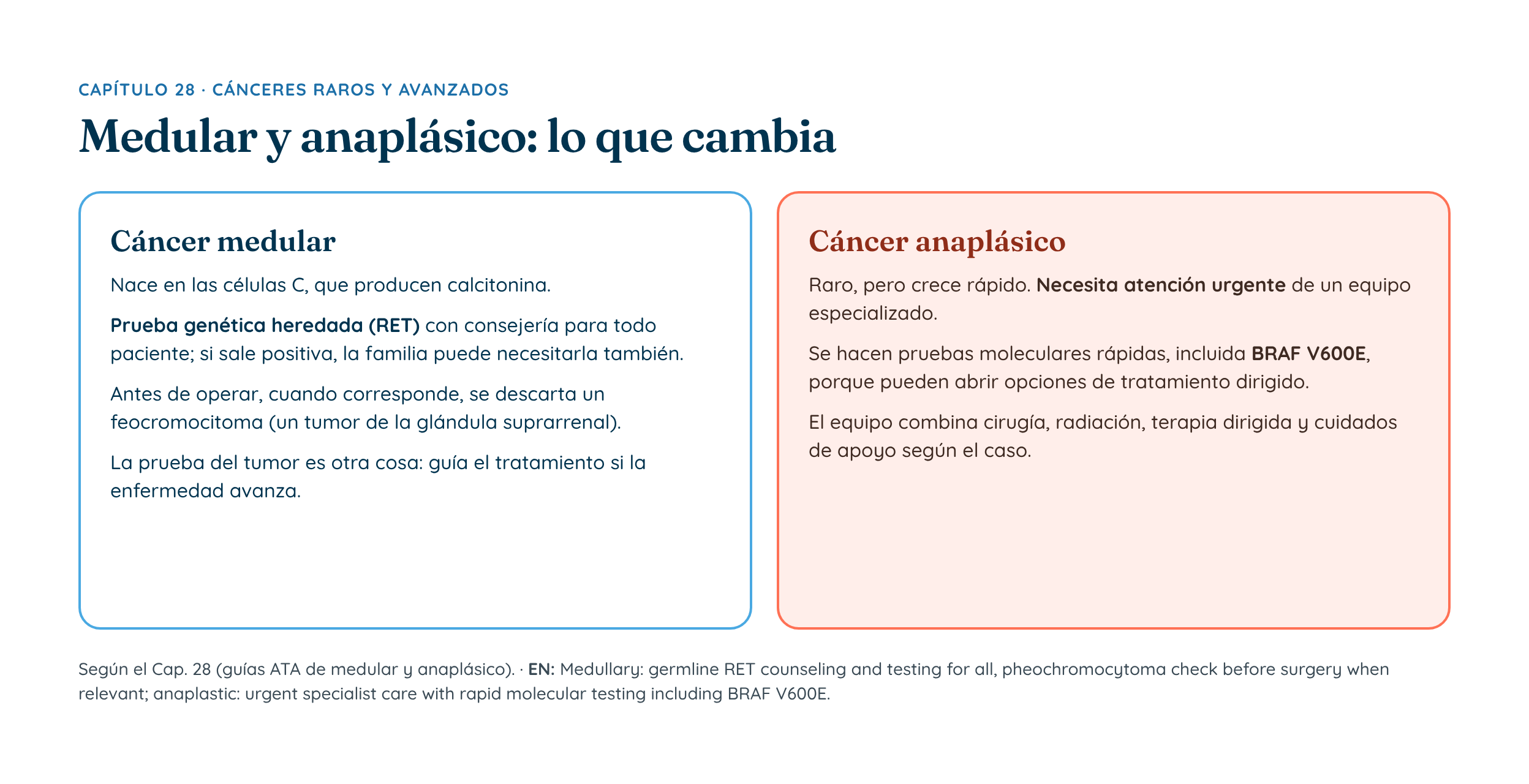
Medullary cancer starts in the C-cells of the thyroid, which make a hormone called calcitonin. It behaves differently from papillary cancer and is not treated with radioactive iodine.
- Calcitonin and CEA blood tests are used to diagnose medullary cancer and to follow it after treatment.
- Genetic testing: there are two different tests. An inherited (germline) RET test, usually from blood or saliva with genetic counseling, is recommended for people with medullary cancer, because a positive result means relatives can be tested and, if needed, treated early. Testing the tumor itself is a separate test, used to choose drug treatment if the cancer is advanced. If an inherited syndrome (MEN2) is possible, doctors check for an adrenal tumor called pheochromocytoma before surgery [1].
- Surgery (usually total thyroidectomy with removal of central neck lymph nodes) is the main treatment [1].
- Advanced disease: for medullary cancer that has spread and is growing, targeted drugs can help. In a large trial in people whose tumor had a RET mutation, selpercatinib, a drug designed for RET changes, controlled the cancer longer and caused fewer side effects than older drugs [2][3]. Responses can last years [4].
Anaplastic thyroid cancer
Anaplastic cancer is rare but aggressive. It usually appears as a fast-growing neck mass, sometimes with hoarseness, trouble swallowing or trouble breathing. It needs urgent evaluation at an experienced center [5].
What has changed:
- Fast molecular testing, including for the BRAF V600E mutation, should be done right away; with an urgent referral to a specialist team, it can guide treatment within days [5].
- Targeted therapy and immunotherapy, sometimes followed by surgery once the tumor shrinks, have improved survival. At one major cancer center, 1-year survival rose from about 35% to about 59% over two decades [6].
- Palliative care and goals-of-care discussions are part of good treatment from the start, alongside active treatment [5].
These results come from specialized centers, which is why referral matters.
When differentiated cancer stops responding to radioactive iodine
A small number of papillary or follicular cancers spread and stop absorbing radioactive iodine. This is called radioiodine-refractory disease. Many of these cancers grow slowly and can be watched for a time. When they are growing or causing symptoms, options include [9]:
- Targeted drugs (kinase inhibitors) such as lenvatinib. In a major trial, lenvatinib extended the time before the cancer grew from about 4 months to about 18 months, compared with placebo [7].
- Drugs matched to the tumor’s genetics (BRAF, RET, NTRK and others), found by molecular testing of the tumor.
- Local treatments (surgery, radiation or ablation) for a single growing spot.
These drugs have real side effects, such as high blood pressure, diarrhea, fatigue and weight loss [7]. Your oncology team manages these side effects, including any pause in treatment; never stop or change a dose on your own. In one later analysis of a trial, shorter pauses were linked to more benefit, but that kind of analysis cannot prove cause and effect [8].
Questions to ask
- What type of thyroid cancer do I have, and has the tumor been tested for genetic changes?
- Should I have genetic testing? Should my family?
- Is my care being reviewed by a multidisciplinary team experienced with this type of cancer?
- Am I eligible for any clinical trials?
Key points
- Medullary cancer is followed with calcitonin and CEA. Genetic testing protects families.
- Anaplastic cancer is urgent, and new targeted treatments have improved survival at experienced centers.
- Cancer that no longer responds to radioactive iodine can be treated with targeted drugs.
- Specialized, multidisciplinary care matters most in these situations.
A head and neck surgeon experienced in thyroid and voice care can help.
Sources
- Wells SA, et al. Revised American Thyroid Association guidelines for the management of medullary thyroid carcinoma. Thyroid. 2015;25(6):567-610. doi:10.1089/thy.2014.0335 PubMed PMID 25810047
- Hadoux J, et al. Phase 3 Trial of Selpercatinib in Advanced RET-Mutant Medullary Thyroid Cancer. N Engl J Med. 2023;389(20):1851-1861. doi:10.1056/NEJMoa2309719 PubMed PMID 37870969
- Elisei R, et al. Patient-Reported Tolerability of Selpercatinib Compared to Cabozantinib/Vandetanib: A Secondary Analysis of the LIBRETTO-531 Randomized-Controlled Trial in RET-Mutant Medullary Thyroid Cancer. Thyroid. 2025;35(10):1162-1172. doi:10.1177/10507256251367352 PubMed PMID 40828665
- Wirth LJ, et al. Durability of Response With Selpercatinib in Patients With RET-Activated Thyroid Cancer: Long-Term Safety and Efficacy From LIBRETTO-001. J Clin Oncol. 2024;42(27):3187-3195. doi:10.1200/JCO.23.02503 PubMed PMID 39094065
- Bible KC, et al. 2021 American Thyroid Association Guidelines for Management of Patients with Anaplastic Thyroid Cancer. Thyroid. 2021;31(3):337-386. doi:10.1089/thy.2020.0944 PubMed PMID 33728999
- Maniakas A, et al. Evaluation of Overall Survival in Patients With Anaplastic Thyroid Carcinoma, 2000-2019. JAMA Oncol. 2020;6(9):1397-1404. doi:10.1001/jamaoncol.2020.3362 PubMed PMID 32761153
- Schlumberger M, et al. Lenvatinib versus placebo in radioiodine-refractory thyroid cancer. N Engl J Med. 2015;372(7):621-630. doi:10.1056/NEJMoa1406470 PubMed PMID 25671254
- Tahara M, et al. Impact of dose interruption on the efficacy of lenvatinib in a phase 3 study in patients with radioiodine-refractory differentiated thyroid cancer. Eur J Cancer. 2019;106:61-68. doi:10.1016/j.ejca.2018.10.002 PubMed PMID 30471649
- Ringel MD, et al. 2025 American Thyroid Association Management Guidelines for Adult Patients with Differentiated Thyroid Cancer. Thyroid. 2025;35(8):841-985. doi:10.1177/10507256251363120 PubMed PMID 40844370
This guide is for general education only. It does not diagnose conditions or replace a medical evaluation. Talk with your own doctor about your situation. In an emergency, call 911 now (in Puerto Rico or the United States; elsewhere, your local emergency number).