Half or all? Lobectomy vs total thyroidectomy
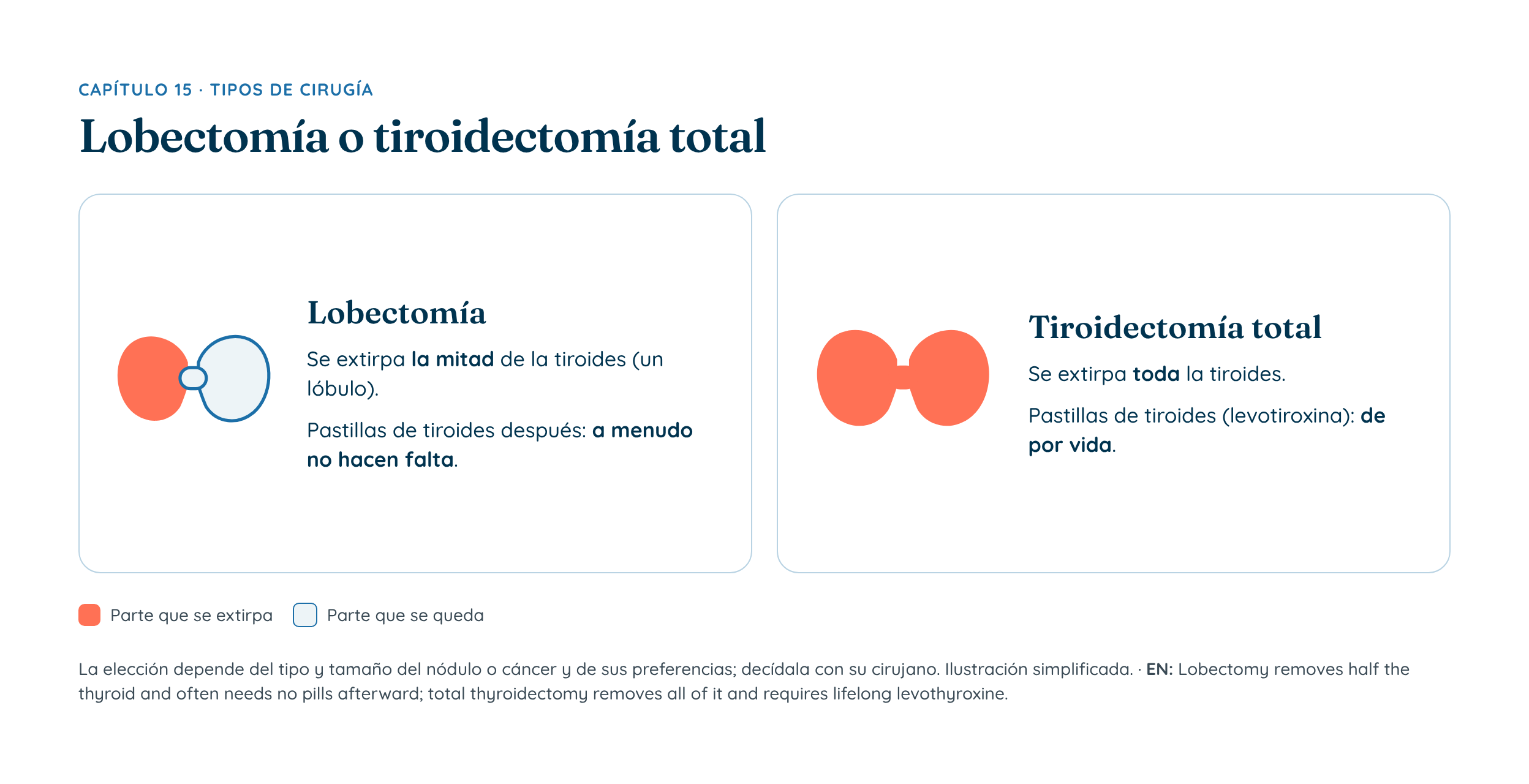
The thyroid has two halves, called lobes, joined by a thin bridge in the middle. When surgery is needed, your surgeon will remove either one lobe (a lobectomy, also called a hemithyroidectomy) or the whole gland (a total thyroidectomy) [1]. Both are common, safe operations. The right choice depends on why you need surgery.
Lobectomy: removing one half
A lobectomy removes the side with the problem and leaves the other half working.
When it is usually chosen
- A nodule on one side whose biopsy result is uncertain, to find out whether it is cancer.
- A benign nodule on one side that is growing or causing symptoms.
- Many low-risk thyroid cancers confined to one side. When surgery is chosen, the 2025 American Thyroid Association guidelines prefer lobectomy for cancers 2 cm or smaller that stay inside the thyroid, with no spread to lymph nodes or elsewhere and no other reason to remove both sides. For selected low-risk cancers between 2 and 4 cm on one side, lobectomy may also be preferred [2].
Advantages
- The remaining half often makes enough thyroid hormone on its own.
- Only one side of the neck is operated on, so only one voice nerve and two of the four parathyroid glands are near the surgery. Low calcium after a lobectomy is uncommon.
Will I need thyroid hormone pills? Many people do not. In a 2024 review of 66 studies, about 29 in 100 patients had some degree of low thyroid function on blood tests after a lobectomy, about 23 in 100 ended up taking thyroid hormone, and only about 4 in 100 developed clearly (overtly) low thyroid levels [3]. These are three different measures, so they should not be added together. About a third of early low readings were temporary. The chance is higher if your TSH was already in the high-normal range before surgery, if you have thyroid antibodies or Hashimoto’s thyroiditis, and in women and older adults [3][4]. Your doctor will check a blood test a few weeks after surgery.
The trade-off: if the final pathology shows a cancer with higher-risk features, a second operation to remove the other half (a completion thyroidectomy) may be recommended.
Total thyroidectomy: removing the whole gland
When it is usually chosen
- Cancers larger than 4 cm, cancers growing visibly beyond the thyroid, or cancer that has clearly spread to lymph nodes or elsewhere [2].
- Nodules or goiter on both sides.
- Graves’ disease when surgery is the chosen treatment.
- When radioactive iodine treatment after surgery is likely.
What it means for you
- You will take a thyroid hormone pill every day for life. Chapter 21 explains how this works and why most people feel well on it.
- Both sides are operated on, so temporary low calcium is more common than after a lobectomy; it usually recovers [1]. Chapter 20 explains what to watch for.
Side by side
| Lobectomy | Total thyroidectomy | |
|---|---|---|
| What is removed | One half | The whole gland |
| Thyroid hormone pill | About 1 in 4 need it | Always, for life |
| Low calcium risk | Uncommon | More common, usually temporary |
| Voice nerves near surgery | One | Both |
| Chance of a second operation | Possible if final pathology is higher risk | Rare |
Questions to ask your surgeon
- Why do you recommend removing half, or all, of my thyroid?
- What are the chances I will need thyroid hormone after a lobectomy, given my blood tests?
- If the final result shows cancer, would I need a second operation?
A head and neck surgeon experienced in thyroid and voice care can help.
Sources
- Patel KN, et al. The American Association of Endocrine Surgeons Guidelines for the Definitive Surgical Management of Thyroid Disease in Adults. Ann Surg. 2020;271(3):e21-e93. doi:10.1097/SLA.0000000000003580 PubMed PMID 32079830
- Ringel MD, et al. 2025 American Thyroid Association Management Guidelines for Adult Patients with Differentiated Thyroid Cancer. Thyroid. 2025;35(8):841-985. doi:10.1177/10507256251363120 PubMed PMID 40844370
- Cooper D, et al. Hypothyroidism after hemithyroidectomy: a systematic review and meta-analysis. Thyroid Res. 2024;17(1):18. doi:10.1186/s13044-024-00200-z PubMed PMID 38972987
- Li Z, et al. Prevalence of and risk factors for hypothyroidism after hemithyroidectomy: a systematic review and meta-analysis. Endocrine. 2020;70(2):243-255. doi:10.1007/s12020-020-02410-5 PubMed PMID 32638212
This guide is for general education only. It does not diagnose conditions or replace a medical evaluation. Talk with your own doctor about your situation. In an emergency, call 911 now (in Puerto Rico or the United States; elsewhere, your local emergency number).