Thyroid surgery without a neck scar
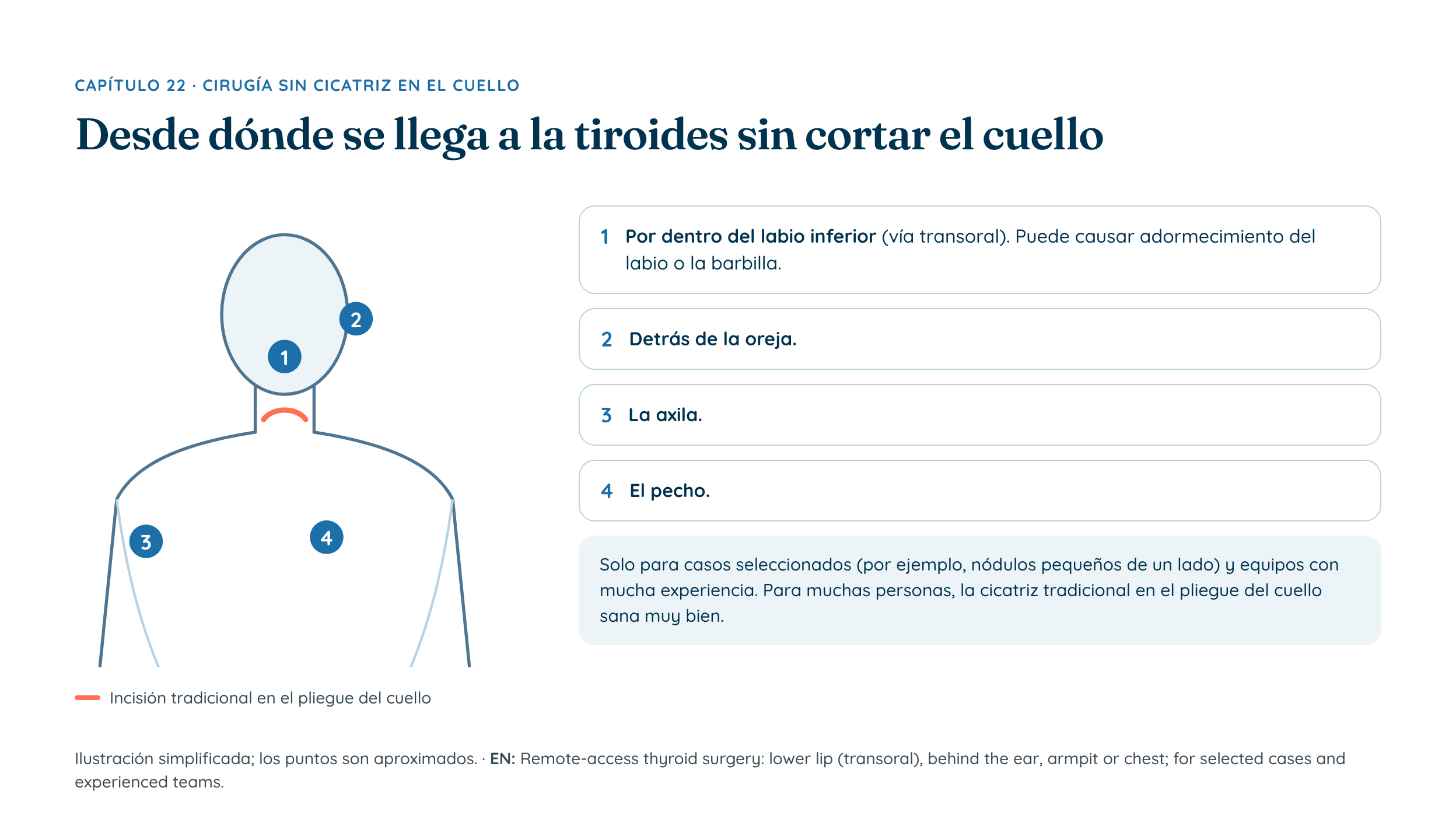
Traditional thyroid surgery uses a small incision in the front of the neck, usually hidden in a skin crease. For most people the scar fades well. Some patients, though, strongly prefer to avoid any visible neck scar. Remote-access thyroid surgery reaches the thyroid from somewhere else: through the inside of the lower lip, the armpit, the chest or behind the ear.
The main approaches
An international panel of six surgical and thyroid societies, including the Latin American Thyroid Society, reviewed these techniques in 2025 [1]:
| Approach | Where the incisions are |
|---|---|
| Transoral (TOETVA) | Inside the lower lip, with no skin scar |
| Transaxillary | In the armpit |
| Axillo-breast | Armpits and around the nipples |
| Retroauricular (facelift) | Behind the ear and along the hairline |
The operation is done with an endoscope (a thin camera) or a surgical robot. The thyroid is still removed completely through these small openings.
What the evidence shows
In experienced hands, these approaches give results similar to standard surgery for selected patients, with better satisfaction about appearance [1]. For the transoral approach in particular, studies comparing it with open surgery found similar rates of voice nerve injury, bleeding and infection [3][4]. Most of these comparisons are observational studies from very experienced teams, so the results may not apply everywhere.
The trade-offs are real:
- Longer operations: often an hour or more longer than open surgery [4].
- Approach-specific side effects: for example, temporary numbness of the chin or lower lip after transoral surgery, or of the chest or arm after armpit approaches [1].
- A steep learning curve: results improve markedly once a surgeon has done many of these operations [5]. Experts recommend that only surgeons with specific training and enough volume perform them [1][2].
- Cost and availability: these techniques cost more and are offered at fewer centers [2].
Who is a good candidate?
Remote-access surgery is best suited to a small, carefully selected group: usually people with a small nodule on one side, a benign condition or a small low-risk cancer, and a strong wish to avoid a neck scar [1][2]. It is usually not a good option for large goiters, large or advanced cancers, cancer in the lymph nodes of the side of the neck, or repeat surgery.
Questions to ask
- Am I a candidate for a remote-access approach, and which one?
- How many of these operations have you done?
- What side effects are specific to this approach?
- How would my scar look with standard surgery? For many people, a well-placed neck incision heals so well that remote access offers little extra.
A head and neck surgeon experienced in thyroid and voice care can help.
Sources
- Russell JO, et al. Remote-Access Thyroidectomy and Parathyroidectomy: A 2025 Consensus Statement from the Asia-Pacific Society of Thyroid Surgery, American Head and Neck Society, American Association of Endocrine Surgeons, American Thyroid Association, European Society of Endocrine Surgeons, and Latin American Thyroid Society. Thyroid. 2025;35(11):1285-1296. doi:10.1177/10507256251388410 PubMed PMID 41173534
- Berber E, et al. American Thyroid Association Statement on Remote-Access Thyroid Surgery. Thyroid. 2016;26(3):331-337. doi:10.1089/thy.2015.0407 PubMed PMID 26858014
- Alharbi W, et al. Transoral endoscopic thyroidectomy vestibular approach versus open thyroidectomy in surgical resection of the thyroid: a systematic review and meta-analysis. Ann Med Surg (Lond). 2026;88(4):2648-2660. doi:10.1097/MS9.0000000000004813 PubMed PMID 41939112
- Huo J, et al. Safety and Efficacy of Transoral Endoscopic Thyroidectomy Vestibular Approach Versus Conventional Open Thyroidectomy: A Systematic Review and Meta-analysis. Surg Laparosc Endosc Percutan Tech. 2023;33(5):547-555. doi:10.1097/SLE.0000000000001197 PubMed PMID 37523575
- Wang JP, et al. Comparison of learning curves and related postoperative indicators between endoscopic and robotic thyroidectomy: a systematic review and meta-analysis. Int J Surg. 2025;111(1):1123-1134. doi:10.1097/JS9.0000000000001852 PubMed PMID 38905504
This guide is for general education only. It does not diagnose conditions or replace a medical evaluation. Talk with your own doctor about your situation. In an emergency, call 911 now (in Puerto Rico or the United States; elsewhere, your local emergency number).