The parathyroids and calcium: the tiny glands that matter in thyroid surgery
Case of a fictitious patient: When Marisol, a 47-year-old teacher, signed the consent form for her total thyroidectomy, one line surprised her: “low calcium.” “Why would thyroid surgery affect my calcium?” she asked. The answer is four glands most people have never heard of.
What the parathyroids are
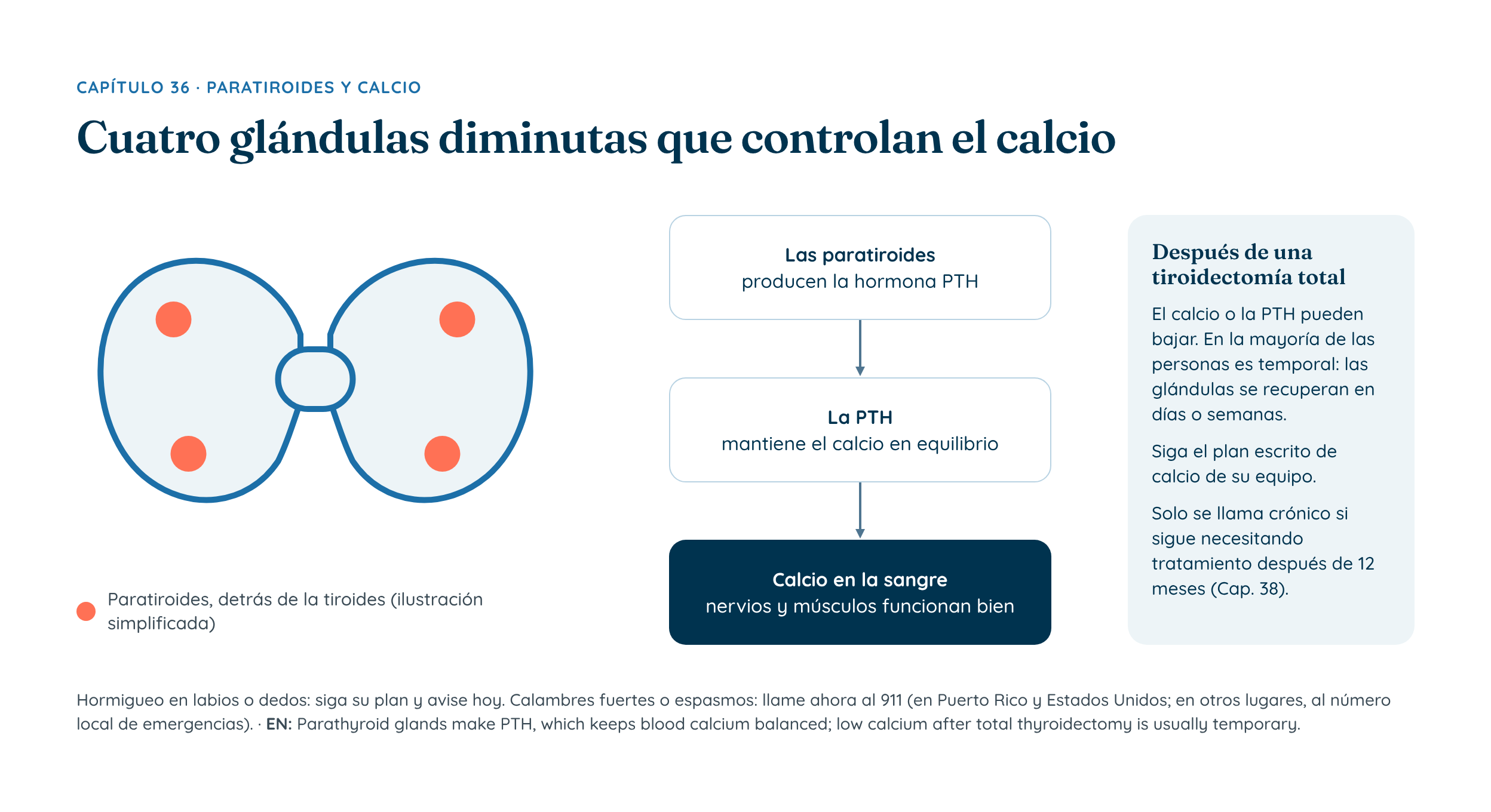
Most people have four parathyroid glands, each about the size of a grain of rice, sitting on or right next to the back of the thyroid. Despite the name, they have nothing to do with thyroid hormone. Their job is to control the level of calcium in your blood by releasing parathyroid hormone (PTH). PTH pulls calcium from bone, tells the kidneys to keep calcium, and activates vitamin D so the gut absorbs more calcium. Calcium in turn keeps nerves and muscles, including the heart, working normally.
Why they matter in thyroid surgery
Because the parathyroids are tiny, sit against the thyroid, and share its delicate blood supply, they can be bruised, lose blood flow, or (rarely) be removed by accident. When they stop working, PTH and calcium drop. The American Thyroid Association calls this hypoparathyroidism and identifies it as the most common complication after operations on both sides of the thyroid [1].
Two things are measured, and they are not the same: low blood calcium (what causes symptoms) and low PTH (the hormone the glands make) [1]. Early after surgery, either can be low, and in most people this is temporary: the glands “wake up” over days to weeks. Hypoparathyroidism is called chronic (permanent) only when it persists more than 12 months after surgery, and some people recover even later [4]. We cover chronic hypoparathyroidism in Chapter 38.
The risk is higher with [1]:
- Surgery on both sides (total thyroidectomy)
- Central neck lymph node dissection (often done for cancer, see Chapter 25)
- Autoimmune thyroid disease, such as Graves’ disease or Hashimoto’s
- A large goiter that extends into the chest
- Conditions that affect absorption, such as prior gastric bypass
- Less surgeon experience
A lobectomy (half the thyroid) leaves the other side’s parathyroids untouched, so serious low calcium is uncommon after it.
How surgeons protect them
The ATA statement describes several protective steps [1]: correcting low vitamin D before surgery, carefully preserving the glands’ blood supply, and, if a gland loses its blood supply, autotransplanting it: cutting it into small pieces and placing them in a neck muscle, where it usually regains function over weeks.
Some surgeons also use near-infrared autofluorescence (NIRAF), a camera that makes parathyroid tissue glow so it is easier to see. Pooled randomized trials of camera-based systems found that they lowered the rate of low calcium after total thyroidectomy and of glands removed by accident [2][3]. Handheld probe-based devices work differently and have their own, separate evidence. Either way, it is a helpful tool, not a guarantee.
How calcium is checked after surgery
Many teams measure PTH within hours of surgery. A very low early PTH (in the ATA statement, under about 15 pg/mL) signals a higher chance of low calcium [1]. Depending on the team, patients may get [1]:
- Preventive calcium (and sometimes active vitamin D) for everyone after total thyroidectomy,
- Calcium only if the PTH is low, or
- Calcium guided by repeated blood calcium levels.
All three are reasonable. Your surgeon will explain which one your team uses. Do not stop or change doses on your own: too much calcium can also cause problems, which is why levels are rechecked [1].
What low calcium feels like
- Tingling or numbness around the lips, fingertips or toes (the most common early sign)
- Muscle cramps or twitching, especially in the hands
- Feeling anxious or “jittery”
Mild tingling or cramps: follow the written calcium plan your team gave you at discharge, and call your team if symptoms do not settle.
Marisol’s recovery
Marisol’s PTH was low the morning after surgery, so she went home with calcium tablets and active vitamin D. On day three her fingertips tingled; she took the extra dose her team had written down and the tingling faded. At three weeks her calcium and PTH were normal and the pills were tapered off. “The tingling scared me,” she said, “but having the plan in writing made all the difference.”
Questions to ask your surgeon
- Will my PTH be checked after surgery?
- Will I go home on calcium, and for how long?
- What symptoms should make me take an extra dose, and which mean I should call 911?
- Should my vitamin D be checked before surgery?
Key points
- The parathyroids control blood calcium, and they sit right against the thyroid.
- Low calcium after surgery on both sides is common and usually temporary.
- Your team will give you a written calcium plan; follow it and do not change doses on your own.
- Severe symptoms such as spasms, chest pain, trouble breathing or confusion need 911.
A head and neck surgeon experienced in thyroid and voice care can help.
Sources
- Orloff LA, et al. American Thyroid Association Statement on Postoperative Hypoparathyroidism: Diagnosis, Prevention, and Management in Adults. Thyroid. 2018;28(7):830-841. doi:10.1089/thy.2017.0309 PubMed PMID 29848235
- Canali L, et al. Camera-based near-infrared autofluorescence versus visual identification in total thyroidectomy for parathyroid function preservation: Systematic review and meta-analysis of randomized clinical trials. Head Neck. 2025;47(1):225-234. doi:10.1002/hed.27900 PubMed PMID 39104194
- Javed A, et al. Utilisation of Near Infrared Autofluorescence in Parathyroid Identification During Thyroidectomy: A Systematic Review and Meta-Analysis of Randomised Controlled Trials. Clin Otolaryngol. 2025;50(4):609-618. doi:10.1111/coa.14313 PubMed PMID 40186524
- Bollerslev J, et al. Revised European Society of Endocrinology Clinical Practice Guideline: Treatment of Chronic Hypoparathyroidism in Adults. Eur J Endocrinol. 2025;193(5):G49-G78. doi:10.1093/ejendo/lvaf222 PubMed PMID 41231236
This guide is for general education only. It does not diagnose conditions or replace a medical evaluation. Talk with your own doctor about your situation. In an emergency, call 911 now (in Puerto Rico or the United States; elsewhere, your local emergency number).