What the thyroid does: your body's thermostat
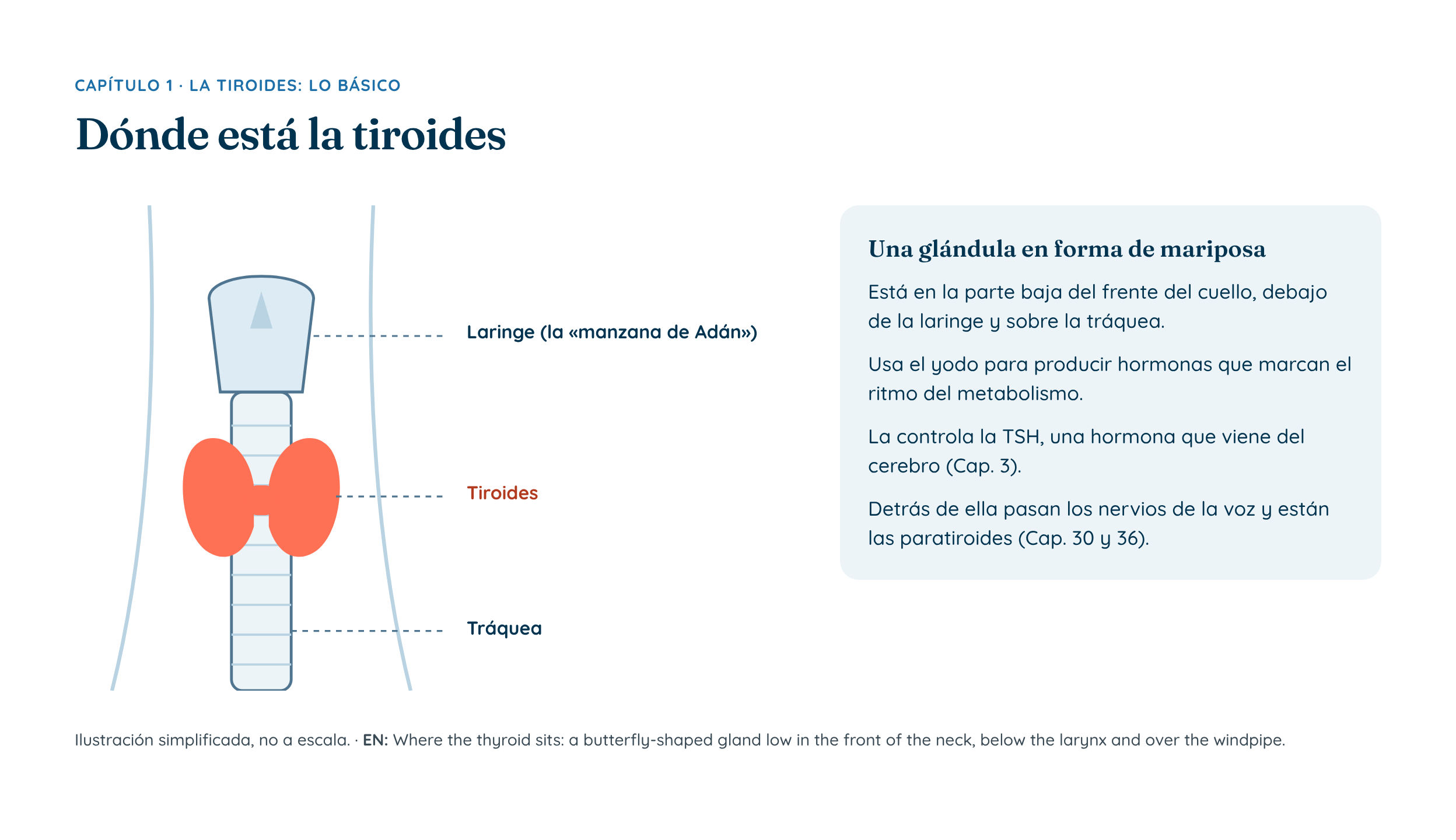
When Luis, 28 (a fictitious patient), heard his mother had “a thyroid problem,” he realized he had no idea what the thyroid even was. “Is it in the throat? Is it serious?” This chapter is the place to start.
Where it is
The thyroid is a small, butterfly-shaped gland at the front of the neck, just below the Adam’s apple, wrapped around the windpipe. It has two lobes, one on each side, joined by a thin bridge called the isthmus. Right behind it run the nerves that move your vocal cords, and on its back sit the tiny parathyroid glands that control calcium (Chapter 36). That is why thyroid surgery is also about protecting your voice and your calcium.
What it makes
The thyroid uses iodine from food to make two hormones: thyroxine (T4) and triiodothyronine (T3). Most of what it releases is T4, which the body converts into the more active T3 inside the tissues. These hormones set the pace of your metabolism: how fast your heart beats, how warm you feel, how quickly you burn energy, how your bowels move, and even how clearly you think. That is how the system works; it does not mean a symptom like tiredness comes from the thyroid, because such symptoms have many causes (Chapter 2).
How it is controlled
The thyroid takes orders from the pituitary gland at the base of the brain. The pituitary releases TSH (thyroid-stimulating hormone). When thyroid hormone levels drop, TSH goes up to push the thyroid to work harder; when levels are high, TSH goes down. It works like a thermostat, which is why TSH is usually the first blood test doctors order (Chapter 3).
Why iodine matters
Without enough iodine, the thyroid cannot make enough hormone. Severe iodine deficiency causes goiter (an enlarged thyroid) and hypothyroidism, and even milder deficiency increases nodular goiter over time [2]. Adding iodine to table salt has greatly reduced these problems worldwide [2]. Common sources include iodized salt, dairy, seafood and eggs. More iodine is not better: supplements can cause problems too (Chapter 7). Whether you need an iodine supplement depends on your diet and situation, for example pregnancy (Chapter 6); it is not a general recommendation.
When things go wrong
Most thyroid problems fall into a few groups:
- Too little hormone (hypothyroidism): often tiredness, feeling cold, weight gain, constipation, dry skin and a hoarser voice [1]. See Chapter 4.
- Too much hormone (hyperthyroidism): often from Graves’ disease or overactive nodules [3]. See Chapter 5.
- Lumps (nodules) or enlargement (goiter): very common and usually benign. See Chapters 8–12.
- Thyroid cancer: usually very treatable. See Part IV.
Luis’s takeaway
Luis learned that his mother’s condition, an underactive thyroid, is common and usually managed with one daily pill [1]. “I thought it was something rare,” he said. “Now I know what to ask at her next visit.”
A head and neck surgeon experienced in thyroid and voice care can help.
Sources
- Chaker L, et al. Hypothyroidism. Lancet. 2017;390(10101):1550-1562. doi:10.1016/S0140-6736(17)30703-1 PubMed PMID 28336049
- Zimmermann MB, Boelaert K. Iodine deficiency and thyroid disorders. Lancet Diabetes Endocrinol. 2015;3(4):286-295. doi:10.1016/S2213-8587(14)70225-6 PubMed PMID 25591468
- Ross DS, et al. 2016 American Thyroid Association Guidelines for Diagnosis and Management of Hyperthyroidism and Other Causes of Thyrotoxicosis. Thyroid. 2016;26(10):1343-1421. doi:10.1089/thy.2016.0229 PubMed PMID 27521067
This guide is for general education only. It does not diagnose conditions or replace a medical evaluation. Talk with your own doctor about your situation. In an emergency, call 911 now (in Puerto Rico or the United States; elsewhere, your local emergency number).