When a vocal cord stops moving: recovery and treatment
Case of a fictitious patient: Two weeks after her thyroid surgery, Marisol, a 46-year-old teacher, still sounded breathy and ran out of air halfway through a sentence. Water sometimes made her cough. A camera exam showed her left vocal cord was not moving. Her first question was the one most people ask: “Is this permanent?”
Often it is not, but the honest answer depends on how the nerve was injured and what the exam shows. This chapter explains what is happening, how long recovery tends to take, and what can be done while you wait, or if the nerve does not recover.
What vocal cord paralysis means
Each vocal cord is moved by the recurrent laryngeal nerve, which runs right behind the thyroid gland. If that nerve is stretched, bruised, heated or cut during surgery, the vocal cord on that side may move weakly (paresis) or not at all (paralysis). The other cord can no longer meet it fully. Air leaks through the gap, so the voice becomes weak, breathy or hoarse, you run out of breath when speaking, and liquids can slip into the airway.
A national guideline estimates that about 1 in 10 patients has temporary nerve weakness after thyroid surgery, and up to 1 in 25 has lasting problems [1]. Rates vary by surgeon, by the extent of surgery, and by how carefully the vocal cords are examined.
How long recovery takes
Most nerve injuries are not cuts. They recover as the nerve heals. One registry followed each patient closely [2]:
- About 15% recovered within the first 4 weeks.
- Average recovery took about 4 to 5 months.
- At 6 months, nearly 1 in 5 of those affected still had an abnormal exam.
- By 12 months, only a very small fraction remained paralyzed, and a few recovered even later.
The practical message: it is normal to wait months, and “not better yet” at 6 weeks does not mean “never.” Your surgeon may know from the operation whether the nerve was intact. That changes the outlook a great deal.
What you can do while you wait
Get the diagnosis. A short in-office scope exam (laryngoscopy, often with stroboscopy) shows whether the cord moves, how big the gap is, and whether you are at risk of aspiration (Chapter 31) [1].
Voice therapy. A speech-language pathologist teaches exercises that help the working cord close the gap, reduce strain, and protect your airway when swallowing. In one study, starting therapy within the first month was associated with faster recovery than no therapy [3].
Protect your swallowing. If you cough with drinks, ask for a swallowing evaluation. After that evaluation, a speech-language pathologist may teach simple strategies, such as tucking the chin or turning the head, that are tailored to you (Chapter 34).
Treatment options
1. Injection laryngoplasty (temporary or longer-lasting). A filler is placed into the paralyzed cord to push it toward the middle so the healthy cord can meet it. This is usually done in the office through the mouth, nose or neck under local anesthesia, or briefly in the operating room. Temporary fillers last a few months, which suits a nerve that is expected to recover. Fat or longer-lasting materials can last longer; fat injection has shown benefit beyond 12 months [5].
Many laryngologists favor injecting early when the voice or swallowing is significantly affected. A meta-analysis found that both injection and open surgery improve the voice, and suggested that early injection may lower the chance of needing a permanent procedure later [4]. For swallowing specifically, most reports describe improvement, but none had a comparison group, so the evidence is weaker than many people assume [6].
If the filler wears off before the nerve recovers, the injection can be repeated. A second injection works best when the first one lasted longer than about 6 months [7].
2. Medialization thyroplasty (permanent). Through a small incision in the neck, the surgeon places a small implant beside the paralyzed cord to hold it in a better position. You are usually awake, so the voice can be fine-tuned during surgery. Because it is meant to be permanent, it is usually offered once recovery is unlikely, often after 9 to 12 months, or sooner if the nerve is known to be cut.
3. Laryngeal reinnervation (restoring nerve supply). A nearby nerve (often the ansa cervicalis) is connected to the injured nerve. This restores tone and bulk to the vocal cord, though not normal movement. It takes several months to work. A small randomized trial found reinnervation and medialization gave similar voice results at 1 year [8]. An age difference seen in a subgroup of that trial is a clue for discussion, not a rule for choosing. When a cancer requires removing the nerve, some surgeons reconnect it immediately during the same operation, with encouraging early results in small studies [9].
What is the right choice for me?
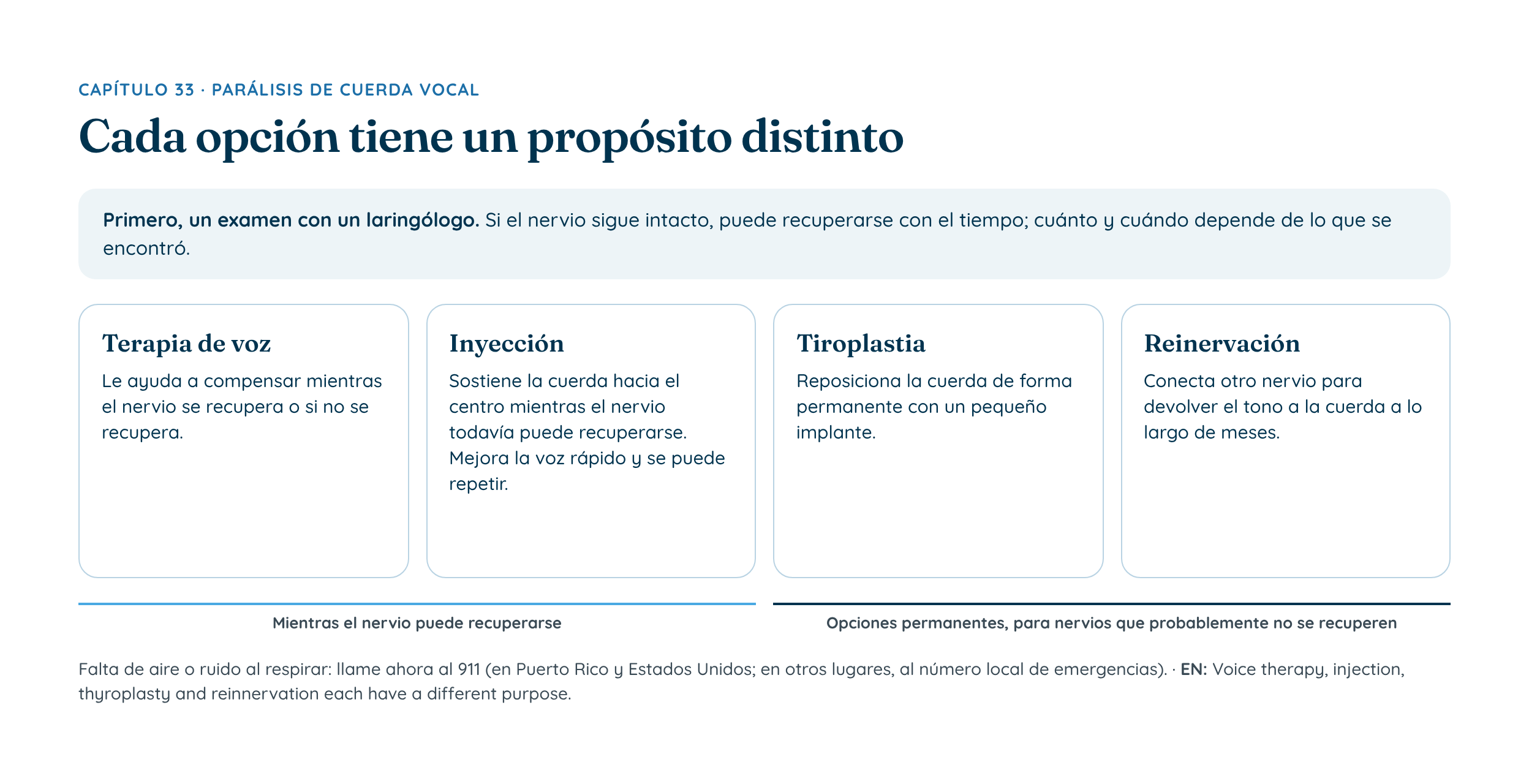
Each option has a different purpose: voice therapy helps you compensate; injection supports the cord while the nerve may still recover (or longer term); thyroplasty permanently repositions the cord; reinnervation restores tone over months. There is no single correct path. It depends on whether the nerve was intact, how much the gap affects your voice and swallowing, your voice demands at work, your age and health, and your preference about procedures. A laryngologist (an ENT specialist in voice) can examine the cord and walk you through the options.
When to seek care urgently
Contact your surgical team promptly (the same day) for a new breathy or weak voice, coughing or choking with liquids, fever, or chest symptoms that could mean aspiration pneumonia.
Key points
- Many cases of vocal cord paralysis after thyroid surgery recover, depending on how the nerve was injured and what the exam shows; recovery often takes months.
- An exam confirms the diagnosis and guides treatment.
- Voice therapy and swallowing strategies help while you wait.
- Injection can improve the voice quickly and can be repeated. Permanent options (thyroplasty, reinnervation) are reserved for nerves unlikely to recover.
A head and neck surgeon experienced in thyroid and voice care can help.
Sources
- Chandrasekhar SS, et al. Clinical practice guideline: improving voice outcomes after thyroid surgery. Otolaryngol Head Neck Surg. 2013;148(6 Suppl):S1-37. doi:10.1177/0194599813487301 PubMed PMID 23733893
- Guglielmetti L, et al. Recovery Takes Time: Loss of Signal Predicts Delayed Recovery of Vocal Cord Function After Thyroidectomy. J Clin Med. 2026;15(10):3844. doi:10.3390/jcm15103844 PubMed PMID 42194805
- Kim GJ, et al. The efficacy of early voice therapy in patients with vocal fold paralysis after thyroidectomy. Auris Nasus Larynx. 2025;52(3):263-271. doi:10.1016/j.anl.2025.04.008 PubMed PMID 40263007
- Granato F, et al. The surgical treatment of unilateral vocal cord paralysis (UVCP): qualitative review analysis and meta-analysis study. Eur Arch Otorhinolaryngol. 2019;276(10):2649-2659. doi:10.1007/s00405-019-05587-2 PubMed PMID 31375895
- Chang WD, et al. Autologous Fat Injection Laryngoplasty for Unilateral Vocal Fold Paralysis. J Clin Med. 2021;10(21):5034. doi:10.3390/jcm10215034 PubMed PMID 34768558
- Pan S, Sadoughi B. Effectiveness of Injection Laryngoplasty for Aspiration in Acute Iatrogenic Vocal Fold Paralysis: A Systematic Review. Laryngoscope. 2022;132(4):813-821. doi:10.1002/lary.29326 PubMed PMID 33305851
- Kim T, et al. Additional injection laryngoplasty as a salvage treatment for unilateral vocal fold paralysis. Sci Prog. 2024;107(3):368504241276768. doi:10.1177/00368504241276768 PubMed PMID 39248181
- Paniello RC, et al. Medialization versus reinnervation for unilateral vocal fold paralysis: a multicenter randomized clinical trial. Laryngoscope. 2011;121(10):2172-2179. doi:10.1002/lary.21754 PubMed PMID 21898419
- Wang S, et al. Immediate ansa cervicalis-recurrent laryngeal nerve anastomosis promotes multidimensional voice recovery following RLN resection in thyroid cancer. Eur Arch Otorhinolaryngol. 2025;282(11):5873-5882. doi:10.1007/s00405-025-09672-7 PubMed PMID 41085698
This guide is for general education only. It does not diagnose conditions or replace a medical evaluation. Talk with your own doctor about your situation. In an emergency, call 911 now (in Puerto Rico or the United States; elsewhere, your local emergency number).