The day of your thyroid surgery
Knowing what will happen on the day of surgery makes it much less stressful. Here is what to expect, from arriving at the hospital to going home.
Before the operation
You will check in, change into a gown and meet the nurses, the anesthesia team and your surgeon. Your surgeon may mark your neck to plan where the incision will sit, usually in a natural skin crease so the scar is hard to see once healed. This is a good moment to ask any last questions.
Thyroid surgery is done under general anesthesia: you are fully asleep and feel nothing. A breathing tube is placed after you are asleep, which is why your throat may feel sore for a few days afterward.
During the operation
The operation usually takes a few hours, depending on whether half or all of the thyroid is removed and whether lymph nodes are also taken. Throughout, your surgeon works to protect two kinds of structures.
Your voice nerves. Your surgeon finds and protects the nerves that move the vocal cords [1]. Many surgeons also use nerve monitoring, a system that checks nerve function during surgery through a special breathing tube. In randomized trials, nerve injuries were somewhat less common with monitoring, but the difference was small and not statistically certain [2]. Monitoring helps the surgeon identify the nerve and check how it is working, especially in complex cases; it does not replace experience and cannot guarantee a normal voice.
Your parathyroid glands. These four tiny glands control calcium. Your surgeon looks for them and keeps them alive with their blood supply. Some surgeons use near-infrared autofluorescence, a camera or probe that makes the parathyroids glow, as an aid to finding them. In randomized trials this lowered the chance of low calcium after surgery and of lasting calcium problems [3], with more benefit for some surgeons than others [4]; each device has its own evidence.
At the end, the incision is closed, often with stitches under the skin and skin glue or tape. Some surgeons place a small drain; many do not.
Waking up and the first hours
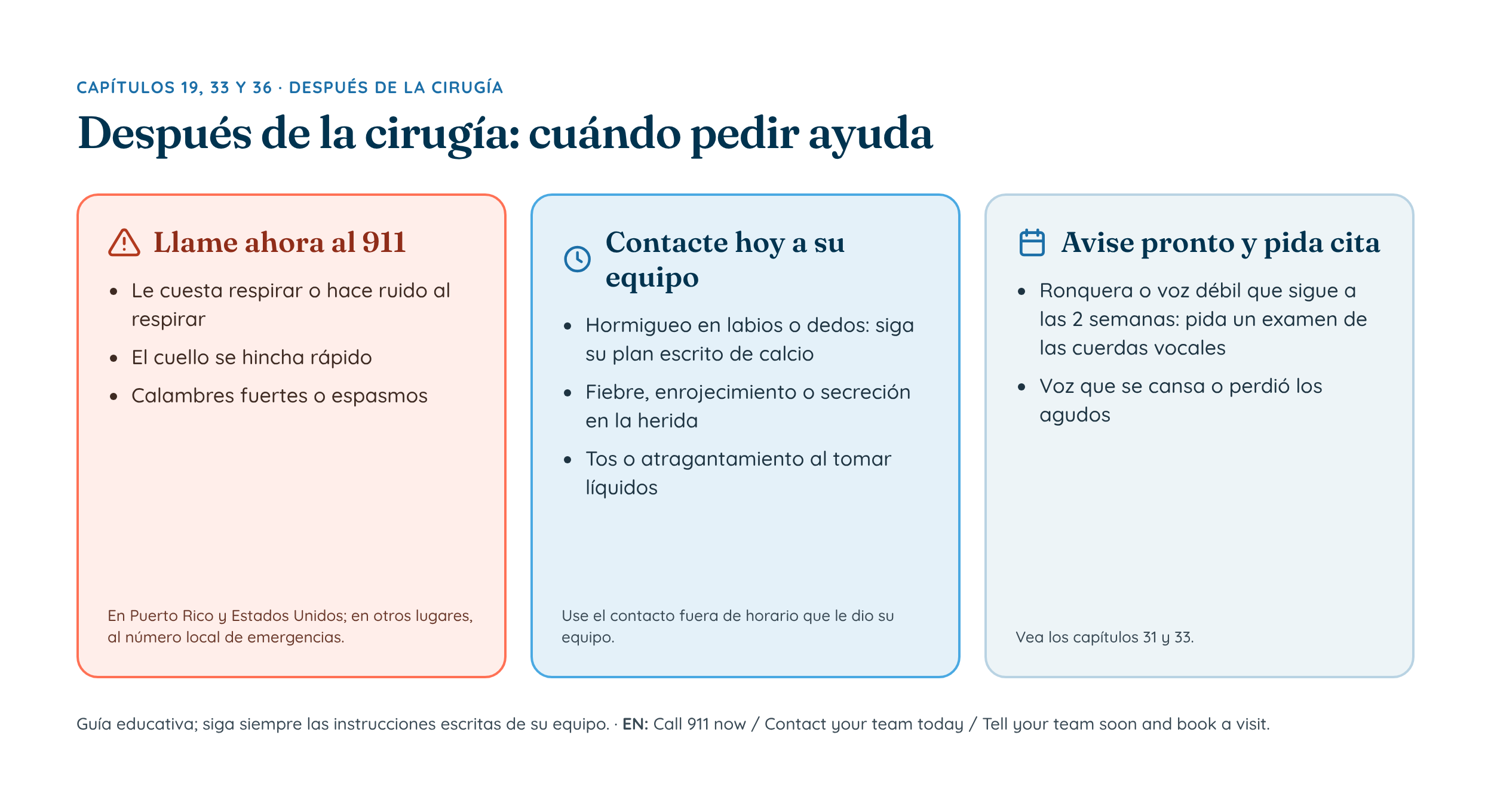
You will wake up in the recovery room. A sore throat, a scratchy voice and some neck tightness are normal. Nurses will check your breathing, your neck and your voice closely. This close watch matters because serious bleeding, though rare, most often shows up within the first six hours [5]; it can occasionally appear later, so the warning signs in Chapter 20 still apply at home.
Going home: same day or next day?
Many patients go home the same day after several hours of observation; others stay one night, especially after a total thyroidectomy or a longer operation. For carefully selected patients, going home the same day is as safe as staying overnight [6]. How long you are observed and the checks you must pass before going home are set by your surgeon and the hospital or surgery center, and can differ between facilities.
Before you leave, make sure you know:
- Your calcium plan, if you had a total thyroidectomy (Chapter 20).
- Your pain medicine plan.
- When to start your thyroid hormone pill, if you need one (Chapter 21).
- The warning signs that need the ER (Chapter 20).
- Who to call after hours, and when your follow-up visit is.
A head and neck surgeon experienced in thyroid and voice care can help.
Sources
- Chandrasekhar SS, et al. Clinical practice guideline: improving voice outcomes after thyroid surgery. Otolaryngol Head Neck Surg. 2013;148(6 Suppl):S1-S37. doi:10.1177/0194599813487301 PubMed PMID 23733893
- Davey MG, et al. Intraoperative recurrent laryngeal nerve monitoring versus visualisation alone – A systematic review and meta-analysis of randomized controlled trials. Am J Surg. 2022;224(3):836-841. doi:10.1016/j.amjsurg.2022.03.036 PubMed PMID 35422329
- Javed A, et al. Utilisation of Near Infrared Autofluorescence in Parathyroid Identification During Thyroidectomy: A Systematic Review and Meta-Analysis of Randomised Controlled Trials. Clin Otolaryngol. 2025;50(4):609-618. doi:10.1111/coa.14313 PubMed PMID 40186524
- Takahashi T, et al. Parathyroid near-infrared autofluorescence differently benefits depending on the surgeon’s skill for preventing from hypoparathyroidism after total thyroidectomy: A systematic review and meta-analysis. PLoS One. 2025;20(4):e0321310. doi:10.1371/journal.pone.0321310 PubMed PMID 40273098
- Canu GL, et al. Risk factors for postoperative cervical haematoma in patients undergoing thyroidectomy: a retrospective, multicenter, international analysis (REDHOT study). Front Surg. 2023;10:1278696. doi:10.3389/fsurg.2023.1278696 PubMed PMID 37850042
- Hu QL, et al. Same-day discharge is not associated with increased readmissions or complications after thyroid operations. Surgery. 2020;167(1):117-123. doi:10.1016/j.surg.2019.06.054 PubMed PMID 31582306
This guide is for general education only. It does not diagnose conditions or replace a medical evaluation. Talk with your own doctor about your situation. In an emergency, call 911 now (in Puerto Rico or the United States; elsewhere, your local emergency number).