Hypothyroidism and Hashimoto's: when the thyroid slows down
Maritza, 42 (a fictitious patient), thought being exhausted, cold and constipated was just part of raising three kids and working nights. When her TSH came back high and her TPO antibodies positive, her doctor said, “You have Hashimoto’s.” Her first question: “Is it dangerous?”
What hypothyroidism is
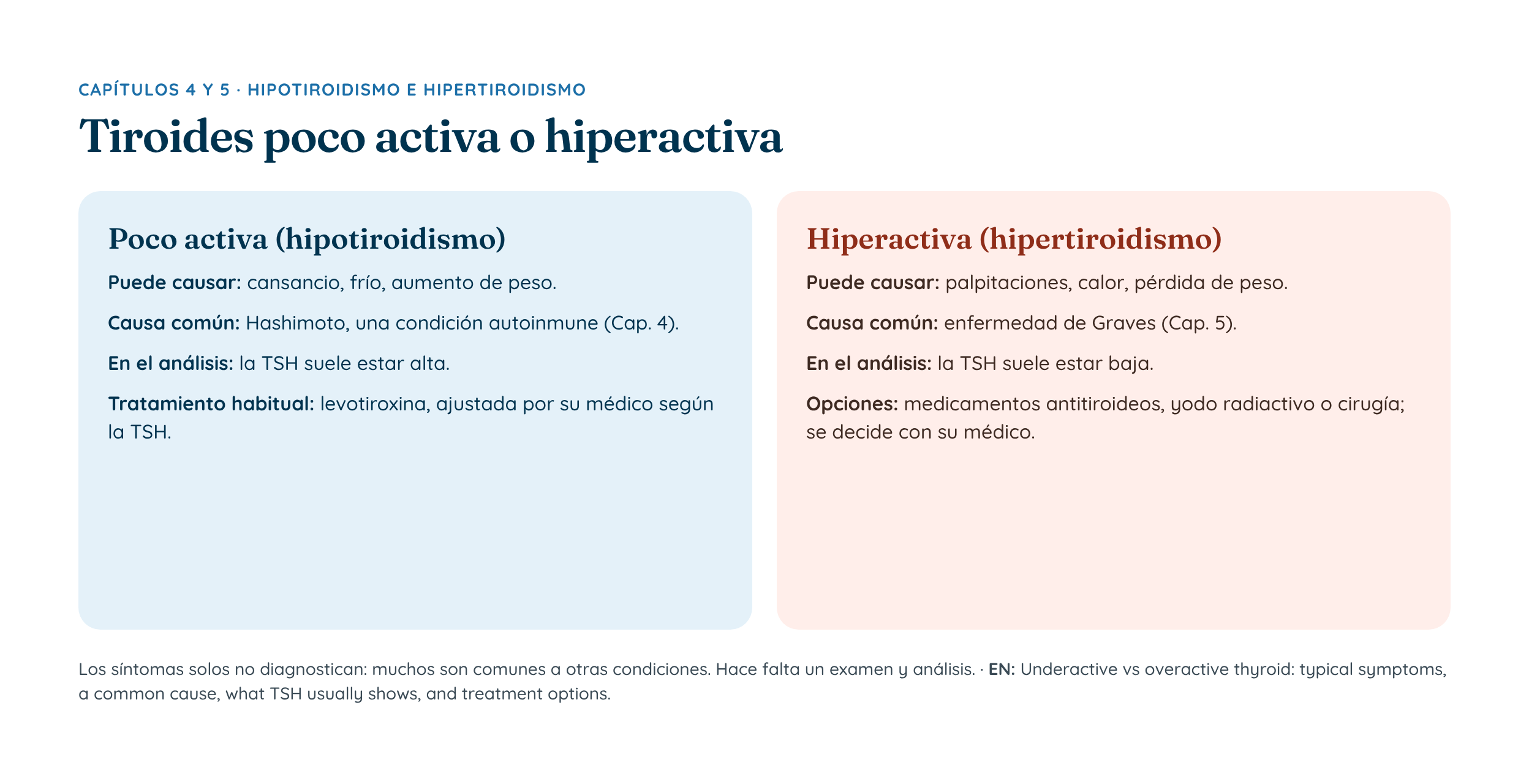
Hypothyroidism means the thyroid is not making enough hormone. It is common, readily diagnosed with a blood test, and usually well managed, although severe untreated cases can be dangerous [1]. Symptoms range from none at all to serious; the most common in adults are tiredness, sluggishness, feeling cold, weight gain, constipation, voice changes and dry skin [1].
Hashimoto’s: the most common cause
In places with enough iodine, the most common cause is Hashimoto’s thyroiditis, an autoimmune condition in which the immune system slowly attacks the thyroid. Blood tests often show TPO antibodies (Chapter 3). Many people have antibodies for years before their thyroid function changes, and some never need treatment; a positive antibody test on its own is not a reason to start levothyroxine. Other causes include thyroid surgery (Chapter 21), radioactive iodine, some medicines and, worldwide, iodine deficiency.
Mild (“subclinical”) hypothyroidism
Sometimes the TSH is a little high while free T4 is still normal. Whether to treat this is debated [1]. In a large trial of adults 65 and older with this mild pattern, levothyroxine did not improve symptoms or tiredness compared with a placebo after one year [3]. That result applies to people 65 and older with a persistently mild pattern; it may not apply to younger people or to overt hypothyroidism, where free T4 is low and treatment is standard. Decisions depend on your age, TSH level, symptoms, antibodies, and plans such as pregnancy (Chapter 6).
Treatment: levothyroxine
The standard treatment is levothyroxine, a synthetic form of the T4 hormone, taken once a day [1][2]. Your doctor adjusts the dose based on TSH tests, usually every few weeks at first and less often once stable.
Tips that help it work consistently (confirm with your doctor) [4]:
- Take it the same way every day, usually on an empty stomach with water.
- Keep it apart from calcium, iron and some antacids, which reduce absorption.
- Tell your doctor about new medicines or supplements, and about pregnancy.
- Do not switch brands or stop on your own.
“I’m on treatment but I still don’t feel right”
This is real and common: a substantial number of people who reach their TSH target still have symptoms [1]. The ATA reviewed alternatives such as combination T4/T3 pills and thyroid extracts (“natural” desiccated thyroid) and found no consistently strong evidence that they work better than levothyroxine alone [2]. Talk with your doctor about other causes of fatigue as well, and see Chapter 7 for supplement myths.
Maritza’s update
Six weeks after starting levothyroxine, Maritza’s TSH was back in range. “The cold hands went first,” she said. “The energy took longer, but it came back.”
A head and neck surgeon experienced in thyroid and voice care can help.
Sources
- Chaker L, et al. Hypothyroidism. Lancet. 2017;390(10101):1550-1562. doi:10.1016/S0140-6736(17)30703-1 PubMed PMID 28336049
- Jonklaas J, et al. Guidelines for the Treatment of Hypothyroidism (ATA Task Force). Thyroid. 2014;24(12):1670-1751. doi:10.1089/thy.2014.0028 PubMed PMID 25266247
- Stott DJ, et al. Thyroid Hormone Therapy for Older Adults with Subclinical Hypothyroidism (TRUST). N Engl J Med. 2017;376(26):2534-2544. doi:10.1056/NEJMoa1603825 PubMed PMID 28402245
- Al-Bahadili H, et al. The Complex Web of Interferences With Thyroid Function Tests. Endocr Pract. 2025;31(1):92-101. doi:10.1016/j.eprac.2024.10.007 PubMed PMID 39477092
This guide is for general education only. It does not diagnose conditions or replace a medical evaluation. Talk with your own doctor about your situation. In an emergency, call 911 now (in Puerto Rico or the United States; elsewhere, your local emergency number).