"My nerves are fine, so why does my voice feel different?"
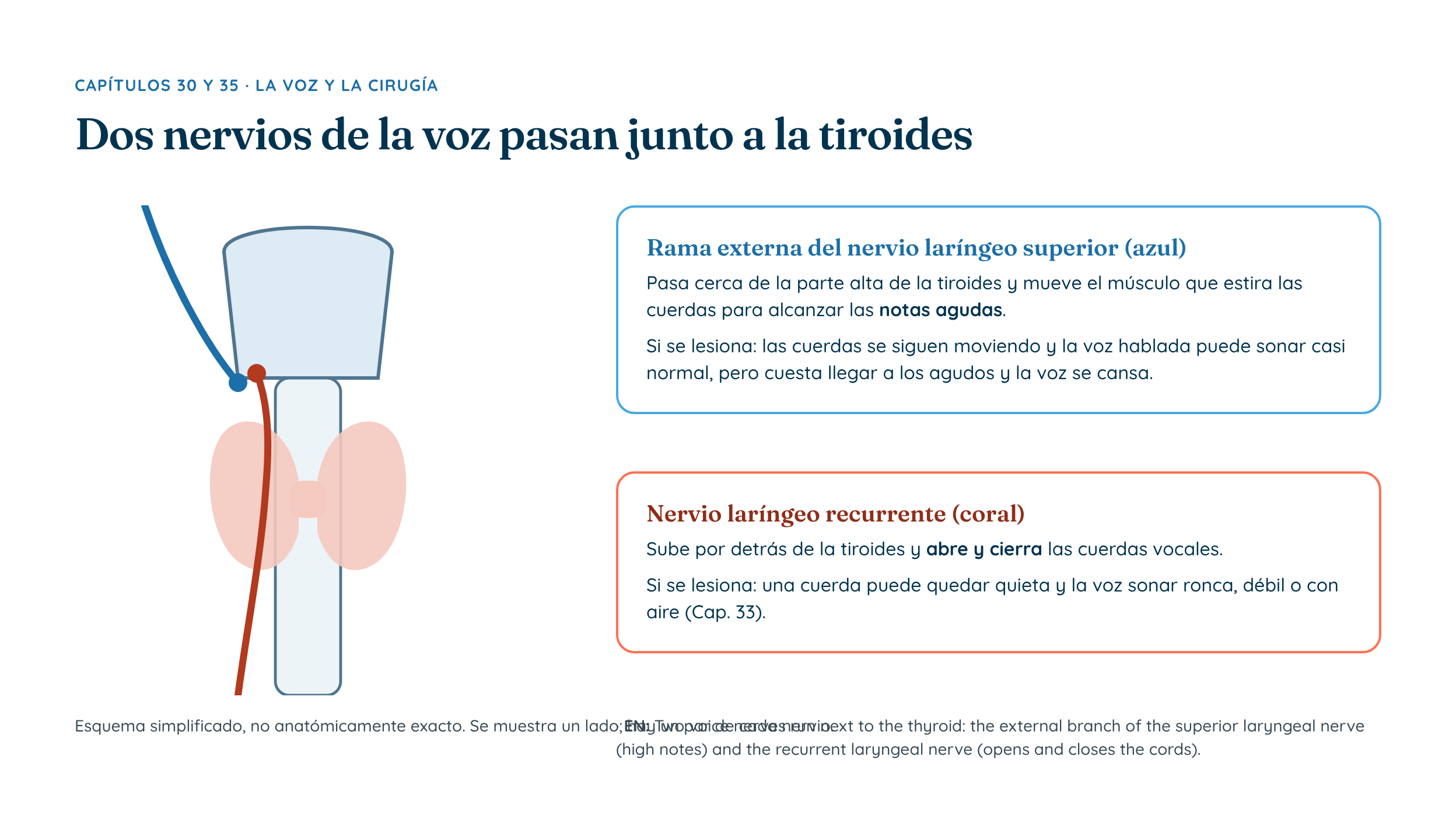
Many people are surprised to hear that their vocal cords move normally after thyroid surgery, yet their voice still feels tired, lower or harder to use. This is very common, it is real, and for most people it improves with time. Normal movement on exam is reassuring, but it does not completely rule out a subtle problem with the superior laryngeal nerve, which helps control pitch.
How common is it?
In a study that followed patients for six months, nearly half reported voice or neck discomfort in the first two weeks after thyroid surgery, even though there were no signs of injury to the main voice nerve [1]. Other studies found the same pattern: patients felt strain and fatigue early even when voice measurements looked normal, and these changes faded over the following months [2][3].
What it can feel like
- A voice that tires after talking for a while.
- A slightly lower pitch, or difficulty reaching high notes.
- Needing more effort to speak loudly or project.
- A feeling of tightness or a lump in the throat.
- Clearing the throat more often.
Why it happens
There is probably no single cause. Possible contributors include:
- The breathing tube used during anesthesia, which can irritate the vocal cords for a few days.
- Swelling and healing of the tissues around the voice box, which moves up and down when you speak and swallow.
- A subtle effect on the superior laryngeal nerve, which controls pitch. This nerve is hard to test, so mild weakness can be missed [4].
- The extent of surgery: larger thyroids and more extensive operations are linked to more voice symptoms [4].
Women, especially after menopause, seem more likely to notice these changes [4]. People who use their voice professionally may notice them more and recover more slowly [1].
What to expect
For most people, symptoms are strongest in the first two weeks and improve steadily, usually settling by about six months [1][3]. Some improvement can continue for up to a year or more [2].
When to get your voice checked
Guidelines recommend checking your voice between two weeks and two months after surgery, and examining the vocal cords if it has changed [5]. A careful exam, ideally with stroboscopy, can confirm that both vocal cords move and look for subtle problems such as uneven vibration [4].
Get examined sooner if your voice is very weak or breathy, you cough or choke when drinking, or you have any noisy breathing (Chapter 31).
What helps
- Voice rest in moderation: avoid shouting and long phone calls in the first weeks, but keep talking normally.
- Hydration: drink water through the day; it helps the vocal cords vibrate easily.
- Voice therapy: after your larynx has been examined, a speech-language pathologist can teach techniques to use the voice efficiently. It is an option that is commonly offered, and guidelines recommend counseling patients about voice rehabilitation [5]. To be honest, there is little thyroidectomy-specific evidence, and studies have not yet proven that therapy speeds recovery when vocal-cord movement is preserved [4].
Key points
- A tired or lower voice after thyroid surgery is common even when the vocal cords move normally.
- It usually improves over a few months.
- If your voice has changed two weeks after surgery, ask for a vocal cord exam, ideally with stroboscopy.
A head and neck surgeon experienced in thyroid and voice care can help.
Sources
- Mahmoud NF, et al. Time-Related Voice and Swallowing Symptoms in Patients With Uncomplicated Thyroidectomy Versus Those With Other Laryngeal Disorders. J Voice. 2024. doi:10.1016/j.jvoice.2024.11.045 PubMed PMID 39709306
- Sõber L, et al. Voice and Swallowing Disorders After Thyroid Surgery. J Voice. 2024;38(5):1254.e11-1254.e20. doi:10.1016/j.jvoice.2022.03.013 PubMed PMID 35410778
- Aygun N, et al. The effect of strap muscle transection on voice and swallowing changes after thyroidectomy in patients without laryngeal nerve injury. Ann R Coll Surg Engl. 2022;104(7):517-524. doi:10.1308/rcsann.2021.0225 PubMed PMID 34846194
- Beka E, Gimm O. Voice Changes Without Laryngeal Nerve Alterations After Thyroidectomy: The Need For Prospective Trials – A Review Study. J Voice. 2024;38(1):231-238. doi:10.1016/j.jvoice.2021.07.012 PubMed PMID 34404582
- Chandrasekhar SS, et al. Clinical practice guideline: improving voice outcomes after thyroid surgery. Otolaryngol Head Neck Surg. 2013;148(6 Suppl):S1-37. doi:10.1177/0194599813487301 PubMed PMID 23733893
This guide is for general education only. It does not diagnose conditions or replace a medical evaluation. Talk with your own doctor about your situation. In an emergency, call 911 now (in Puerto Rico or the United States; elsewhere, your local emergency number).