Thyroid symptoms: what your body may be telling you
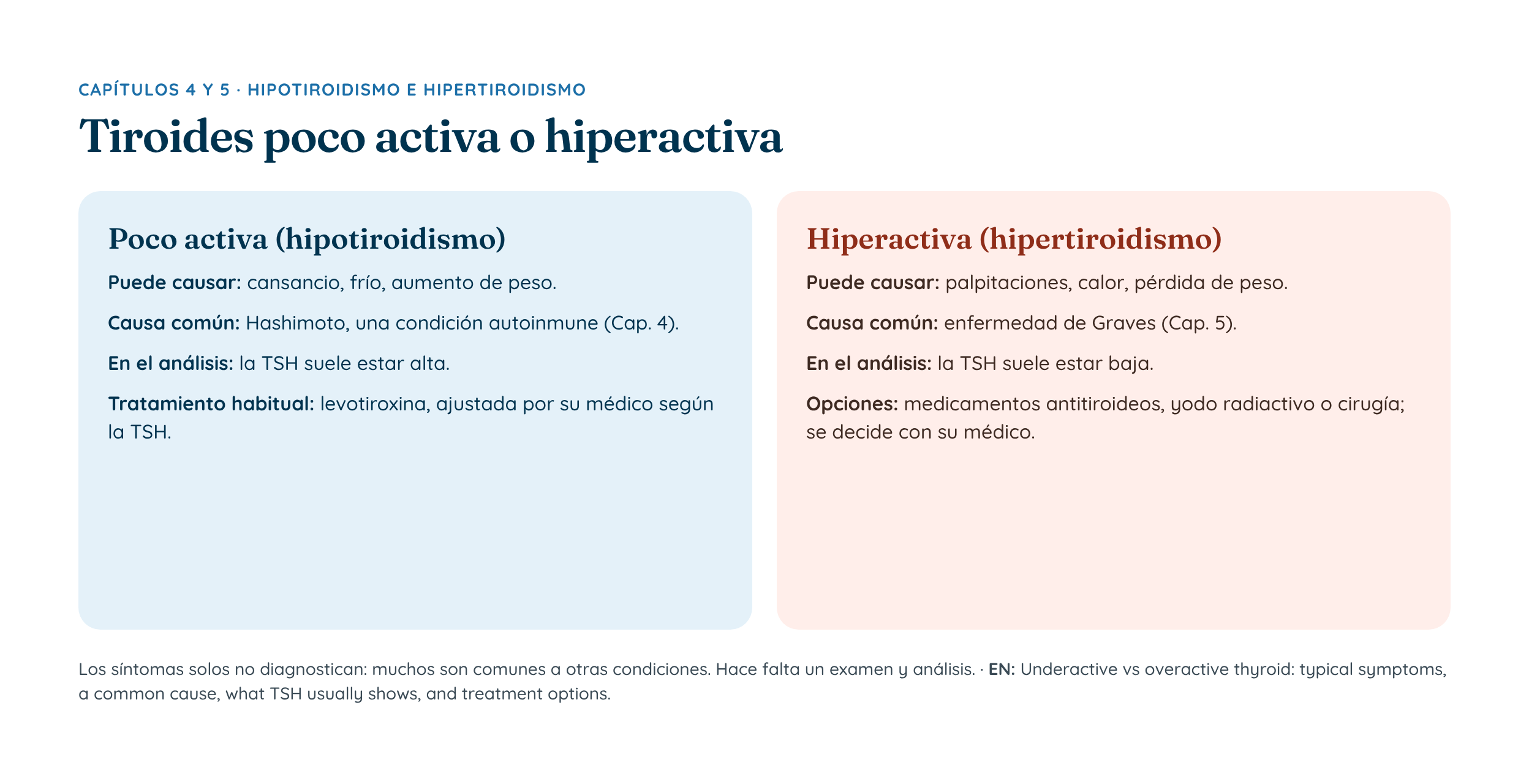
Symptoms alone cannot diagnose a thyroid problem; only an exam and tests can.
Carmen, 51 (a fictitious patient), blamed her exhaustion on menopause and her hoarse voice on teaching all day. Her hairdresser was the one who said, “You have a little bump on your neck.” Thyroid problems often hide behind everyday explanations.
Why thyroid symptoms are confusing
Thyroid hormone touches almost every organ, so thyroid problems can cause a wide range of symptoms, and many of them are also caused by stress, aging, sleep problems or other conditions. Some people with thyroid disease have no symptoms at all [1]. That is why a blood test, not a symptom list, is the starting point (Chapter 3).
When the thyroid is underactive (hypothyroidism)
The most common symptoms in adults are [1]:
- Tiredness and low energy
- Feeling cold when others are comfortable
- Weight gain
- Constipation
- Dry skin
- A deeper or hoarser voice
Symptoms can be very different from one person to another and can change with age and sex [1]. See Chapter 4.
When the thyroid is overactive (hyperthyroidism)
Common symptoms include a fast or pounding heartbeat, feeling hot and sweaty, weight loss despite a good appetite, shaky hands, anxiety or irritability, trouble sleeping and more frequent bowel movements. In Graves’ disease, some people also develop eye changes: bulging, gritty or red eyes, or double vision [2]. See Chapter 5.
A lump or swelling in the neck
Thyroid nodules are very common and most are benign [3]. Many are found by chance on a scan done for another reason. A large goiter may cause no symptoms, or it may press on the windpipe or swallowing tube, causing shortness of breath, trouble breathing when lying flat, or trouble swallowing, especially when it extends into the chest [4]. See Chapters 8 and 12.
Your voice
The nerves that move your vocal cords run right behind the thyroid. Hoarseness can come from many causes, but hoarseness that lasts more than about four weeks deserves an exam of the vocal cords, especially if you also have a neck lump; a national guideline recommends a laryngeal exam when hoarseness does not improve within four weeks [5]. See Chapter 30.
See a doctor promptly (within days to weeks) if you notice: a neck lump that is growing, a lump that feels hard or fixed, hoarseness that lasts more than about four weeks, swallowing that keeps getting harder, or swollen lymph nodes in the neck. Tiredness, weight change and palpitations are common and have many causes, and a nodule can be present even when thyroid blood tests are normal, so these are reasons to get checked, not a diagnosis.
Carmen’s story
Carmen’s blood tests showed a mildly underactive thyroid, and an ultrasound found a small nodule that was later shown to be benign. With treatment, her energy improved. Her hoarseness turned out to be vocal strain, which improved with voice therapy. “Three different things,” she said. “I’m glad someone looked at all of them.”
A head and neck surgeon experienced in thyroid and voice care can help.
Sources
- Chaker L, et al. Hypothyroidism. Lancet. 2017;390:1550-1562. doi:10.1016/S0140-6736(17)30703-1 PubMed PMID 28336049
- Ross DS, et al. 2016 American Thyroid Association Guidelines for Hyperthyroidism and Other Causes of Thyrotoxicosis. Thyroid. 2016;26(10):1343-1421. doi:10.1089/thy.2016.0229 PubMed PMID 27521067
- Haugen BR, et al. 2015 American Thyroid Association Guidelines for Thyroid Nodules and Differentiated Thyroid Cancer. Thyroid. 2016;26(1):1-133. doi:10.1089/thy.2015.0020 PubMed PMID 26462967
- Chen AY, et al. American Thyroid Association statement on optimal surgical management of goiter. Thyroid. 2014;24(2):181-189. doi:10.1089/thy.2013.0291 PubMed PMID 24295043
- Stachler RJ, et al. Clinical Practice Guideline: Hoarseness (Dysphonia) (Update). Otolaryngol Head Neck Surg. 2018. doi:10.1177/0194599817751031 PubMed PMID 29494316
This guide is for general education only. It does not diagnose conditions or replace a medical evaluation. Talk with your own doctor about your situation. In an emergency, call 911 now (in Puerto Rico or the United States; elsewhere, your local emergency number).