Do I need thyroid surgery?
Most thyroid problems never need an operation. Nodules are very common and most are harmless, an underactive thyroid is treated with a daily pill, and many overactive thyroids are controlled with medicine. Surgery is recommended when it is the best way to remove a cancer, relieve pressure on the neck, or cure a thyroid that cannot be controlled another way.
This chapter explains the main reasons surgeons recommend thyroid surgery, when watching or a non-surgical treatment is reasonable, and how to make the decision together with your doctor.
The main reasons for thyroid surgery
1. Cancer, or a nodule that may be cancer. When a biopsy shows cancer or a strong suspicion of cancer, surgery is usually the first treatment. Biopsy results are reported in six standard categories, each with its own level of risk [7]. Some results fall in the middle, and further tests or a diagnostic operation may be needed. Chapter 11 explains these results.
2. A large thyroid that presses on the neck (goiter). A goiter can press on the windpipe or the esophagus. You may notice trouble breathing when lying flat, a feeling of choking, or difficulty swallowing pills or food. Surgery is the recommended treatment for goiters that cause these symptoms, and breathing and swallowing usually improve afterward, especially when the goiter extends down into the chest [3]. See Chapter 12.
3. An overactive thyroid. Graves’ disease and overactive nodules can be treated with medicine, radioactive iodine or surgery [4]. Surgery may be a good choice if you have a large goiter, a suspicious nodule, moderate or severe thyroid eye disease, plans for pregnancy soon, or if you prefer a quick, definitive treatment. See Chapter 5.
4. Nodules that grow or cause symptoms. A benign nodule that keeps growing, causes discomfort or is visible may be treated, either with surgery or with a non-surgical procedure (see below).
When surgery may not be needed
A benign nodule with no symptoms is usually followed with ultrasound every so often instead of being removed [5].
Some small, low-risk thyroid cancers can be safely watched with regular ultrasounds, an approach called active surveillance. The 2025 American Thyroid Association guidelines also support smaller operations for many low-risk cancers [2]. Chapter 24 explains who qualifies.
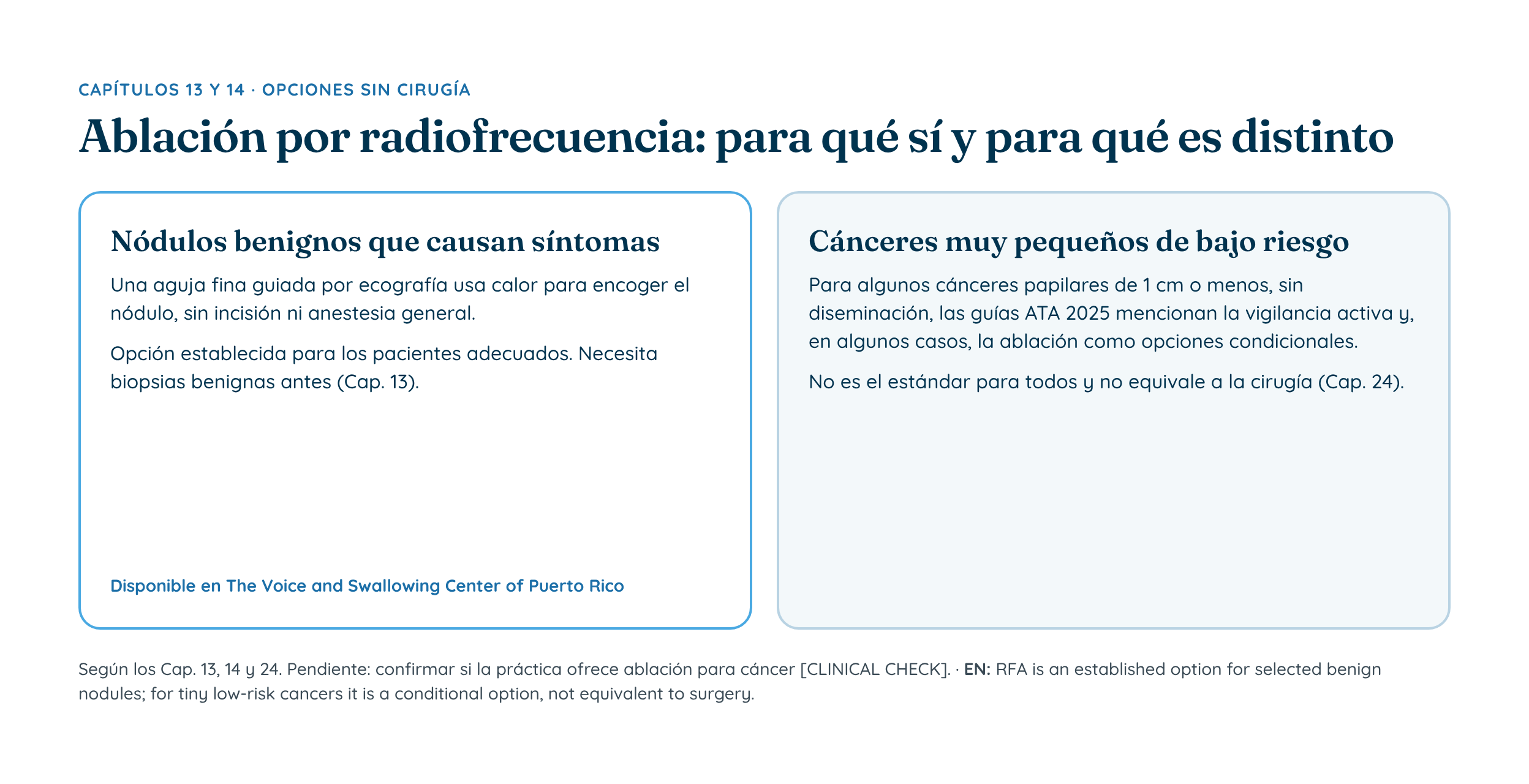
Radiofrequency ablation (RFA) shrinks selected benign nodules with heat delivered through a thin needle under ultrasound, without an incision or general anesthesia. International experts consider it an established option for the right patients [6]. RFA for benign nodules is offered at The Voice and Swallowing Center of Puerto Rico; Chapter 13 explains who is a good candidate.
Small cancers are a separate question. For selected very small, low-risk papillary cancers (1 cm or less, confined to the thyroid, with no spread), the 2025 American Thyroid Association guidelines list active surveillance and, in some cases, ablation as conditional options alongside surgery; they are not the standard for everyone [2]. See Chapter 24.
Making the decision together
Modern thyroid care is built on shared decision-making: your surgeon explains the options, the benefits and the risks, and the choice reflects your situation and your priorities [2]. Thyroid surgery done by an experienced surgeon is safe [1], but so is watching a harmless nodule. A good surgeon will tell you honestly when you do not need an operation.
Questions to ask your surgeon
- Why are you recommending surgery for me, and what happens if I wait?
- Is there a non-surgical option, such as watching or radiofrequency ablation?
- Would you remove half of my thyroid or all of it, and why? (See Chapter 15.)
- How many thyroid operations do you perform each year? (See Chapter 16.)
A head and neck surgeon experienced in thyroid and voice care can help.
Sources
- Patel KN, et al. The American Association of Endocrine Surgeons Guidelines for the Definitive Surgical Management of Thyroid Disease in Adults. Ann Surg. 2020;271(3):e21-e93. doi:10.1097/SLA.0000000000003580 PubMed PMID 32079830
- Ringel MD, et al. 2025 American Thyroid Association Management Guidelines for Adult Patients with Differentiated Thyroid Cancer. Thyroid. 2025;35(8):841-985. doi:10.1177/10507256251363120 PubMed PMID 40844370
- Chen AY, et al. American Thyroid Association statement on optimal surgical management of goiter. Thyroid. 2014;24(2):181-189. doi:10.1089/thy.2013.0291 PubMed PMID 24295043
- Ross DS, et al. 2016 American Thyroid Association Guidelines for Diagnosis and Management of Hyperthyroidism and Other Causes of Thyrotoxicosis. Thyroid. 2016;26(10):1343-1421. doi:10.1089/thy.2016.0229 PubMed PMID 27521067
- Haugen BR, et al. 2015 American Thyroid Association Management Guidelines for Adult Patients with Thyroid Nodules and Differentiated Thyroid Cancer. Thyroid. 2016;26(1):1-133. doi:10.1089/thy.2015.0020 PubMed PMID 26462967
- Orloff LA, et al. Radiofrequency ablation and related ultrasound-guided ablation technologies for treatment of benign and malignant thyroid disease: An international multidisciplinary consensus statement. Head Neck. 2022;44(3):633-660. doi:10.1002/hed.26960 PubMed PMID 34939714
- Ali SZ, et al. The 2023 Bethesda System for Reporting Thyroid Cytopathology. Thyroid. 2023;33(9):1039-1044. doi:10.1089/thy.2023.0141 PubMed PMID 37427847
This guide is for general education only. It does not diagnose conditions or replace a medical evaluation. Talk with your own doctor about your situation. In an emergency, call 911 now (in Puerto Rico or the United States; elsewhere, your local emergency number).