Thyroid cancer: the essentials
Case of a fictitious patient: Luis, 38, heard the word “cancer” and stopped listening. It was only later, at home, that he read the report again: a 1.4-centimeter papillary thyroid cancer, no spread seen on ultrasound. “My doctor kept saying ‘this is the good kind,’” he said. “I didn’t know there was a good kind of cancer.”
No cancer diagnosis is good news. But thyroid cancer is, for most people, one of the most treatable cancers there is. This chapter explains why, and what the next steps usually look like.
The main types
Thyroid cancers are named by how the cells look under the microscope:
- Papillary thyroid cancer: by far the most common. Usually slow-growing. May spread to lymph nodes in the neck, yet still has an excellent outlook for most patients.
- Follicular thyroid cancer: less common. More likely to spread through the bloodstream than to lymph nodes, but usually very treatable.
- Oncocytic carcinoma (formerly Hürthle cell): a related type, often managed similarly to follicular cancer.
- Medullary thyroid cancer: starts in different cells (C-cells) that make calcitonin. Some cases are inherited, so genetic testing is recommended for every patient, and family members may need testing too (Chapter 28). [7]
- Anaplastic thyroid cancer: rare, but fast-growing and serious. It needs urgent care from a specialized team (Chapter 28). [8]
Papillary, follicular and oncocytic cancers are together called differentiated thyroid cancer, the most common group by far. [1]
Why so many people are diagnosed now
In the United States, thyroid cancer diagnoses nearly tripled between the 1970s and 2009 and have since leveled off or fallen. [3][6] Deaths from thyroid cancer, however, stayed low and fairly stable. [4][6]
The main reason is overdiagnosis. Ultrasound and other scans now find tiny cancers that would likely never have caused a problem in a person’s lifetime. [4] One modeling analysis of US cancer registries estimated that most early-stage papillary cancers diagnosed from 2000 to 2019 fall in this category. [5] These are estimates for whole populations: they cannot tell whether any one person’s cancer is harmless. That depends on the details of your own cancer, which your care team weighs with you.
Why this matters to you: it is one reason current guidelines favor less aggressive treatment for small, low-risk cancers, including active surveillance in some cases (Chapter 24) and removing only half the thyroid (Chapter 15).
How doctors decide on treatment: the DATA approach
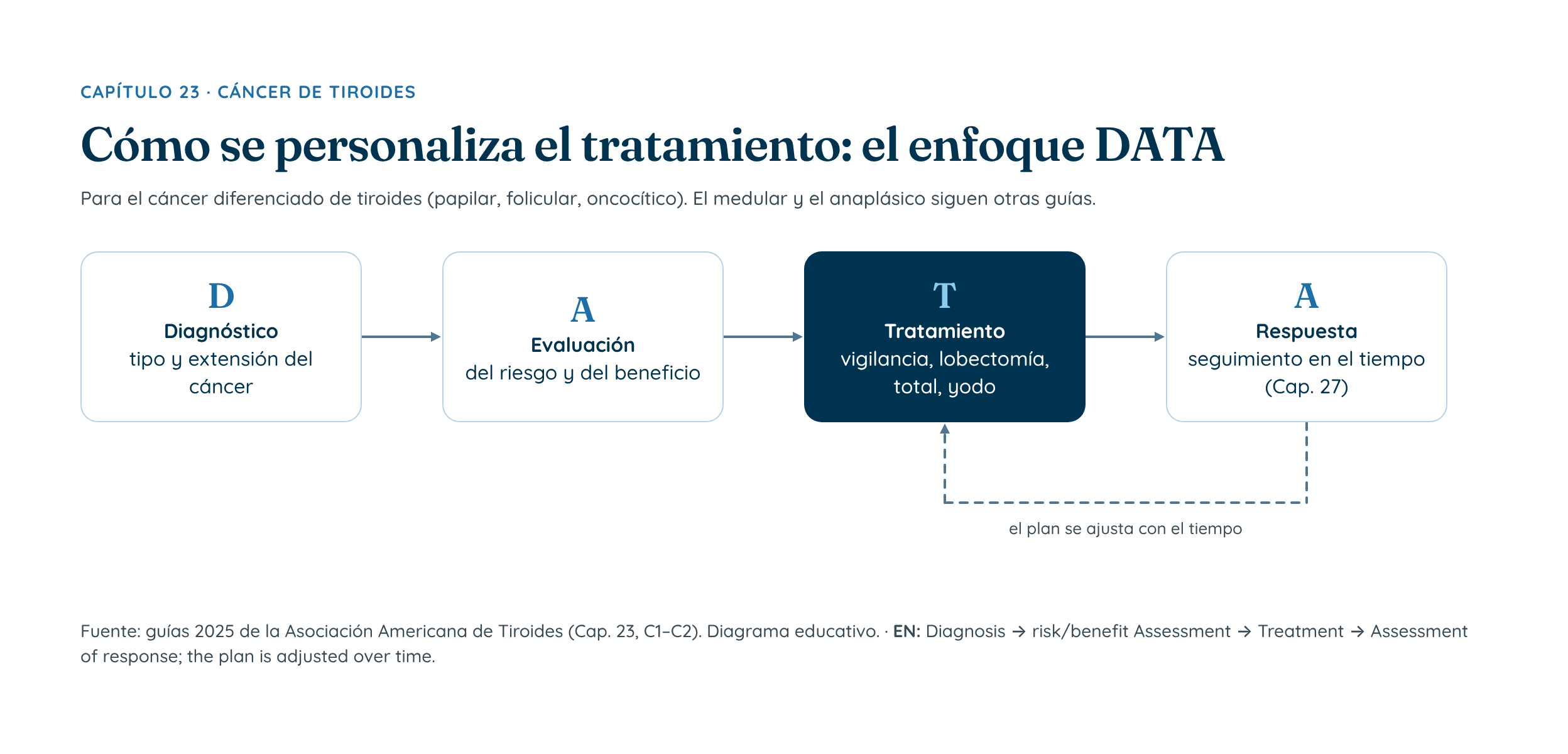
For differentiated thyroid cancer (not medullary or anaplastic, which have their own guidelines), the 2025 American Thyroid Association guidelines organize care around four steps, called DATA: [2]
- Diagnosis: confirm the type and extent of cancer (biopsy, ultrasound of the neck, sometimes molecular testing).
- Assessment of risk and benefit: estimate how likely the cancer is to come back or cause harm, and weigh treatment benefits against side effects.
- Treatment decisions: choose among active surveillance, lobectomy, total thyroidectomy, neck dissection, radioactive iodine and other options (Chapters 15, 24–26).
- Assessment of response: check over time how well treatment worked and adjust follow-up (Chapter 27).
The 2025 guidelines put more emphasis on shared decision-making, active surveillance and lobectomy for low-risk cancers, and lighter follow-up for patients who are doing well. [2]
Questions to ask after a diagnosis
- What type of thyroid cancer is it, and how big is it?
- Has an ultrasound checked the lymph nodes in my neck?
- Am I low, intermediate or high risk? What does that mean for treatment?
- Is active surveillance an option for me? Is lobectomy?
- Will I need radioactive iodine?
- Should I have a vocal cord exam before surgery? (Chapter 31)
Key points
- Most thyroid cancers are differentiated (mainly papillary) and have an excellent outlook.
- Medullary and anaplastic cancers are different diseases that need specialized care.
- Many small cancers are found because of more imaging; treatment is now tailored to risk.
- The 2025 guidelines use the DATA approach to personalize care.
A head and neck surgeon experienced in thyroid and voice care can help.
Sources
- Ringel MD, Sosa JA, et al. 2025 American Thyroid Association Management Guidelines for Adult Patients with Differentiated Thyroid Cancer. Thyroid. 2025;35(8):841–985. doi:10.1177/10507256251363120. Erratum: Thyroid. 2025;35(11):1350. doi:10.1177/10507256251387671 PubMed PMID 40844370; erratum PubMed PMID 41182278
- Executive summary, 2025 ATA guidelines for differentiated thyroid cancer. Thyroid. 2025. doi:10.1177/10507256251390877 PubMed PMID 41173539
- Chen et al. Lancet Diabetes Endocrinol. 2025. doi:10.1016/S2213-8587(24)00310-3 PubMed PMID 39922210
- Chen & Haymart. Nat Rev Endocrinol. 2025. doi:10.1038/s41574-025-01168-y PubMed PMID 40903496
- Zhang et al. Int J Cancer. 2025. doi:10.1002/ijc.70143 PubMed PMID 40938315
- Meng et al. Endocrinol Metab. 2026. doi:10.3803/EnM.2025.2810 PubMed PMID 42543222
- Wells SA Jr, et al. Revised American Thyroid Association guidelines for the management of medullary thyroid carcinoma. Thyroid. 2015. doi:10.1089/thy.2014.0335 PubMed PMID 25810047
- Bible KC, et al. 2021 American Thyroid Association guidelines for management of patients with anaplastic thyroid cancer. Thyroid. 2021. doi:10.1089/thy.2020.0944 PubMed PMID 33728999
This guide is for general education only. It does not diagnose conditions or replace a medical evaluation. Talk with your own doctor about your situation. In an emergency, call 911 now (in Puerto Rico or the United States; elsewhere, your local emergency number).