Primary hyperparathyroidism: when calcium runs high
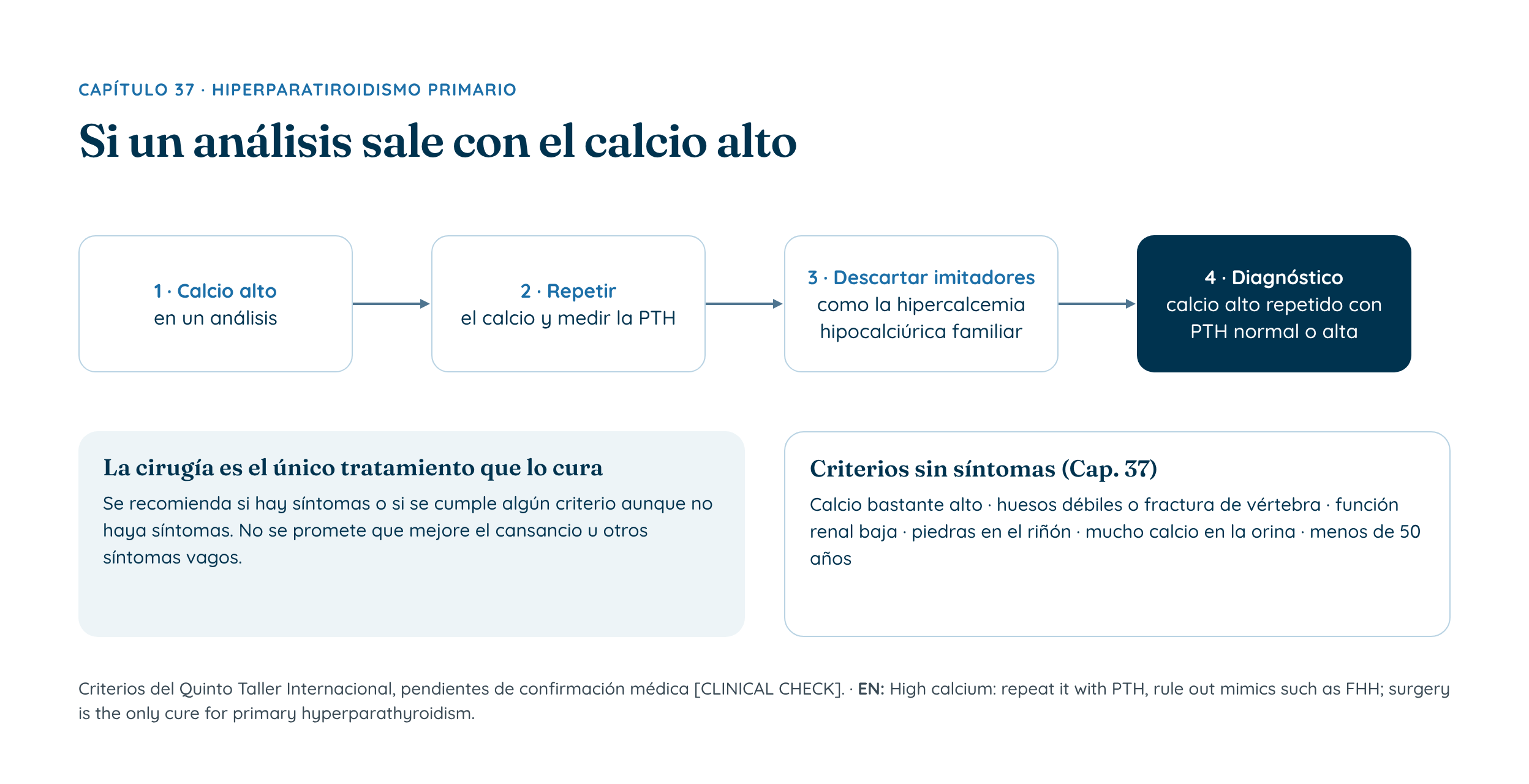
Case of a fictitious patient: Ramón, 62, went for a routine checkup and left with an unexpected note: “calcium slightly high, repeat with PTH.” He felt fine, or so he thought. Looking back, he had been more tired than usual, had a kidney stone two years earlier, and kept forgetting where he had left his keys.
What it is
In primary hyperparathyroidism, one or more of the parathyroid glands (Chapter 36) makes too much parathyroid hormone (PTH) on its own, without listening to the body’s calcium level. The result is blood calcium that runs high. Most often a single gland has grown into a benign lump called an adenoma; less often, several glands are enlarged [1]. It is more common in women after menopause.
It is not the same as a thyroid problem, although the glands sit right next to each other, and the two conditions sometimes appear together. The AAES guideline recommends checking the thyroid before parathyroid surgery so both can be handled in one operation if needed [1].
Symptoms, or none at all
Today most people are diagnosed by a routine blood test before they feel clearly sick. When symptoms appear, they can include:
- Kidney stones
- Thinning bones (osteoporosis) or fractures
- Fatigue, low mood, poor concentration, muscle aches
- Thirst and frequent urination
How it is confirmed
The key finding is a high calcium, confirmed on repeat tests, with a PTH that is high or “inappropriately normal.” Your doctor will also rule out conditions that can look similar, including an inherited condition called familial hypocalciuric hypercalcemia (FHH), which does not need surgery. The AAES guideline recommends a vitamin D level, a 24-hour urine calcium, and a bone density scan (DXA) as part of the initial evaluation, and treating low vitamin D [1]. These tests also help decide whether surgery is recommended.
Who needs surgery
Surgery is the only treatment that cures the condition [1]. The AAES recommends it for everyone with symptoms and says it should be considered for most people without symptoms [1]. An international workshop (2022) updated the criteria that favor surgery in people without symptoms, including revised kidney criteria [2]. Factors your doctor weighs include how high your calcium is, your bone density or a past fracture, kidney stones or reduced kidney function, the amount of calcium in your urine, and your age. Surgery treats the calcium problem; it may not relieve vague symptoms such as tiredness or poor concentration.
For some people with mild disease, careful observation is reasonable. A Scandinavian trial followed patients for 10 years: those who had surgery had better bone density, but fracture rates were similar, and quality-of-life differences were small (vitality scored somewhat better after surgery) [3][4]. That is why the decision is individual: your age, bones, kidneys, symptoms and preferences all matter.
Finding the gland: imaging
Before surgery, imaging such as a neck ultrasound or other high-resolution scans helps the surgeon plan [1]. Important: imaging is for planning, not for diagnosis. A scan that does not find the gland does not mean you cannot have surgery [1]. Biopsy of a suspected parathyroid gland should be avoided [1].
The operation
There are two well-established approaches, and both cure most patients [1]:
- Focused (minimally invasive) parathyroidectomy: when imaging points to one gland, the surgeon removes it through a small incision. A PTH level measured during the operation confirms that the remaining glands have taken over [1].
- Bilateral exploration: the surgeon looks at all four glands. This is preferred when more than one gland may be involved [1].
As with any neck surgery, the team watches for bleeding and for low calcium afterward [1]. Surgeons who do these operations often have better results [1]. Cure is confirmed when calcium stays normal more than six months after surgery [1].
If you cannot or choose not to have surgery
Medications can lower calcium or protect bone, but surgery is the only treatment that cures the condition [1][2]. Regular blood tests, bone scans and kidney checks are part of observation.
Ramón’s decision
Ramón’s DXA showed osteoporosis in his forearm, and his ultrasound pointed to one gland. He chose a focused operation. A month later his calcium was normal. “I didn’t realize how foggy I was until it lifted,” he said.
Questions to ask
- Do I meet the criteria for surgery?
- What do my bone density and kidney tests show?
- Which imaging will you use, and what if it does not find the gland?
- How many parathyroid operations does your team do each year?
Key points
- Primary hyperparathyroidism means a parathyroid gland makes too much PTH, so calcium runs high.
- Surgery is the only cure and is recommended for people with symptoms and many without.
- A scan that does not find the gland does not rule out surgery.
- For mild disease, careful observation can be reasonable; the decision is individual.
A head and neck surgeon experienced in thyroid and voice care can help.
Sources
- Wilhelm SM, et al. The American Association of Endocrine Surgeons Guidelines for Definitive Management of Primary Hyperparathyroidism. JAMA Surg. 2016;151(10):959-968. doi:10.1001/jamasurg.2016.2310 PubMed PMID 27532368
- Bilezikian JP, et al. Evaluation and Management of Primary Hyperparathyroidism: Summary Statement and Guidelines from the Fifth International Workshop. J Bone Miner Res. 2022;37(11):2293-2314. doi:10.1002/jbmr.4677 PubMed PMID 36245251
- Lundstam K, et al. Positive Effect of Parathyroidectomy Compared to Observation on BMD in a Randomized Controlled Trial of Mild Primary Hyperparathyroidism. J Bone Miner Res. 2023;38(3):372-380. doi:10.1002/jbmr.4763 PubMed PMID 36593641
- Pretorius M, et al. Effects of Parathyroidectomy on Quality of Life: 10 Years of Data From a Prospective Randomized Controlled Trial on Primary Hyperparathyroidism (the SIPH-Study). J Bone Miner Res. 2021;36(1):3-11. doi:10.1002/jbmr.4199 PubMed PMID 33125769
This guide is for general education only. It does not diagnose conditions or replace a medical evaluation. Talk with your own doctor about your situation. In an emergency, call 911 now (in Puerto Rico or the United States; elsewhere, your local emergency number).