Thyroid fine-needle biopsy: what to expect and how to read the result
Case of a fictitious patient: Elena was terrified of the word “biopsy.” She pictured a big needle, a hospital stay and days of pain. Her actual biopsy took about 20 minutes in the office. Afterward, she drove herself back to work, holding an ice pack to her neck. “The waiting for results was the hard part,” she said. “The needle wasn’t.”
What a fine-needle biopsy is
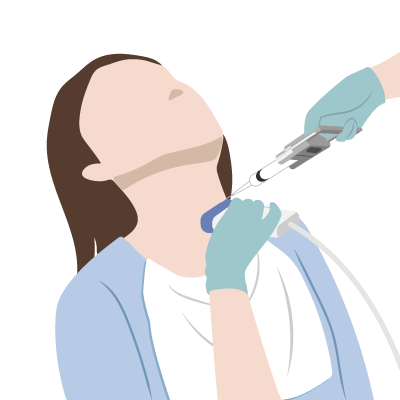
A fine-needle aspiration (FNA) uses a very thin needle, thinner than the one used for most blood draws, to collect cells from a thyroid nodule. A doctor guides the needle with ultrasound to reach exactly the right spot. The cells go to a pathologist (cytopathologist), who looks at them under a microscope. The decision to biopsy is based on the nodule’s ultrasound appearance and size (Chapter 9) [3].
What happens during the procedure
- You lie on your back with a pillow under your shoulders to extend the neck.
- The skin is cleaned. Some doctors use a numbing medicine.
- Using ultrasound, the doctor inserts the thin needle into the nodule several times, for a few seconds each, to collect enough cells.
- Light pressure is applied afterward to prevent bruising.
The whole visit usually takes less than 30 minutes, and you can usually go back to normal activities the same day.
Is it safe? Does it hurt?
FNA is a very safe procedure. A review of 23 studies found that most people feel no discomfort or only mild discomfort. A small bruise or bleeding happens in up to about 6 in 100 people, and serious problems are rare [2].
Before the biopsy, tell your doctor if you take blood thinners (anticoagulants) or antiplatelet medicines such as aspirin. Do not stop or change any of them on your own; any change must be coordinated between the doctor who prescribed it and the biopsy team.
Understanding your result: the Bethesda categories
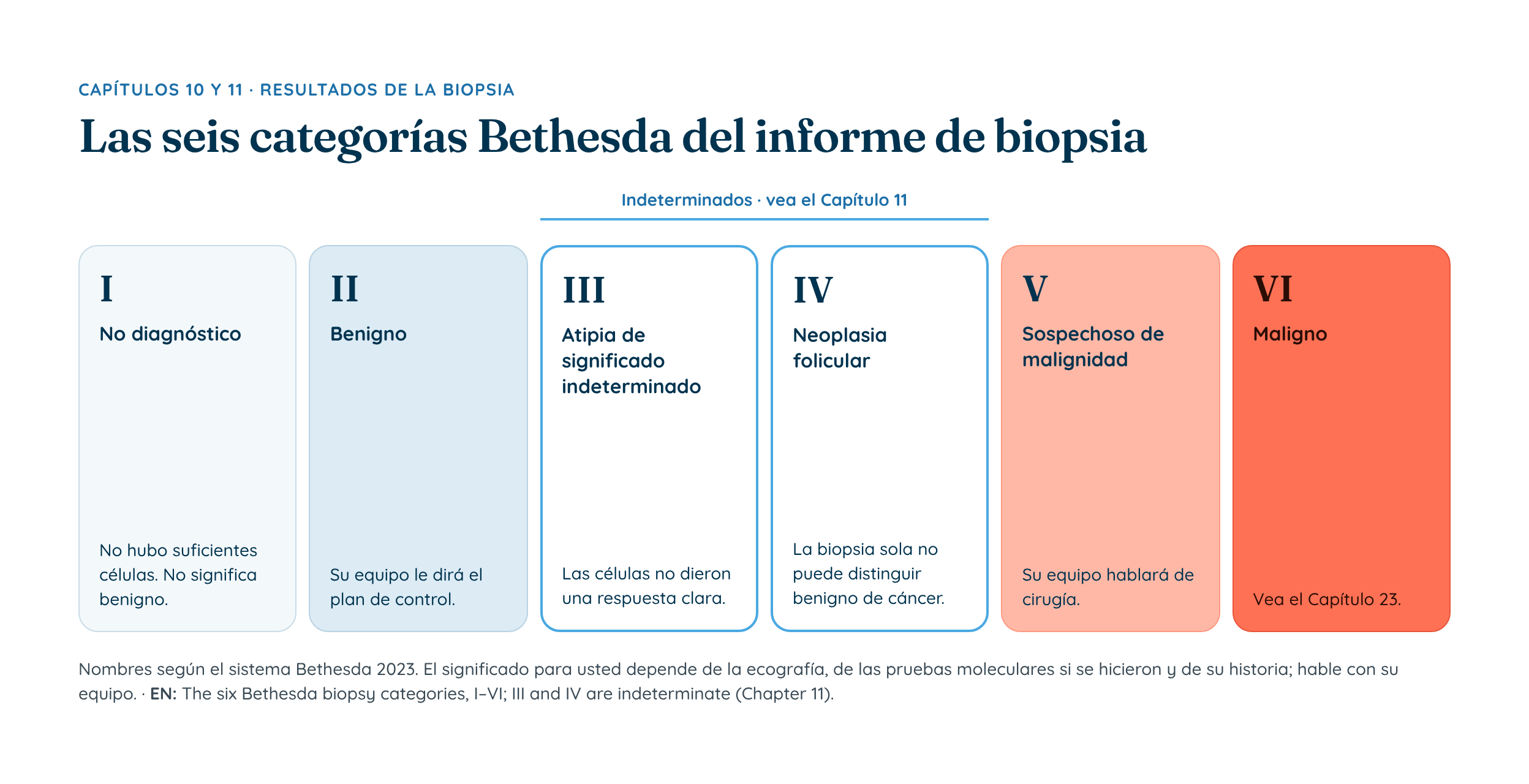
Thyroid biopsy results are reported using the Bethesda System, which has six categories [1]:
| Category | Name | What it usually means |
|---|---|---|
| I | Nondiagnostic | Not enough cells to tell. The biopsy is usually repeated. |
| II | Benign | Not cancer. Usually followed with ultrasound. |
| III | Atypia of undetermined significance | Cells look slightly unusual, but it is unclear why. Often a repeat biopsy or molecular testing (Chapter 11). |
| IV | Follicular neoplasm | A growth pattern that cannot be called benign or cancer from cells alone. Usually molecular testing or diagnostic surgery (Chapter 11). |
| V | Suspicious for malignancy | Probably cancer, but not certain. Surgery is usually recommended. |
| VI | Malignant | Cancer cells are present (most often papillary cancer). See Chapter 23. |
A nondiagnostic result is not the same as benign: it means the sample did not have enough cells to answer the question, and the biopsy is usually repeated. The chance of cancer in each category varies between centers.
Each category carries a different estimated risk of cancer, which your doctor will explain. The newest edition also gives molecular testing a bigger role in uncertain results [1].
Questions to ask
- Why does my nodule need a biopsy?
- Should I continue my blood thinner or aspirin?
- How and when will I get the results?
- If the result is uncertain (category III or IV), what are my options?
Key points
- A fine-needle biopsy is quick, done with ultrasound guidance, and safe.
- Most people feel little or no pain, and serious complications are rare.
- Results fall into six Bethesda categories, from nondiagnostic to malignant.
- Category II (benign) is the most reassuring. Uncertain results have clear next steps.
A head and neck surgeon experienced in thyroid and voice care can help.
Sources
- Ali SZ, et al. The 2023 Bethesda System for Reporting Thyroid Cytopathology. Thyroid. 2023;33(9):1039-1044. doi:10.1089/thy.2023.0141 PubMed PMID 37427847
- Park JY, et al. A Comprehensive Assessment of the Harms of Fine-Needle Aspiration Biopsy for Thyroid Nodules: A Systematic Review. Endocrinol Metab (Seoul). 2023;38(1):104-116. doi:10.3803/EnM.2023.1669 PubMed PMID 36891657
- Haugen BR, et al. 2015 American Thyroid Association Management Guidelines for Adult Patients with Thyroid Nodules and Differentiated Thyroid Cancer. Thyroid. 2016;26(1):1-133. doi:10.1089/thy.2015.0020 PubMed PMID 26462967
This guide is for general education only. It does not diagnose conditions or replace a medical evaluation. Talk with your own doctor about your situation. In an emergency, call 911 now (in Puerto Rico or the United States; elsewhere, your local emergency number).