Thyroid and pregnancy: before, during and after
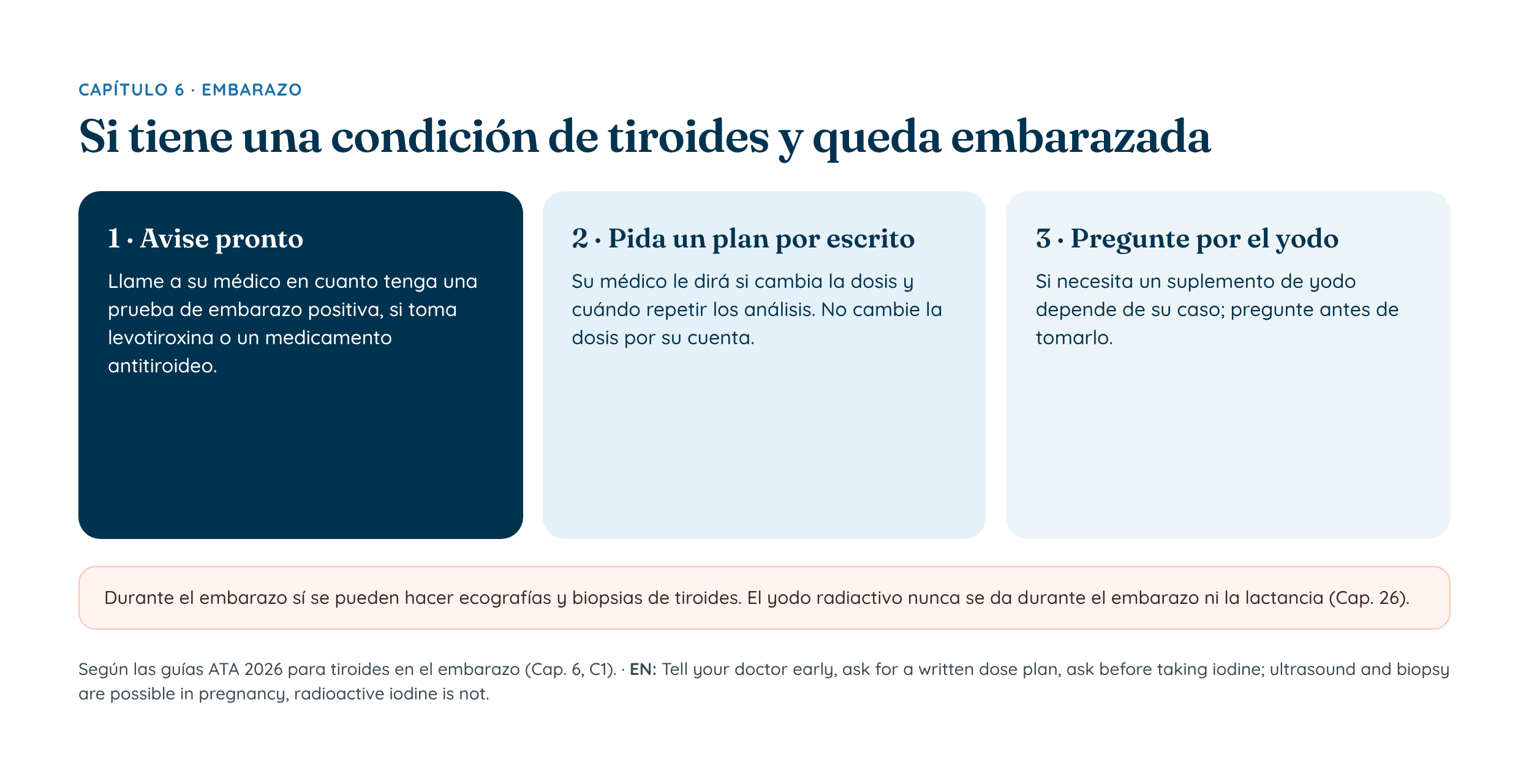
If you are pregnant or planning a pregnancy, talk with your doctor before changing any thyroid medicine.
Isabel, 31 (a fictitious patient), had taken levothyroxine since college. When her pregnancy test turned positive, her first call was to her mother; her second, on her endocrinologist’s advice, was to the clinic. “They told me to call the day I found out,” she said. “I didn’t know why until they explained.”
Why the thyroid matters in pregnancy
Thyroid problems before, during and after pregnancy are common and can affect both mother and baby [1]. In early pregnancy the baby depends on the mother’s thyroid hormone, and pregnancy itself changes how the thyroid works and how test results are read [1][2]. In 2026 the American Thyroid Association published updated recommendations covering the whole journey, from trying to conceive to breastfeeding [1].
If you already take levothyroxine
Most women who take levothyroxine need a higher dose once they are pregnant. Contact your doctor as soon as your pregnancy is confirmed so your levels can be checked and your dose adjusted. Ideally, ask before pregnancy for a written plan that says what to do the day your test turns positive. The same applies if you take medicine for an overactive thyroid. Thyroid tests are usually repeated regularly during pregnancy [1].
Hypothyroidism and antibodies
The guideline addresses when to test, how to interpret results in pregnancy, and what to do about mild thyroid changes and positive thyroid antibodies [1]. Much of the evidence in this area is still of low to moderate quality, which is why recommendations are individualized [1].
Hyperthyroidism and Graves’ disease
An overactive thyroid in pregnancy needs specialist care. The choice and timing of antithyroid medicine change during pregnancy, and radioactive iodine is not used while pregnant [1][3]. Women with Graves’ disease, even if treated in the past, should tell their obstetrician, because antibodies can affect the baby (Chapter 5).
Iodine
The baby’s brain development depends on iodine. An iodine supplement is mainly suggested for women at risk of low iodine, for example because of where they live, a restricted diet or a condition that affects absorption; ask your doctor whether you need one [1]. More is not better: avoid kelp and high-dose iodine supplements (Chapter 7).
Nodules and thyroid cancer in pregnancy
A nodule found during pregnancy can usually be evaluated with ultrasound and, if needed, a needle biopsy; both are considered safe in pregnancy [1]. Radioactive iodine, by contrast, is never used while pregnant. Surgery is usually postponed until after delivery unless there is an urgent reason; when needed during pregnancy, it is often done in the second trimester. If you have been treated for thyroid cancer, pregnancy afterward is generally safe; see Chapter 39 [4].
After the baby: postpartum thyroiditis
In the months after delivery, some women develop inflammation of the thyroid that can cause a short overactive phase, an underactive phase, or both, and often resolves. Tiredness and mood changes after birth are easy to blame on a newborn, so mention them to your doctor [1].
Isabel’s pregnancy
Isabel’s dose was increased in the first weeks, and her levels were checked through each trimester. Her daughter was born healthy. “The plan made it simple,” she said. “Call early, test often.”
A head and neck surgeon experienced in thyroid and voice care can help.
Sources
- Korevaar TIM, Leung AM, Alexander EK, et al. American Thyroid Association 2026 Guidelines for Thyroid Disease in Preconception, Pregnancy, and Postpartum. Thyroid. 2026;36(5):481-544. doi:10.1177/10507256261445624 PubMed PMID 42219800
- Alexander EK, et al. 2017 Guidelines of the American Thyroid Association for the Diagnosis and Management of Thyroid Disease During Pregnancy and the Postpartum. Thyroid. 2017;27(3):315-389. doi:10.1089/thy.2016.0457 PubMed PMID 28056690
- Ross DS, et al. 2016 American Thyroid Association Guidelines for Hyperthyroidism and Other Causes of Thyrotoxicosis. Thyroid. 2016;26(10):1343-1421. doi:10.1089/thy.2016.0229 PubMed PMID 27521067
- Moon S, et al. Risk of Adverse Pregnancy Outcomes in Young Women with Thyroid Cancer: A Systematic Review and Meta-Analysis. Cancers. 2022;14(10):2382. doi:10.3390/cancers14102382 PubMed PMID 35625995
This guide is for general education only. It does not diagnose conditions or replace a medical evaluation. Talk with your own doctor about your situation. In an emergency, call 911 now (in Puerto Rico or the United States; elsewhere, your local emergency number).