Thyroid myths, diets and supplements: what the evidence says
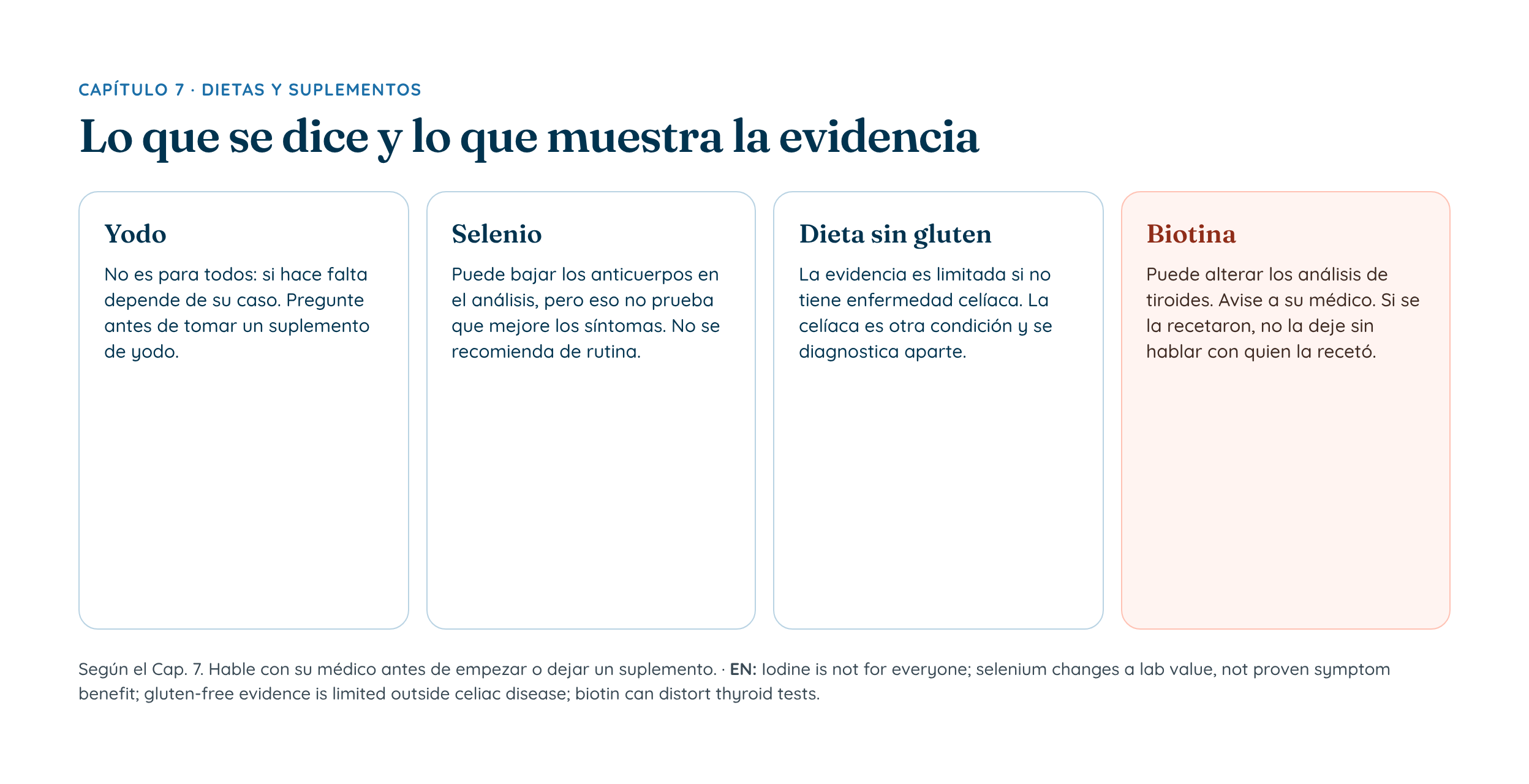
Tell your doctor about every supplement you take.
Rosa, 48 (a fictitious patient), had a cabinet full of bottles: a “thyroid support” blend, kelp tablets, a hair-and-nails biotin gummy. She had also cut out gluten after watching a video. When her lab results came back confusing, her doctor asked her to bring every bottle to the next visit.
Myth: “More iodine helps a sluggish thyroid”
Iodine is essential, and deficiency causes goiter and hypothyroidism [2]. But where people already get enough iodine, extra iodine does not boost the thyroid. In people with nodular thyroids, a sudden increase in iodine can trigger an overactive thyroid, and higher intake is linked to small increases in mild hypothyroidism and thyroid autoimmunity [2]. Kelp and seaweed supplements can contain large and variable amounts. Ordinary iodized salt and a normal diet are enough for most people.
Myth: “Biotin is harmless”
Biotin is safe for most people, but it can interfere with some lab tests and make thyroid results look abnormal, even mimicking Graves’ disease, when nothing is wrong [1]. Tell your doctor and the lab if you take it (Chapter 3). If a doctor prescribed biotin for a medical condition, do not stop it without talking to the doctor who prescribed it and the one who ordered your test.
Myth: “Natural desiccated thyroid is better than levothyroxine”
Thyroid extracts from animal glands contain both T4 and T3. The ATA reviewed these, as well as combination T4/T3 pills and compounded hormones, and found no consistently strong evidence that they work better than levothyroxine, which remains the standard [3]. Some people prefer them; any change should be made with your doctor, with careful monitoring.
Myth: “‘Thyroid support’ supplements are a gentle natural option”
Products sold as “thyroid support” are not regulated like medicines, and their contents can vary; some may contain substances that affect the thyroid or interfere with your prescribed treatment. Bring them to your appointment.
Gluten-free diets
If you have celiac disease, a gluten-free diet is essential; celiac disease is more common in people with autoimmune thyroid disease. For people with Hashimoto’s without celiac disease, the evidence is thin: a 2025 review found only three small trials, with no clear effect on thyroid function and conflicting antibody results [5]. An earlier review suggested possible benefit, mainly in people with gluten-related conditions, but concluded the evidence is not enough to recommend it to everyone [6]. If you want to try it, talk to your doctor about testing for celiac disease first.
Selenium
Selenium is a trace mineral the thyroid uses. In trials of people with Hashimoto’s, selenium supplements modestly lowered antibody levels and, in people not taking thyroid hormone, TSH; they did not change thyroid hormone levels [4]. Lower antibody numbers are a lab change; they have not been shown to make people feel better, so selenium is not routinely recommended. Selenium is not a replacement for treatment, and too much can be harmful. Ask your doctor before starting it.
“Adrenal fatigue”
This term is common online but is not a recognized medical diagnosis. Persistent tiredness deserves a proper evaluation for real causes, including thyroid problems, anemia, sleep disorders and depression.
Coffee, food and levothyroxine
Food, coffee and some supplements (calcium, iron) can reduce how much levothyroxine you absorb [1]. The key is consistency: take it the same way every day, and keep it apart from those items, as your doctor advises (Chapter 4).
Rosa’s cabinet
Rosa’s doctor found that her “thyroid support” blend and biotin were the likely reasons for her confusing results. She stopped them, kept her levothyroxine routine steady, and her levels stabilized. “I thought natural meant safe,” she said. “Now I check with my doctor first.”
A head and neck surgeon experienced in thyroid and voice care can help.
Sources
- Al-Bahadili H, et al. The Complex Web of Interferences With Thyroid Function Tests. Endocr Pract. 2025;31(1):92-101. doi:10.1016/j.eprac.2024.10.007 PubMed PMID 39477092
- Zimmermann MB, Boelaert K. Iodine deficiency and thyroid disorders. Lancet Diabetes Endocrinol. 2015;3(4):286-295. doi:10.1016/S2213-8587(14)70225-6 PubMed PMID 25591468
- Jonklaas J, et al. Guidelines for the Treatment of Hypothyroidism (ATA Task Force). Thyroid. 2014;24(12):1670-1751. doi:10.1089/thy.2014.0028 PubMed PMID 25266247
- Huwiler VV, et al. Selenium Supplementation in Patients with Hashimoto Thyroiditis: A Systematic Review and Meta-Analysis of Randomized Clinical Trials. Thyroid. 2024;34(3):295-313. doi:10.1089/thy.2023.0556 PubMed PMID 38243784
- Araújo EMQ, et al. Effects of Gluten-Free Diet in Non-Celiac Hashimoto’s Thyroiditis: A Systematic Review and Meta-Analysis. Nutrients. 2025;17(21):3437. doi:10.3390/nu17213437 PubMed PMID 41228508
- Piticchio T, et al. Effect of gluten-free diet on autoimmune thyroiditis progression in patients with no symptoms or histology of celiac disease: a meta-analysis. Front Endocrinol. 2023;14:1200372. doi:10.3389/fendo.2023.1200372 PubMed PMID 37554764
This guide is for general education only. It does not diagnose conditions or replace a medical evaluation. Talk with your own doctor about your situation. In an emergency, call 911 now (in Puerto Rico or the United States; elsewhere, your local emergency number).