Thyroid nodules: what to know when they find one
Case of a fictitious patient: Lucy, 42, went to the emergency room after a minor car accident. The CT scan of her neck was normal, except for one line at the bottom of the report: “incidental 1.8 cm thyroid nodule.” She spent that night searching online and convinced herself she had cancer. Six weeks later, after an ultrasound and a biopsy, she learned what most people with a nodule learn: it was benign.
What a nodule is
A thyroid nodule is a lump or growth within the thyroid gland. Some are solid, some are filled with fluid (cysts), and some are a mix. Many people have more than one.
Very common, and usually harmless
Thyroid nodules are extremely common. Studies pooling data from millions of people found that about 1 in 4 adults has at least one. Nodules are more common in women, in older people and in people with higher body weight. [2] Most nodules are benign. Many are found by chance on scans done for other reasons, and over the years the nodules found have tended to be smaller as more imaging is done [4]. That is one reason U.S. preventive guidelines advise against ultrasound screening of people who have no symptoms or lumps; what to do with a nodule depends on your history, TSH, the ultrasound appearance and size.
Most nodules are benign (not cancer). In a large study that followed nearly 1,000 people with benign-appearing nodules for 5 years: [3]
- Most nodules did not grow significantly.
- About 1 in 5 people saw their nodules shrink on their own.
- Cancer was found in only 0.3% of the original nodules.
When a nodule deserves a closer look
Tell your doctor promptly if you notice:
- A lump that is growing quickly
- Hoarseness or a voice change that does not go away
- Trouble swallowing or breathing
- A hard lump that does not move
- Swollen lymph nodes in the neck
- A history of radiation to the head or neck in childhood, or a family history of thyroid cancer
The usual steps after a nodule is found
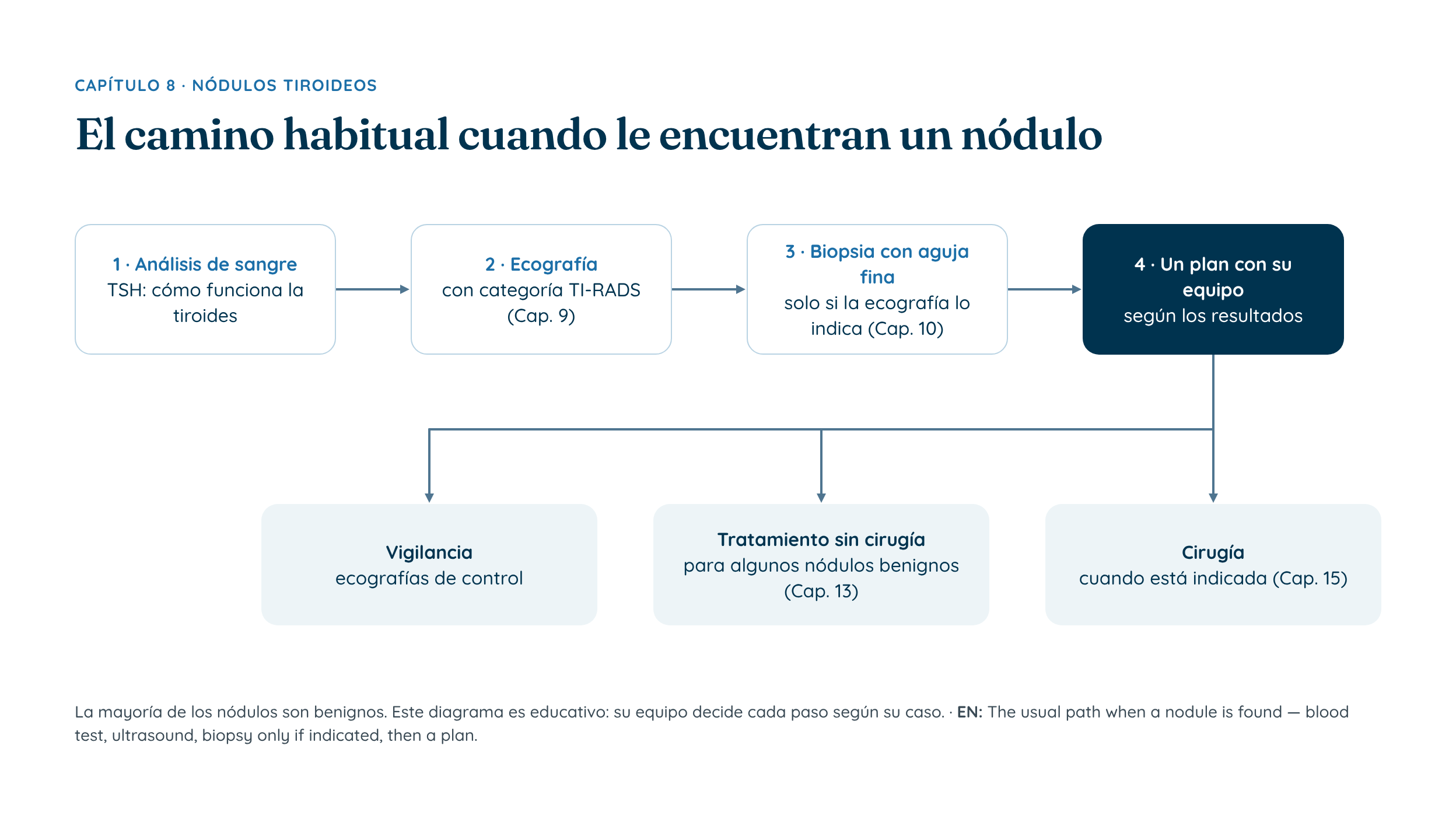
Guidelines lay out a step-by-step evaluation: [1]
- A blood test (TSH) to check how the thyroid is working. If TSH is low (an overactive thyroid), a thyroid scan may be done first to show whether the nodule is “hot” (making hormone), before deciding whether it needs a biopsy. Hot nodules are rarely cancer. During pregnancy this scan is not used, so the plan is different (Chapter 6).
- A thyroid ultrasound to look at the nodule’s size and features. Radiologists often use a scoring system called TI-RADS (Chapter 9).
- A fine-needle biopsy if the ultrasound features and size call for it (Chapter 10). Many nodules do not need a biopsy at all.
- A plan: most benign nodules are simply followed with occasional ultrasounds. Some are treated if they cause symptoms (Chapters 12 and 13). Surgery is reserved for suspicious or cancerous nodules, or for large nodules causing problems (Chapter 14).
Questions to ask
- Is my thyroid working normally (TSH)?
- What does the ultrasound show, and what is the TI-RADS category?
- Do I need a biopsy? Why or why not?
- If not, when should I have my next ultrasound?
Key points
- About 1 in 4 adults has a thyroid nodule, and most are benign.
- Most benign nodules stay the same size or shrink over years.
- An ultrasound, not the nodule’s mere presence, decides whether a biopsy is needed.
- Watch for warning signs such as rapid growth, voice change, or trouble swallowing or breathing.
A head and neck surgeon experienced in thyroid and voice care can help.
Sources
- Haugen BR, et al. 2015 American Thyroid Association Management Guidelines for Adult Patients with Thyroid Nodules and Differentiated Thyroid Cancer. Thyroid. 2016. doi:10.1089/thy.2015.0020 PubMed PMID 26462967
- Mu C, et al. Mapping global epidemiology of thyroid nodules among general population. Front Oncol. 2022. doi:10.3389/fonc.2022.1029926 PubMed PMID 36439513
- Durante C, et al. The natural history of benign thyroid nodules. JAMA. 2015. doi:10.1001/jama.2015.0956 PubMed PMID 25734734
- Mann et al. JAMA Otolaryngol Head Neck Surg. 2025. doi:10.1001/jamaoto.2024.3623 PubMed PMID 39446361
This guide is for general education only. It does not diagnose conditions or replace a medical evaluation. Talk with your own doctor about your situation. In an emergency, call 911 now (in Puerto Rico or the United States; elsewhere, your local emergency number).