"Indeterminate" biopsy results: what they mean and what comes next
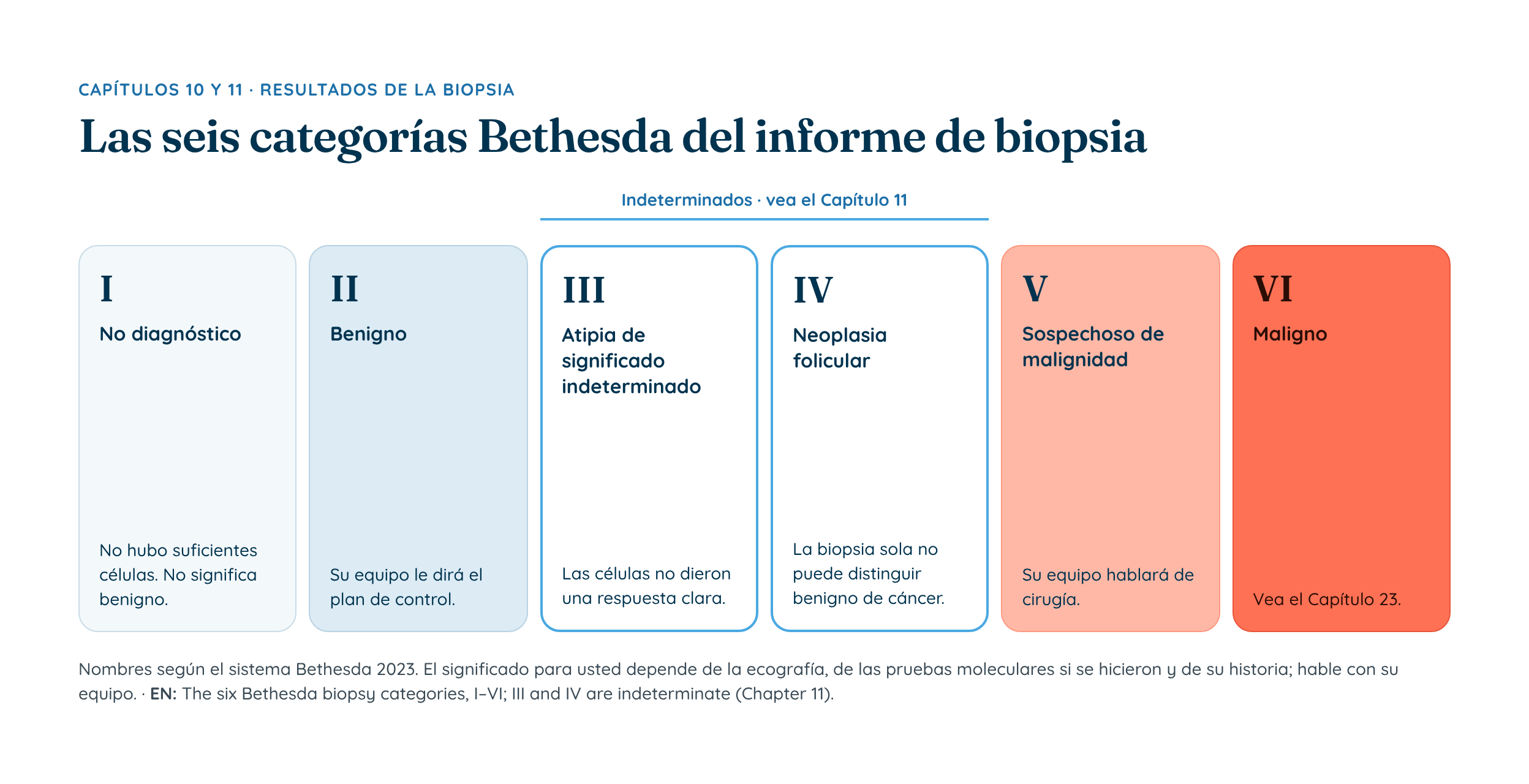
Case of a fictitious patient: Marta’s biopsy report said “Bethesda III, atypia of undetermined significance.” She read it as “they don’t know, so it must be bad.” Her surgeon explained it differently: “It means the cells didn’t give us a clear answer. We have good ways to get one, and many people in your situation avoid surgery.”
What “indeterminate” means
Most thyroid biopsies give a clear answer: benign or cancer. But some results land in the middle. In the Bethesda system these are [1]:
- Category III: atypia of undetermined significance (AUS). Some cells look a little unusual, but not enough to call them suspicious.
- Category IV: follicular neoplasm. The cells grow in a pattern that could belong to a benign growth (adenoma) or a cancer. The difference is whether the growth has invaded its capsule or blood vessels, which can only be seen when the whole nodule is removed and examined.
Most indeterminate nodules turn out to be benign, but some are cancer, so they need a plan [1][2].
Your options
1. Repeat the biopsy. For category III, a repeat biopsy is one reasonable option and sometimes gives a clearer result. It is less helpful for category IV, because the answer there depends on examining the whole nodule. It is not a required first step for everyone [1][7].
2. Molecular testing. The cells from the biopsy (sometimes from the same sample) are tested for genetic changes or gene-expression patterns linked to cancer. Common tests include Afirma, ThyroSeq and ThyGeNEXT/ThyraMIR [3][4].
- A “negative” or “benign” molecular result means a lower chance of cancer, but it does not completely rule cancer out. How reassuring it is depends on how often cancer is found in similar nodules at your center (the local pretest risk). Many patients can then be followed with ultrasound instead of surgery. Across many studies, molecular testing helped about half to two-thirds of patients avoid an operation [3][6].
- A “positive” or “suspicious” result raises the chance of cancer and usually leads to surgery. Some results (for example, a BRAF mutation) also help plan how much surgery to do.
- These tests are good but not perfect, and studies of them have limitations. Your doctor will interpret the result together with your ultrasound and other factors [5].
3. Diagnostic lobectomy. Removing the half of the thyroid that contains the nodule gives a definite answer. If it is benign, nothing more is needed. Many people do not need thyroid hormone pills after a lobectomy. If it is cancer, the lobectomy may be all the treatment needed, or more may be recommended (Chapter 15).
How to decide
The right path depends on the category, how the nodule looks on ultrasound, its size, your symptoms, your preferences, and whether molecular testing is available and covered. Surveillance, repeat biopsy, molecular testing and lobectomy are all reasonable in the right situation, and the usual choice differs between category III and IV [2][7]. Some nodules removed for an indeterminate result turn out to be NIFTP, a very low-risk tumor; that label can only be given after the whole nodule is examined under the microscope.
Questions to ask
- Is my result category III or IV?
- Would a repeat biopsy help?
- Is molecular testing an option? Which test, and is it covered by my insurance?
- If I have surgery, would it be a lobectomy?
Key points
- “Indeterminate” means unclear, not cancer.
- Options include repeat biopsy, molecular testing and diagnostic lobectomy.
- Molecular testing helps many people avoid surgery, though a negative result does not completely rule out cancer.
- Decisions combine the biopsy, ultrasound and your preferences.
A head and neck surgeon experienced in thyroid and voice care can help.
Sources
- Ali SZ, et al. The 2023 Bethesda System for Reporting Thyroid Cytopathology. Thyroid. 2023;33(9):1039-1044. doi:10.1089/thy.2023.0141 PubMed PMID 37427847
- Haugen BR, et al. 2015 American Thyroid Association Management Guidelines for Adult Patients with Thyroid Nodules and Differentiated Thyroid Cancer. Thyroid. 2016;26(1):1-133. doi:10.1089/thy.2015.0020 PubMed PMID 26462967
- Chowdhury R, et al. Impact of Molecular Testing on Surgical Decision-Making in Indeterminate Thyroid Nodules: A Systematic Review and Meta-Analysis of Recent Advancements. Cancers (Basel). 2025;17(7):1156. doi:10.3390/cancers17071156 PubMed PMID 40227659
- Silaghi CA, et al. Thyroseq v3, Afirma GSC, and microRNA Panels Versus Previous Molecular Tests in the Preoperative Diagnosis of Indeterminate Thyroid Nodules: A Systematic Review and Meta-Analysis. Front Endocrinol. 2021;12:649522. doi:10.3389/fendo.2021.649522 PubMed PMID 34054725
- DiGennaro C, et al. Assessing Bias and Limitations of Clinical Validation Studies of Molecular Diagnostic Tests for Indeterminate Thyroid Nodules: Systematic Review and Meta-Analysis. Thyroid. 2022;32(10):1144-1157. doi:10.1089/thy.2022.0269 PubMed PMID 35999710
- Cortes S, et al. Integration of AI-driven ultrasound and molecular testing to improve diagnosis of indeterminate thyroid nodules. Front Endocrinol. 2026;17:1764495. doi:10.3389/fendo.2026.1764495 PubMed PMID 42856861
- Durante C, et al. 2023 European Thyroid Association Clinical Practice Guidelines for thyroid nodule management. Eur Thyroid J. 2023;12(5):e230067. doi:10.1530/ETJ-23-0067 PubMed PMID 37358008
This guide is for general education only. It does not diagnose conditions or replace a medical evaluation. Talk with your own doctor about your situation. In an emergency, call 911 now (in Puerto Rico or the United States; elsewhere, your local emergency number).