Goiter: when an enlarged thyroid needs attention
Case of a fictitious patient: For years, Ramón’s collar size kept creeping up. He blamed weight gain. Then he started waking up at night short of breath, and he could no longer lie flat to sleep. A CT scan showed his thyroid had grown down behind his breastbone, pressing on his windpipe. After surgery, he said the first thing he noticed was simple: “I can sleep lying down again.”
What a goiter is
A goiter is an enlarged thyroid gland. It can be:
- Diffuse: the whole gland is evenly enlarged.
- Multinodular: the gland is enlarged and full of nodules (the most common type in adults).
- Substernal (retrosternal): part of the goiter has grown down into the chest, behind the breastbone.
A goiter can make normal amounts of thyroid hormone, too much (a “toxic” goiter, see Chapter 5), or too little.
Symptoms
Many goiters cause no symptoms and are found by chance. When a goiter presses on nearby structures, it can cause [1]:
- A visible or tight neck, or collars that no longer fit
- Trouble swallowing, or a sense of food sticking
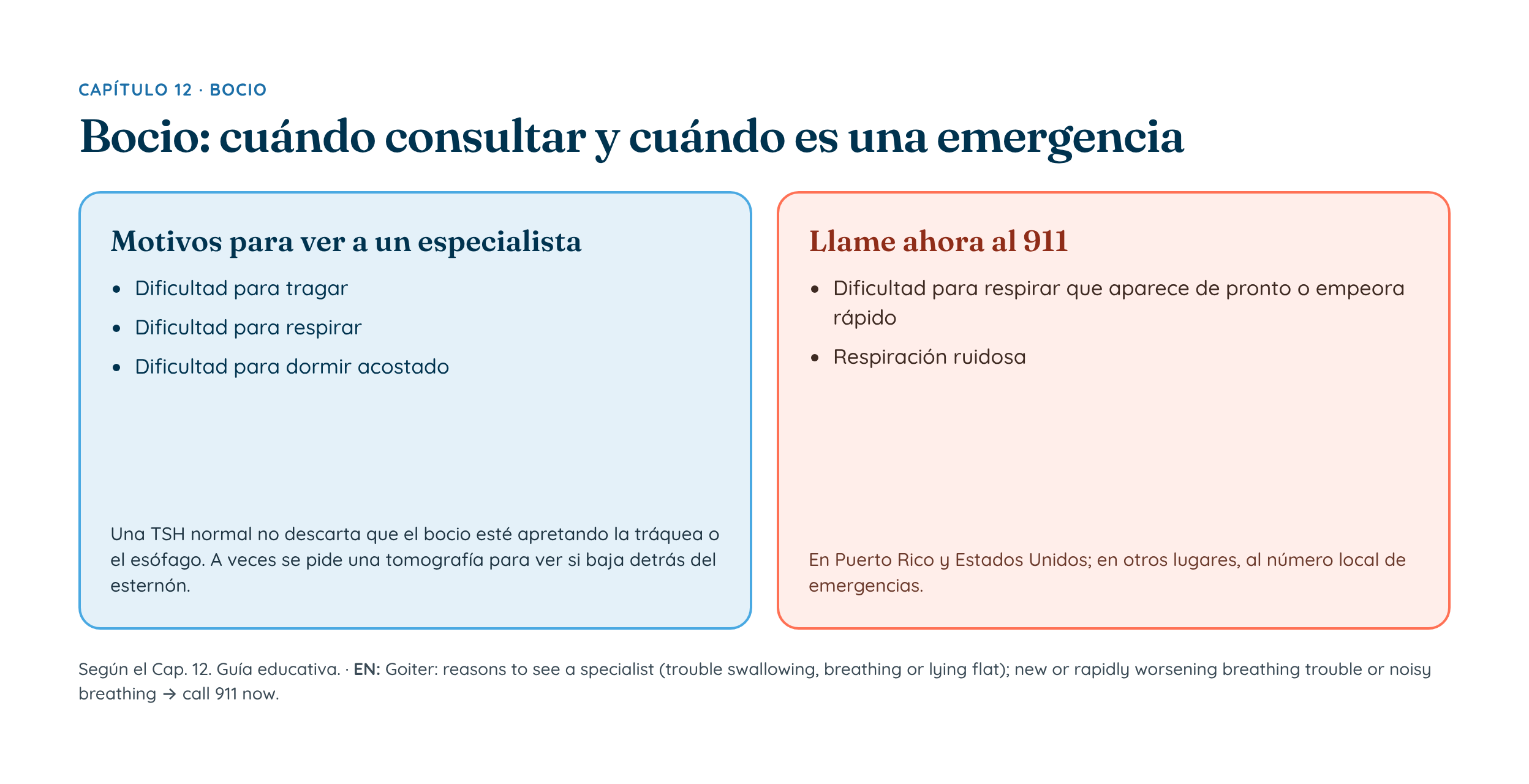
- Shortness of breath, noisy breathing, or trouble breathing when lying flat
- Coughing or a choking feeling
- Hoarseness, which always deserves an exam (Chapter 31)
These pressure symptoms are more common with goiters that extend into the chest [1]. In one large review, about two-thirds of people having surgery for a substernal goiter had pressure symptoms, while more than a quarter had none [3].
How a goiter is evaluated
- Blood tests (TSH) to check thyroid function. A normal TSH does not rule out pressure from the goiter.
- A thyroid ultrasound to look at the nodules (Chapter 9), with biopsy of any suspicious ones (Chapter 10)
- For large or substernal goiters, a CT scan to see how far the goiter extends and whether it narrows the windpipe; ultrasound cannot see behind the breastbone, while CT shows that anatomy clearly for planning surgery
- A vocal cord exam before surgery (Chapter 31)
Treatment options
Watchful waiting. A goiter that causes no symptoms and has no suspicious nodules can often be followed.
Surgery. Surgery is recommended for goiters that cause pressure symptoms [1]. Medicines that try to shrink a goiter have limited, short-lived effects [1]. After thyroidectomy, breathing and swallowing usually improve [1][2]. Even when a goiter extends into the chest, most can be removed through a neck incision. In a review of more than 15,000 operations, about 9 in 10 needed only a neck incision, and about 1 in 10 needed an additional chest approach [3].
Large goiter surgery needs an experienced surgical and anesthesia team, because of the risks of bleeding, airway problems, voice nerve injury and temporary low calcium [1].
Non-surgical options. For selected goiters or single large benign nodules, radiofrequency ablation or radioactive iodine may be options (Chapters 13 and 5).
A note about cancer
In studies of removed substernal goiters, cancer was found in about 1 in 8 [3]. This figure comes from people who had surgery, so it does not apply to every goiter, but it is one reason suspicious nodules in a goiter are evaluated carefully.
Questions to ask
- Does my goiter press on my windpipe or esophagus?
- Does it extend into my chest? Do I need a CT scan?
- Do any nodules need a biopsy?
- If I need surgery, can it be done through the neck?
Key points
- A goiter is an enlarged thyroid. Many cause no symptoms.
- Trouble breathing, swallowing or lying flat are reasons to see a specialist.
- Surgery is the main treatment for goiters that cause pressure symptoms, and it usually relieves them.
- Most goiters, even those reaching into the chest, can be removed through the neck.
A head and neck surgeon experienced in thyroid and voice care can help.
Sources
- Chen AY, et al. American Thyroid Association statement on optimal surgical management of goiter. Thyroid. 2014;24(2):181-189. doi:10.1089/thy.2013.0291 PubMed PMID 24295043
- Sorensen JR, et al. The Impact of Goiter and Thyroid Surgery on Goiter Related Esophageal Dysfunction. A Systematic Review. Front Endocrinol. 2018;9:679. doi:10.3389/fendo.2018.00679 PubMed PMID 30524374
- Cheung MH, et al. Surgical Management of Substernal Goiters: A Systematic Review and Meta-Analysis. Laryngoscope. 2026;136(2):575-585. doi:10.1002/lary.70087 PubMed PMID 40856014
This guide is for general education only. It does not diagnose conditions or replace a medical evaluation. Talk with your own doctor about your situation. In an emergency, call 911 now (in Puerto Rico or the United States; elsewhere, your local emergency number).