Treating thyroid nodules without surgery
Case of a fictitious patient: Sofía had a benign 4-centimeter nodule. Two biopsies confirmed it was not cancer, but it was visible every time she looked in the mirror, and it made swallowing uncomfortable. She did not want a scar or to lose half her thyroid. After radiofrequency ablation in the office, the nodule gradually shrank over the following months. “I stopped wearing scarves,” she said.
Not every nodule needs surgery. For benign nodules, there are good options that avoid an operation.
Option 1: Watchful waiting
Most benign nodules do not grow much, and some shrink on their own [5]. If a benign nodule causes no symptoms and does not bother you, periodic ultrasound follow-up is often all that is needed.
Option 2: Radiofrequency ablation (RFA)
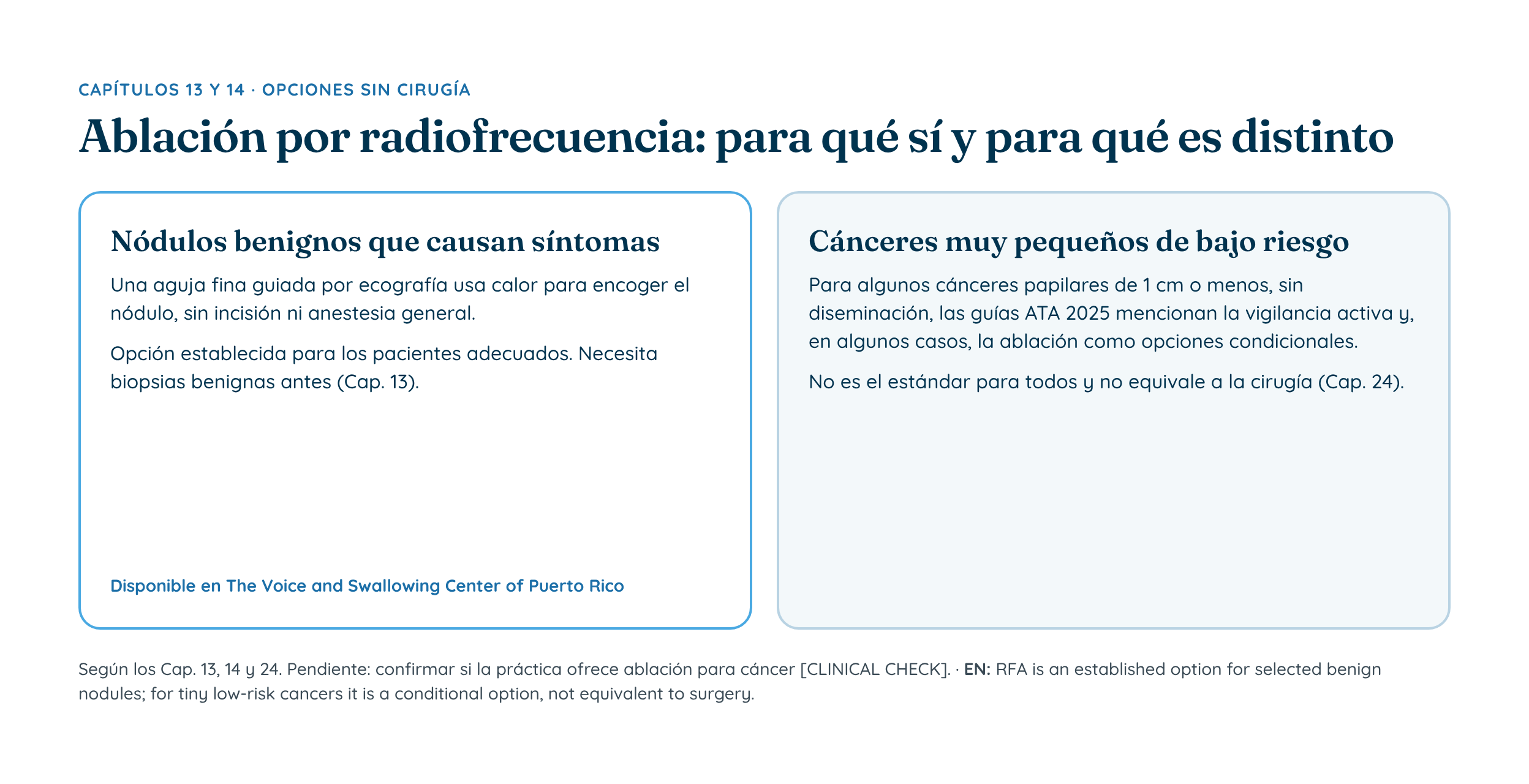
RFA uses a thin needle, guided by ultrasound, to deliver heat that destroys the nodule tissue from the inside. Over the following months, the body absorbs the treated tissue and the nodule shrinks [1].
Who may be a candidate. RFA is mainly used for nodules that [1][7]:
- Have been confirmed benign after a full evaluation in which the ultrasound and biopsy results agree (this sometimes means two biopsies)
- Cause symptoms (pressure, trouble swallowing, discomfort) or a visible lump that bothers the patient
- In selected cases, are overactive (“hot”) nodules making too much thyroid hormone
What to expect. RFA is usually done in the office under local anesthesia, without an incision or general anesthesia. Most people return to normal activities within a day or two. The rest of the thyroid keeps working, so most people do not need thyroid hormone pills.
How well it works. In studies following patients for 3 years or more [2][3]:
- Nodules treated with RFA shrank by about 80% on average.
- Symptoms and cosmetic concerns improved significantly.
- Some nodules grew back (about 7 in 100) and could be treated again.
- Major complications were uncommon (about 2 in 100 in the largest review), and the reduction was long-lasting.
The international consensus on RFA, developed by thyroid, surgical and radiology societies including the Latin American Thyroid Society, sets best practices for evaluation, technique and follow-up [1].
Option 3: Ethanol ablation for cysts
For nodules that are mostly fluid (cysts), the fluid can be drained and a small amount of alcohol injected to make the cyst scar down. It shrinks cysts by about 84% on average, works about as well as RFA for these nodules, and is very safe. It is considered a first-line treatment for benign thyroid cysts [4].
What about uncertain or cancerous nodules?
Ablation is mainly for benign nodules. Its use for small low-risk cancers is covered in Chapter 24. For indeterminate nodules, ablation is still being studied, mostly in people who cannot or do not want to have surgery; it is not part of routine care and needs careful follow-up [6].
Questions to ask
- Is my nodule confirmed benign? Do I need a second biopsy?
- Am I a candidate for RFA or ethanol ablation?
- How much shrinkage can I expect, and how long will it take?
- What follow-up will I need?
Key points
- Many benign nodules only need monitoring.
- RFA shrinks benign nodules by about 80%, without an incision, and preserves thyroid function. Nodules can regrow, and a second treatment is sometimes needed.
- Ethanol ablation is a first-line treatment for benign cysts.
- Our practice offers RFA. Ask whether you are a candidate.
A head and neck surgeon experienced in thyroid and voice care can help.
Sources
- Orloff LA, et al. Radiofrequency ablation and related ultrasound-guided ablation technologies for treatment of benign and malignant thyroid disease: An international multidisciplinary consensus statement. Head Neck. 2022;44(3):633-660. doi:10.1002/hed.26960 PubMed PMID 34939714
- Zhao X, et al. The long-term effects of thermal ablation for benign thyroid nodules: a systematic review and meta-analysis. Eur Radiol. 2025;35(10):6089-6100. doi:10.1007/s00330-025-11543-y PubMed PMID 40214733
- Xu X, et al. Five-year follow-up results of thermal ablation for benign thyroid nodules: Systematic review and meta-analysis. Am J Otolaryngol. 2024;45(1):104025. doi:10.1016/j.amjoto.2023.104025 PubMed PMID 37639985
- Yang CC, et al. Efficacy of Ethanol Ablation for Benign Thyroid Cysts and Predominantly Cystic Nodules: A Systematic Review and Meta-Analysis. Endocrinol Metab (Seoul). 2021;36(1):81-95. doi:10.3803/EnM.2020.833 PubMed PMID 33677930
- Durante C, et al. The natural history of benign thyroid nodules. JAMA. 2015;313(9):926-935. doi:10.1001/jama.2015.0956 PubMed PMID 25734734
- Lim H, et al. Efficacy and Safety of Thermal Ablation for Indeterminate Thyroid Nodules: A Systematic Review of the Literature and Meta-Analysis. Thyroid. 2025;35(7):748-762. doi:10.1089/thy.2024.0679 PubMed PMID 40658618
- Sinclair CF, et al. General Principles for the Safe Performance, Training, and Adoption of Ablation Techniques for Benign Thyroid Nodules: An American Thyroid Association Statement. Thyroid. 2023;33(10):1150-1170. doi:10.1089/thy.2023.0281 PubMed PMID 37642289
This guide is for general education only. It does not diagnose conditions or replace a medical evaluation. Talk with your own doctor about your situation. In an emergency, call 911 now (in Puerto Rico or the United States; elsewhere, your local emergency number).