Preparing for thyroid surgery
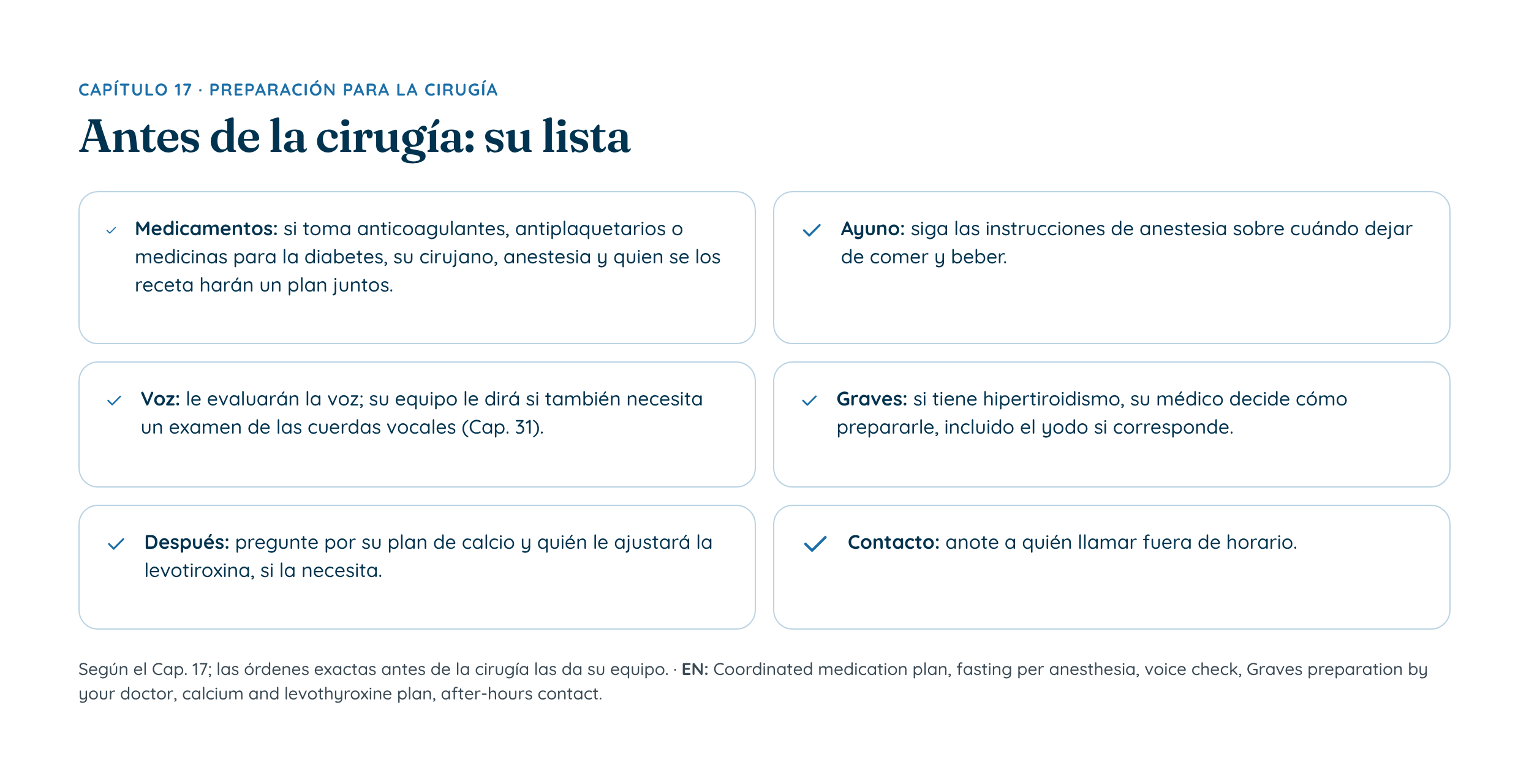
Good preparation makes thyroid surgery safer and recovery smoother. Most of it happens in the two to four weeks before your operation. This chapter walks you through what your surgical team will check, what you can do, and how to plan for the day and the first nights at home.
Your voice and vocal cord exam
Your surgeon should ask about your voice and record how it sounds before surgery. If your voice is already hoarse, if you have had surgery in your neck before, or if a cancer may be growing beyond the thyroid, national guidelines recommend a look at your vocal cords before the operation [1]. Many surgeons do this exam for every patient. It takes a few minutes in the office with a thin camera passed through the nose.
Why it matters: it shows whether both vocal cords move normally before surgery, which helps your surgeon plan and lets the anesthesia team prepare [1].
Blood tests
Your team will usually check your thyroid levels and, often, your calcium and vitamin D. Low vitamin D before a total thyroidectomy is linked to a higher chance of low calcium afterward, especially when the level is very low [2]. This is an association, not proof that everyone needs the same treatment; if your vitamin D is low, your doctor will decide whether to start a supplement before surgery. Low magnesium is another risk factor your team may check [3].
Your medicines
Bring a complete list of everything you take, including vitamins, herbs and supplements. Blood thinners (anticoagulants), antiplatelet medicines such as aspirin or clopidogrel, diabetes medicines and some supplements may need to be paused or adjusted. This needs a coordinated plan between your surgeon, the anesthesia team and the doctor who prescribed each medicine. Never stop or change one on your own.
If you have Graves’ disease or an overactive thyroid
Your thyroid levels need to be under control before surgery, usually with antithyroid medicine [5]. When appropriate, your doctor may also prescribe iodine drops for a short time before the operation; they can reduce blood flow to the thyroid and blood loss during surgery [4][5]. Whether you need them, and for how long, is decided by your doctors. Take them exactly as prescribed.
Practical planning
- Anesthesia instructions: follow the fasting and medicine instructions you receive from the anesthesia team exactly.
- A ride and a helper: you cannot drive yourself home. If you go home the same day, plan for an adult to stay with you the first night.
- Your calcium plan: know before surgery whether you will take calcium afterward and who to call if you feel tingling (see Chapter 20).
- Time off: most people return to desk work within one to two weeks; heavier work may need longer (see Chapter 19).
- Clothing: wear a button-front or loose-neck top so you do not pull clothing over your incision.
Your pre-surgery checklist
- ☐ Voice recorded; vocal cord exam done if recommended
- ☐ Blood tests done; vitamin D plan decided if low
- ☐ Medicine list reviewed; blood-thinner and diabetes-medicine plan confirmed
- ☐ Iodine drops started if prescribed (Graves’ disease)
- ☐ Anesthesia instructions received
- ☐ Ride home and overnight helper arranged
- ☐ Calcium plan and your surgical team’s after-hours contact written down
A head and neck surgeon experienced in thyroid and voice care can help.
Sources
- Chandrasekhar SS, et al. Clinical practice guideline: improving voice outcomes after thyroid surgery. Otolaryngol Head Neck Surg. 2013;148(6 Suppl):S1-S37. doi:10.1177/0194599813487301 PubMed PMID 23733893
- Lopera K, Sanabria A. Threshold-dependent risk of postoperative hypocalcemia in vitamin D-deficient patients undergoing total thyroidectomy: A meta-analysis. Surgery. 2025;182:109333. doi:10.1016/j.surg.2025.109333 PubMed PMID 40107090
- Chen Z, et al. Risk factors for postoperative hypocalcaemia after thyroidectomy: A systematic review and meta-analysis. J Int Med Res. 2021;49(3):300060521996911. doi:10.1177/0300060521996911 PubMed PMID 33779362
- Tsai CH, et al. Effects of Preoperative Iodine Administration on Thyroidectomy for Hyperthyroidism: A Systematic Review and Meta-analysis. Otolaryngol Head Neck Surg. 2019;160(6):993-1002. doi:10.1177/0194599819829052 PubMed PMID 30721111
- Ross DS, et al. 2016 American Thyroid Association Guidelines for Diagnosis and Management of Hyperthyroidism and Other Causes of Thyrotoxicosis. Thyroid. 2016;26(10):1343-1421. doi:10.1089/thy.2016.0229 PubMed PMID 27521067
This guide is for general education only. It does not diagnose conditions or replace a medical evaluation. Talk with your own doctor about your situation. In an emergency, call 911 now (in Puerto Rico or the United States; elsewhere, your local emergency number).