Complications after thyroid surgery: what to watch for
Thyroid surgery is very safe. In a national U.S. registry of more than 160,000 operations, only about 3 in 100 patients had a complication recorded by the registry in the first weeks [1]. Still, knowing what is normal and what is not lets you act quickly if something happens, and avoid an unnecessary trip to the emergency room if it doesn’t.
This chapter covers the three complications that matter most: low calcium, bleeding in the neck, and voice changes. It ends with a simple guide to when to rest, when to call, and when to go to the ER.
What is normal after surgery
Most people feel these in the first days and weeks. They are expected and improve on their own:
- A sore throat or scratchy voice for a few days, mostly from the breathing tube used during anesthesia.
- Mild swelling around the incision and a feeling of tightness when swallowing.
- Numbness of the skin just above or below the scar, which can last for months.
- A stiff neck and tired shoulders.
- Feeling more tired than usual for one to two weeks.
Low calcium: the most common complication
Four tiny glands called the parathyroids sit behind the thyroid. They control the calcium level in your blood. During surgery, your surgeon works carefully to find and protect them, and that care is the most important way to prevent long-term problems [6]. Even so, these glands can be stunned for a while after the operation, especially after removal of the whole thyroid.
Temporary low calcium is common after a total thyroidectomy; in one pooled analysis of randomized trials comparing surgical instruments, it occurred in about 11 to 15 of every 100 patients, depending on the technique [3]. Rates vary from team to team. It is much less common after removing only half the thyroid. In most people the glands recover within days to weeks. Long-term low parathyroid function is uncommon, at about 2 in 100 [4].
Signs of low calcium
- Tingling or numbness around the mouth, lips, fingertips or toes.
- Muscle cramps, especially in the hands, feet or legs.
- Hands or fingers that cramp or curl on their own.
How it is prevented and treated. Some surgeons give calcium, often with vitamin D, to every patient after a total thyroidectomy. Studies show this lowers the chance of symptoms [5]. Other surgeons check your blood levels and treat only if needed. Both approaches are safe and prevent serious problems [4]. Your surgeon will tell you which plan is yours.
If you notice tingling, take the calcium dose your surgeon prescribed and call the office. If symptoms are severe, or you feel chest tightness, trouble breathing or muscle spasms that don’t stop, go to the ER.
Low calcium is the most common reason patients return to the ER after going home the same day, and Hispanic patients make these visits more often [9]. Many of these visits can be avoided by knowing the signs early and having a clear plan with your surgeon.
Bleeding in the neck (hematoma)
A hematoma is a collection of blood under the incision. It happens in about 3 of every 100 operations, and fewer than 1 in 100 needs a return to the operating room [2]. When it is serious, it most often appears within the first hours after surgery, usually on the same day [1][2]. That is why you are watched closely before you go home.
Going home the same day is safe for carefully selected patients and does not increase complications [8]. Your surgical team decides whether that is right for you.
Voice changes
Two nerves that control the vocal cords run right next to the thyroid. Your surgeon identifies and protects them. About 1 in 10 patients has temporary weakness of one of these nerves, which can cause hoarseness, a weak or breathy voice, voice fatigue, or coughing when drinking thin liquids. Most of these improve over weeks to months. Longer-lasting voice problems happen in up to 1 in 25 [7].
If your voice is still not normal two weeks after surgery, tell your surgeon. National guidelines recommend checking the voice between two weeks and two months after surgery, and examining the vocal cords if anything has changed [7]. Effective treatments exist, from voice therapy to office procedures. Chapter 33 explains them.
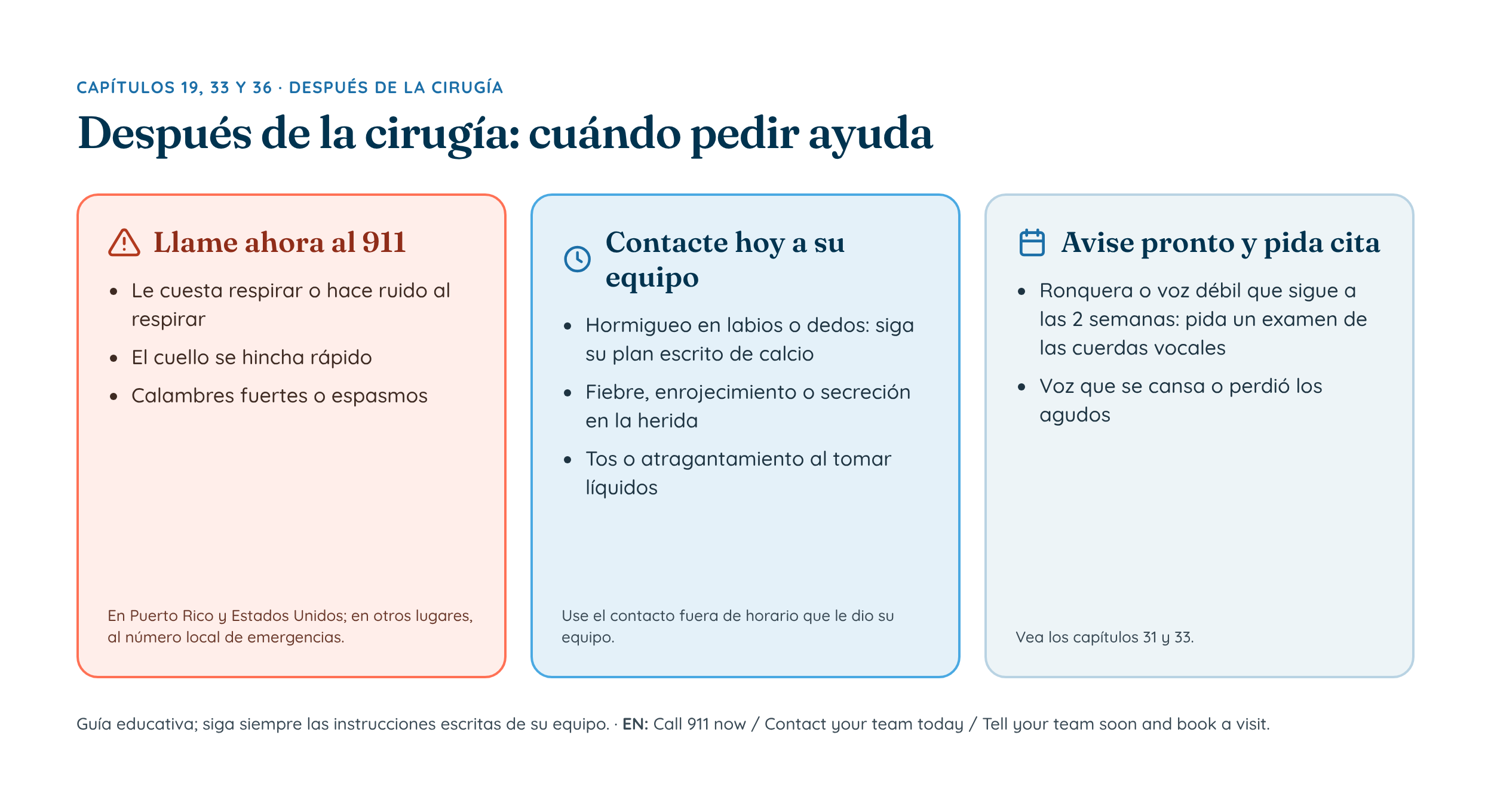
Noisy breathing or shortness of breath at rest is never normal after surgery: Call 911 now.
Infection
Wound infection is uncommon after thyroid surgery; in a large registry, superficial infections appeared at a median of about nine days after the operation [1]. Call your surgeon if the incision becomes red, hot, more painful, drains pus, or if you have a fever.
When to call and when to go
- Rest and watch: sore throat, mild swelling, skin numbness, neck stiffness, tiredness.
- Call your surgeon today: mild tingling around the mouth or fingers, hoarseness that is not improving after two weeks, redness or drainage at the incision, fever.
- ER or 911 now: rapidly growing neck swelling, trouble breathing or noisy breathing, inability to swallow saliva, severe muscle spasms, chest tightness.
Questions to ask before surgery
- Will I take calcium after surgery, or only if my levels drop?
- How will I know my calcium is safe after I go home?
- Who do I call after hours?
- Will my vocal cords be checked before and after surgery?
A head and neck surgeon experienced in thyroid and voice care can help.
Sources
- Fassas S, et al. Postoperative Complications After Thyroidectomy: Time Course and Incidence Before Discharge. J Surg Res. 2021;260:210-219. doi:10.1016/j.jss.2020.11.008 PubMed PMID 33360304
- Canu GL, et al. Risk factors for postoperative cervical haematoma in patients undergoing thyroidectomy: a retrospective, multicenter, international analysis (REDHOT study). Front Surg. 2023;10:1278696. doi:10.3389/fsurg.2023.1278696 PubMed PMID 37850042
- Cirocchi R, et al. Sutureless FOCUS harmonic scalpel versus clamp-and-tie techniques for thyroidectomy: a meta-analysis of 43 randomized controlled trials. Int J Surg. 2024;110(12):8083-8096. doi:10.1097/JS9.0000000000002113 PubMed PMID 39806747
- van Dijk SPJ, et al. Management of Postthyroidectomy Hypoparathyroidism and Its Effect on Hypocalcemia-Related Complications: A Meta-Analysis. Otolaryngol Head Neck Surg. 2024;170(2):359-372. doi:10.1002/ohn.594 PubMed PMID 38013484
- Sanabria A, et al. Meta-analysis of routine calcium/vitamin D3 supplementation versus serum calcium level-based strategy to prevent postoperative hypocalcaemia after thyroidectomy. Br J Surg. 2019;106(9):1126-1137. doi:10.1002/bjs.11216 PubMed PMID 31236917
- Koimtzis G, et al. The outcomes of parathyroid gland autotransplantation during thyroid surgery: a systematic review, meta-analysis and trial sequential analysis. Endocrine. 2025;87(1):27-38. doi:10.1007/s12020-024-04011-y PubMed PMID 39182014
- Chandrasekhar SS, et al. Clinical practice guideline: improving voice outcomes after thyroid surgery. Otolaryngol Head Neck Surg. 2013;148(6 Suppl):S1-S37. doi:10.1177/0194599813487301 PubMed PMID 23733893
- Hu QL, et al. Same-day discharge is not associated with increased readmissions or complications after thyroid operations. Surgery. 2020;167(1):117-123. doi:10.1016/j.surg.2019.06.054 PubMed PMID 31582306
- Visenio MR, et al. Emergency department use after outpatient thyroidectomy across three states. Surgery. 2024;175(1):41-47. doi:10.1016/j.surg.2023.09.027 PubMed PMID 37945478
This guide is for general education only. It does not diagnose conditions or replace a medical evaluation. Talk with your own doctor about your situation. In an emergency, call 911 now (in Puerto Rico or the United States; elsewhere, your local emergency number).