Life without a thyroid
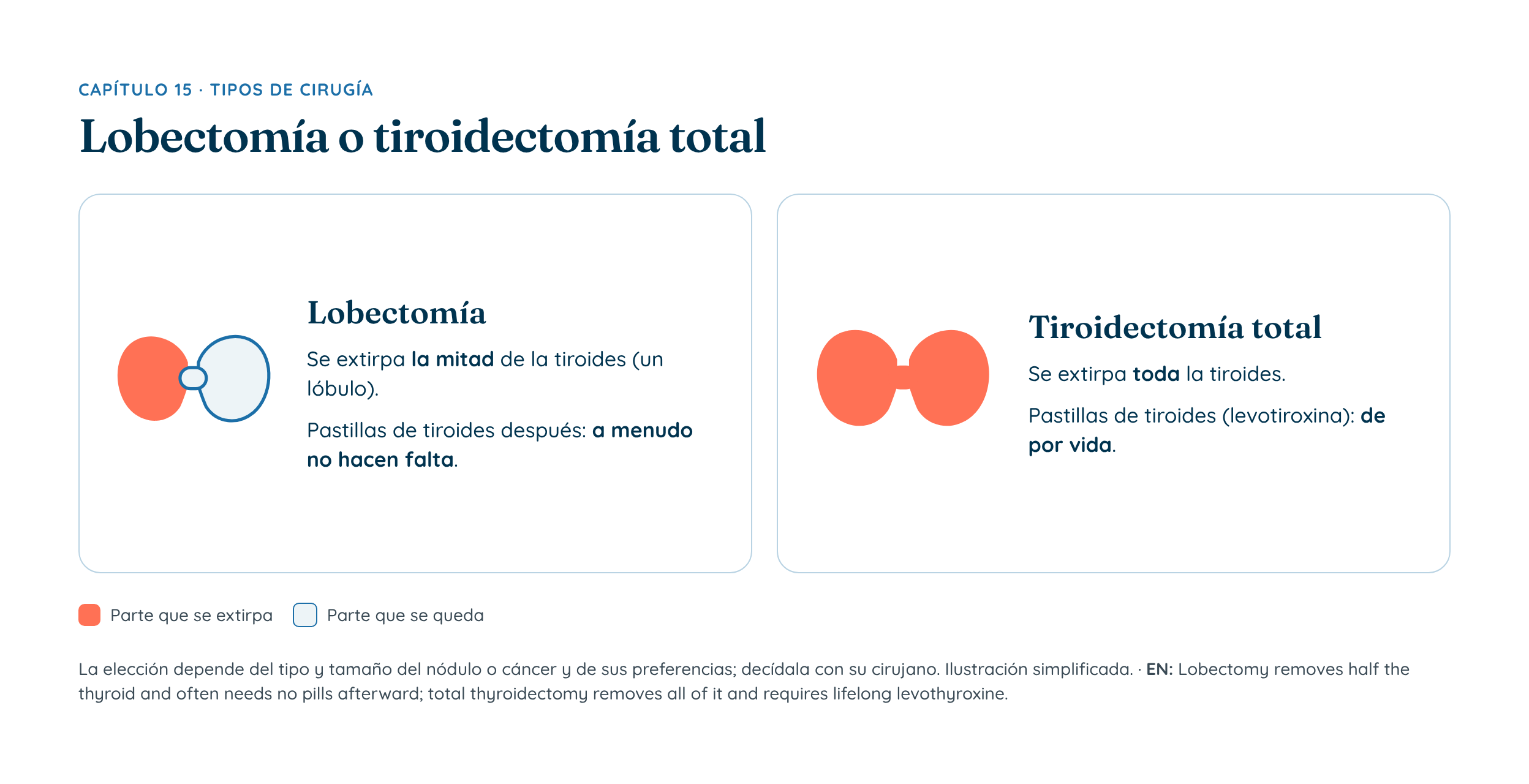
If your whole thyroid was removed, your body can no longer make thyroid hormone. The good news is that it is easy to replace, though you will need the replacement for life. A small pill taken once a day gives your body the same hormone your thyroid used to make, and most people feel and live completely normally on it.
Levothyroxine: the replacement hormone
Levothyroxine (brand names include Synthroid, Levoxyl, Unithroid and Tirosint) is identical to the main hormone the thyroid produces, called T4. Your body converts it to the active form, T3, as needed. National guidelines consider levothyroxine the standard treatment, and studies have not consistently shown that combination pills with T3, “natural” thyroid extracts or compounded hormones work better [1].
If only half your thyroid was removed, you may not need it at all. About 1 in 4 people do (see Chapter 15).
How to take it
Levothyroxine is sensitive to what is in your stomach. Taking it the same way every day matters more than the exact time.
- Empty stomach: take it with water, ideally 30 to 60 minutes before breakfast. Taking it at bedtime, at least a few hours after your last meal, is a good alternative [4][5].
- Keep it apart from calcium and iron: separate it from calcium, iron supplements and multivitamins with minerals by 3 to 4 hours [4]. This is especially important in the weeks after surgery, when many people take calcium.
- Watch coffee, fiber and grapefruit juice: espresso, high-fiber foods and grapefruit juice can reduce absorption [4]. If you drink coffee in the morning, wait before drinking it or switch to bedtime dosing.
- Tell your doctor about stomach medicines: antacids and acid-reducing medicines can affect how much you absorb [4].
- Stay consistent with your brand or generic. If your pharmacy changes the manufacturer, ask your doctor whether to recheck your levels.
Finding the right dose
Your starting dose is usually based on your weight. Several weeks later, a blood test measures your TSH, the signal your brain sends to the thyroid, to see whether the dose is right. It is normal to need one or two adjustments in the first months. Once stable, most people check their levels once or twice a year, and again after changes such as significant weight change, pregnancy, new medicines or getting older.
If you had thyroid cancer, your doctor may aim for a slightly different TSH depending on your cancer’s risk and how you responded to treatment [7]. Chapter 27 explains this.
| Too little hormone may feel like | Too much hormone may feel like |
|---|---|
| Tiredness, feeling cold, constipation, dry skin, low mood, weight gain | Racing heart, anxiety, trouble sleeping, shakiness, feeling hot, weight loss |
These symptoms are not specific, so a blood test is the only reliable way to know. Do not change your dose on your own.
Will I gain weight?
This is one of the most common worries. On average, people gain about 2 kg (4–5 pounds) in the years after a total thyroidectomy [2]. The gain is larger in people operated on for an overactive thyroid, because their metabolism was running too fast before surgery, and smaller after surgery for goiter or cancer [2]. People with thyroid nodules who did not have surgery gained a similar amount over the same time, which suggests much of this is ordinary weight change rather than the operation [3]. These are averages; they do not predict what will happen to any one person.
Pregnancy
If you are planning a pregnancy or become pregnant, tell your doctor right away. Your body needs more thyroid hormone in pregnancy, and your dose usually has to go up early; ask for a written plan for what to do as soon as your test is positive [6]. Chapter 6 explains more.
Questions to ask your doctor
- What dose am I starting, and when is my first blood test?
- What TSH range are you aiming for in my case?
- Who will manage my thyroid hormone long term?
A head and neck surgeon experienced in thyroid and voice care can help.
Sources
- Jonklaas J, et al. Guidelines for the Treatment of Hypothyroidism (ATA Task Force). Thyroid. 2014;24(12):1670-1751. doi:10.1089/thy.2014.0028 PubMed PMID 25266247
- Huynh CN, et al. Weight Gain After Thyroidectomy: A Systematic Review and Meta-Analysis. J Clin Endocrinol Metab. 2021;106(1):282-291. doi:10.1210/clinem/dgaa754 PubMed PMID 33106852
- Singh Ospina N, et al. Weight Changes After Thyroid Surgery for Patients with Benign Thyroid Nodules and Thyroid Cancer: Population-Based Study and Systematic Review and Meta-Analysis. Thyroid. 2018;28(5):639-649. doi:10.1089/thy.2017.0216 PubMed PMID 29631475
- Mana DL, Rizzo LFL. Challenges in the treatment of hypothyroidism: malabsorption and pseudo-malabsorption of levothyroxine. Medicina (B Aires). 2025;85(5):1064-1075. PubMed PMID 41109285
- Srivastava S, et al. A Crossover Study Evaluating Effect of Timing of Levothyroxine on Thyroid Hormone Status in Patients of Hypothyroidism. J Assoc Physicians India. 2018;66(9):37-40. PubMed PMID 31321928
- Korevaar TIM, Leung AM, Alexander EK, et al. American Thyroid Association 2026 Guidelines for Thyroid Disease in Preconception, Pregnancy, and Postpartum. Thyroid. 2026;36(5):481-544. doi:10.1177/10507256261445624 PubMed PMID 42219800
- Ringel MD, et al. 2025 American Thyroid Association Management Guidelines for Adult Patients with Differentiated Thyroid Cancer. Thyroid. 2025;35(8):841-985. doi:10.1177/10507256251363120 PubMed PMID 40844370
This guide is for general education only. It does not diagnose conditions or replace a medical evaluation. Talk with your own doctor about your situation. In an emergency, call 911 now (in Puerto Rico or the United States; elsewhere, your local emergency number).