Small thyroid cancers: is watching instead of operating safe?
Case of a fictitious patient: Carmen, 61, had a neck ultrasound for an unrelated reason. It found a 7-millimeter nodule, and the biopsy showed papillary thyroid cancer. Her endocrinologist said something she did not expect: “You may not need surgery right now.” Carmen’s first reaction was disbelief. “Leave a cancer inside me? On purpose?”
For some small, low-risk thyroid cancers, the answer is yes: carefully watching it can be as safe as removing it. This chapter explains when, and how to decide.
What is a microcarcinoma?
A papillary thyroid microcarcinoma is a papillary cancer 1 centimeter (about 3/8 inch) or smaller. Many are found by chance on imaging done for other reasons (see overdiagnosis, Chapter 23). Most grow very slowly, or not at all, for years.
Three reasonable paths
The 2025 American Thyroid Association guidelines put more emphasis on matching treatment to risk, and on making the choice together with the patient [1][2]. For a small, low-risk cancer, options include:
1. Active surveillance. No surgery for now. The cancer is checked regularly with neck ultrasound, and treatment is offered if it grows or spreads.
2. Surgery. Usually a lobectomy (removing half of the thyroid; see Chapter 15). This removes the cancer and gives a definite pathology result, at the cost of a surgical recovery and small risks to voice and calcium.
3. Thermal ablation (selected centers). Radiofrequency or laser energy is delivered through a needle to destroy the tumor, without an incision. The 2025 guidelines now include ablative procedures [1]. Studies of radiofrequency ablation for microcarcinoma show almost complete shrinkage with few complications [7]. Comparisons with surgery come from observational studies with relatively short follow-up, so ablation has not been shown to be equivalent to surgery [8].
Who may be a candidate for active surveillance
In general, people whose cancer:
- Is small (usually 1 cm or less)
- Is not touching the windpipe or the nerve to the voice box
- Shows no spread to lymph nodes or elsewhere on ultrasound
- Is papillary cancer without aggressive features on biopsy
And who are comfortable with regular monitoring and can keep up with appointments.
Your doctor will weigh two kinds of information. In people on surveillance, growth was more likely with younger age and higher TSH, and possibly with pregnancy [3]. Separately, in people who had surgery, more aggressive findings under the microscope were linked to male sex, tumors larger than 5 mm, multiple tumors and certain mutations such as BRAF [4]. These come from different groups of patients, so they are clues, not predictions. None of these automatically rules out surveillance, but they matter in the conversation.
How monitoring works
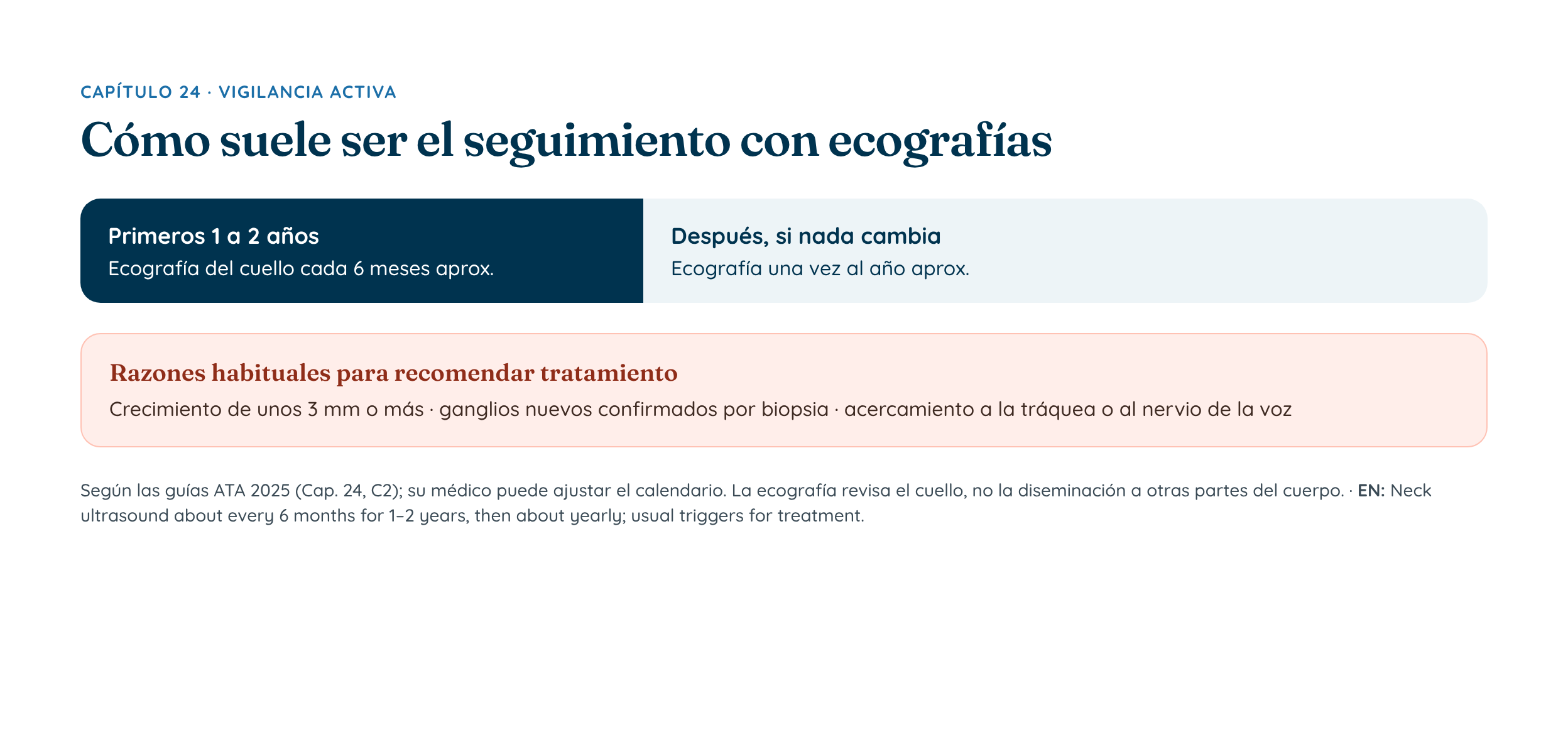
Typically, you have a neck ultrasound about every 6 months for the first 1 to 2 years, then about once a year if nothing changes; your doctor may adjust this for you [2]. Your doctor watches for growth of about 3 mm or more, new lymph nodes confirmed by biopsy, or movement toward the windpipe or nerve. These are the usual reasons to recommend treatment [2]. Ultrasound checks the neck; it is not a test for spread to distant parts of the body.
What the evidence shows: across studies of almost 9,000 people on surveillance, between about 3% and 19% saw their tumor grow [3]. When that happens, surgery or ablation can still be done, and outcomes remain very good.
How does it feel to live with it?
This is a fair worry. Large pooled studies show that people on active surveillance report quality of life that is equal to or better than people who had surgery, especially in voice, energy, scar and emotional well-being [5]. A Canadian study that followed patients for about 3 years found no difference in anxiety or regret between those who chose surveillance and those who chose surgery. The exception was people who started surveillance and later switched to surgery, who reported more worry and regret [6].
That is why the decision should fit your own values. Some people sleep better knowing the cancer is gone. Others prefer to avoid surgery as long as it is safe.
Questions to ask
- Is my cancer low-risk? What features did you see on ultrasound and biopsy?
- Am I a candidate for active surveillance? For lobectomy? For ablation?
- How often would I have ultrasounds, and who will track them?
- What would make you recommend treatment later?
- If I choose surgery, how would we protect my voice?
Key points
- Some small, low-risk papillary cancers can be safely watched instead of removed right away.
- Surgery (usually lobectomy) and, at some centers, ablation are also reasonable options.
- Growth happens in a minority on surveillance, and treatment then still works well.
- Quality of life on surveillance is equal or better on average. The right choice depends on your values.
A head and neck surgeon experienced in thyroid and voice care can help.
Sources
- Praw SS, et al. Executive Summary of the 2025 American Thyroid Association Management Guidelines for Adult Patients with Differentiated Thyroid Cancer. Thyroid. 2025;35(11):1214-1220. doi:10.1177/10507256251390877 PubMed PMID 41173539
- Ringel MD, et al. 2025 American Thyroid Association Management Guidelines for Adult Patients with Differentiated Thyroid Cancer. Thyroid. 2025;35(8):841-985. doi:10.1177/10507256251363120 PubMed PMID 40844370
- Luo N, et al. Risk factors for tumor enlargement in low-risk papillary thyroid microcarcinoma patients: a systematic review and meta-analysis. Endocrine. 2024;85(3):1041-1049. doi:10.1007/s12020-024-03812-5 PubMed PMID 38600392
- Orgoványi M, et al. Risk factors associated with aggressive tumor phenotypes in papillary thyroid microcarcinoma: a systematic review and meta-analysis. Front Endocrinol. 2026;17:1876912. doi:10.3389/fendo.2026.1876912 PubMed PMID 42466333
- van Dijk SPJ, et al. Patient-Reported Outcomes Across Treatment Strategies in Papillary Thyroid Microcarcinoma: A Meta-Analysis. JAMA Otolaryngol Head Neck Surg. 2026;152(2):154-162. doi:10.1001/jamaoto.2025.4670 PubMed PMID 41452620
- Sawka AM, et al. Patient-Reported Outcomes Three Years After Deciding on Surgery or Active Surveillance for Small, Low-Risk Papillary Thyroid Cancer: Results of a Prospective Cohort Study. Thyroid. 2026;36(4):385-396. doi:10.1177/10507256251408857 PubMed PMID 41816978
- Xu X, et al. Three-year follow-up results of radiofrequency ablation for low-risk papillary thyroid microcarcinomas: Systematic review and meta-analysis. Eur J Surg Oncol. 2024;50(9):108470. doi:10.1016/j.ejso.2024.108470 PubMed PMID 38870871
- Zufry H, Hariyanto TI. Efficacy and safety of radiofrequency ablation versus surgery for management of papillary thyroid microcarcinoma: a systematic review, meta-analysis, and meta-regression. Contemp Oncol (Pozn). 2025;29(3):247-256. doi:10.5114/wo.2025.153884 PubMed PMID 41098864
This guide is for general education only. It does not diagnose conditions or replace a medical evaluation. Talk with your own doctor about your situation. In an emergency, call 911 now (in Puerto Rico or the United States; elsewhere, your local emergency number).