Lymph nodes and neck dissection: what to know
Case of a fictitious patient: Before his surgery, Jorge’s ultrasound showed two enlarged lymph nodes on the left side of his neck, and a needle biopsy confirmed papillary cancer in one of them. His surgeon explained that the operation would include removing the thyroid and a group of lymph nodes on that side. “Does that mean the cancer has spread everywhere?” Jorge asked. It did not. Spread to neck nodes is common in papillary cancer, and it is treatable.
The lymph node areas of the neck
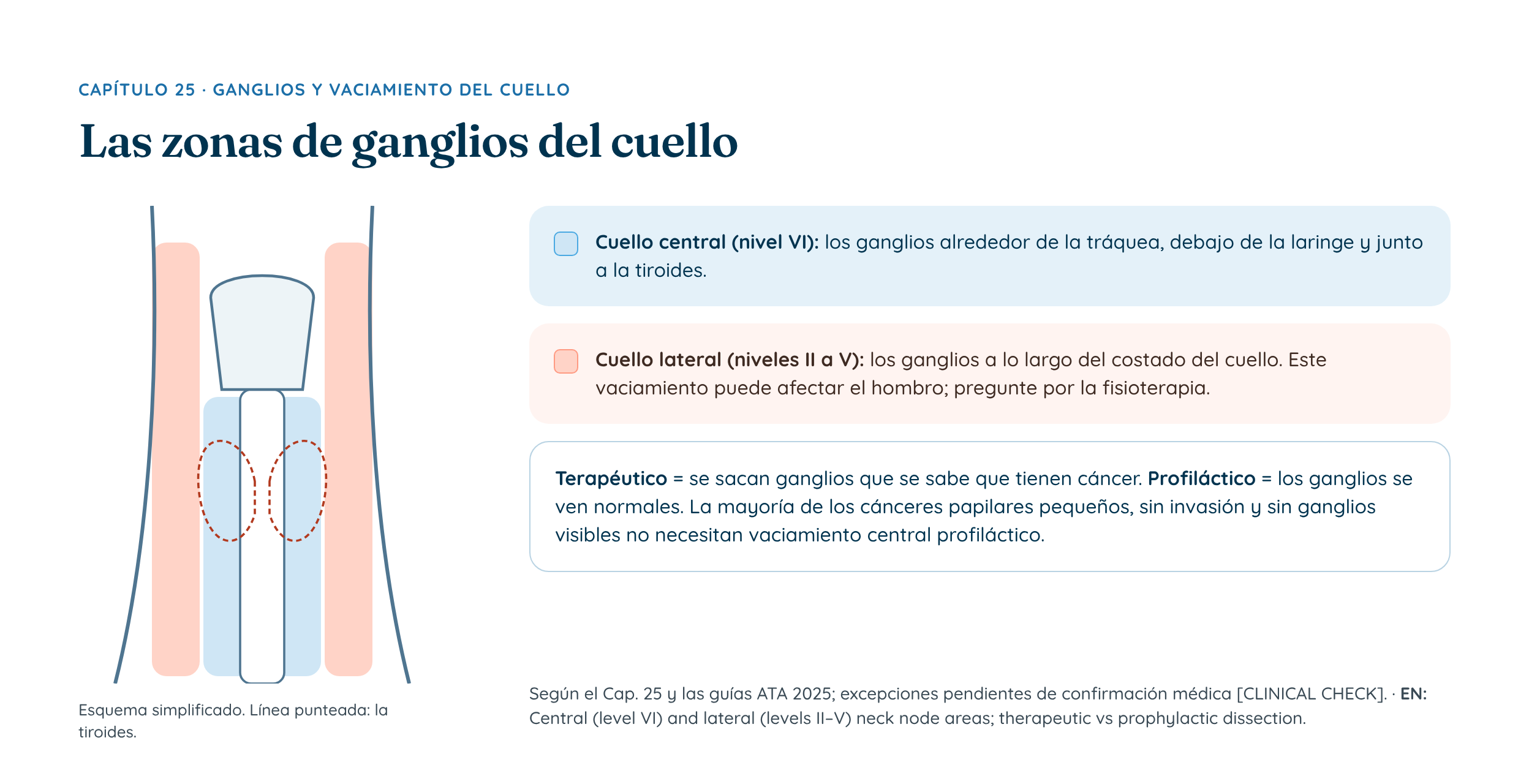
Lymph nodes are small filters along the lymph channels. Papillary thyroid cancer, the most common type, tends to spread first to nearby nodes. Surgeons divide the neck into areas (levels):
- Central neck (level VI): the nodes right next to the thyroid and windpipe, near the voice nerves and the parathyroid glands.
- Lateral neck (levels II–V): the nodes along the side of the neck, around the large blood vessels and under the muscle that turns the head.
Before surgery, a careful neck ultrasound by an experienced examiner is the best way to look for abnormal nodes [1].
Two kinds of neck dissection
Therapeutic neck dissection removes nodes that are known or strongly suspected to contain cancer, from biopsy or clear imaging. When cancer is present in the nodes, removing the involved area is standard treatment [1].
Prophylactic (preventive) central neck dissection removes central nodes that look normal, in case they contain tiny hidden cancer. This is where experts disagree, because the trade-off is real:
- Possible benefit: It finds hidden spread in about half of patients whose nodes looked normal. That information can change decisions about radioactive iodine [4]. Some observational studies report slightly fewer recurrences, but such studies cannot prove a long-term benefit, and randomized trials have not shown one [5].
- But: In randomized trials, the gold standard, adding it did not lower the chance of cancer coming back [2][3].
- Cost: More temporary low calcium, and a small increase in permanent low calcium, because the parathyroid glands sit in the same area [2][4][5]. Removing nodes on one side only, rather than both, appears to lower that risk [6].
For most small papillary cancers that stay inside the thyroid and have normal-looking nodes, the 2025 American Thyroid Association guidelines do not recommend prophylactic central dissection. It may be considered in selected situations, such as larger or more advanced tumors, or when side-of-neck nodes contain cancer [1]. It is worth asking your surgeon how this applies to you.
Recovery and possible side effects
A central neck dissection usually adds little to the recovery from thyroid surgery itself, but watch closely for symptoms of low calcium: tingling around the lips or fingers, or cramps (Chapter 20).
A lateral neck dissection uses a longer incision and takes longer to heal. Possible effects include:
- Numbness of the skin of the neck and earlobe, which often improves over months
- Shoulder stiffness or weakness, especially when nodes low in the back of the neck (level V) are removed. In one study, many patients reported shoulder complaints years later, and few had been warned beforehand [8]. Early physical therapy can help.
- Chyle leak: a leak of milky lymph fluid, uncommon (about 1 in 100), usually managed with diet changes and drainage [7].
- Small risks to the voice nerves and parathyroid glands, as with any thyroid surgery (Chapters 20 and 30)
Questions to ask your surgeon
- Did my ultrasound show any suspicious lymph nodes? Were they biopsied?
- Will you remove lymph nodes? Central, lateral or both? Why?
- If you are considering a prophylactic central dissection, what are the benefits and risks for me?
- What should I watch for afterward? Will I need physical therapy for my shoulder?
Key points
- Spread to neck lymph nodes is common in papillary cancer and is treatable.
- Nodes known to have cancer are removed (therapeutic dissection).
- Removing normal-looking central nodes “just in case” is a judgment call. Randomized trials show no clear recurrence benefit and a higher risk of low calcium.
- Lateral neck dissection can affect the shoulder. Ask about physical therapy.
A head and neck surgeon experienced in thyroid and voice care can help.
Sources
- Ringel MD, et al. 2025 American Thyroid Association Management Guidelines for Adult Patients with Differentiated Thyroid Cancer. Thyroid. 2025;35(8):841-985. doi:10.1177/10507256251363120 PubMed PMID 40844370
- Sanabria A, et al. Prophylactic Central Neck Lymph Node Dissection in Low-risk Thyroid Carcinoma Patients Does Not Decrease the Incidence of Locoregional Recurrence: A Meta-analysis of Randomized Trials. Ann Surg. 2022;276(1):66-73. doi:10.1097/SLA.0000000000005388 PubMed PMID 35129470
- Alsubaie KM, et al. Prophylactic Central Neck Dissection for Clinically Node-Negative Papillary Thyroid Carcinoma. Laryngoscope. 2022;132(6):1320-1328. doi:10.1002/lary.29912 PubMed PMID 34708877
- Hughes DT, et al. Prophylactic Central Compartment Neck Dissection in Papillary Thyroid Cancer and Effect on Locoregional Recurrence. Ann Surg Oncol. 2018;25(9):2526-2534. doi:10.1245/s10434-018-6528-0 PubMed PMID 29786126
- Yang J, et al. Prophylactic central neck dissection for cN0 papillary thyroid carcinoma: is there any difference between western countries and China? A systematic review and meta-analysis. Front Endocrinol. 2023;14:1176512. doi:10.3389/fendo.2023.1176512 PubMed PMID 37576962
- Li Y, Lao L. Comparison of prophylactic ipsilateral and bilateral central lymph node dissection in papillary thyroid carcinoma: a meta-analysis. Braz J Otorhinolaryngol. 2023;89(6):101318. doi:10.1016/j.bjorl.2023.101318 PubMed PMID 37716097
- Park I, et al. Management of chyle leakage after thyroidectomy, cervical lymph node dissection, in patients with thyroid cancer. Head Neck. 2018;40(1):7-15. doi:10.1002/hed.24852 PubMed PMID 29120521
- Roerink SHPP, et al. High prevalence of self-reported shoulder complaints after thyroid carcinoma surgery. Head Neck. 2017;39(2):260-268. doi:10.1002/hed.24579 PubMed PMID 27859810
This guide is for general education only. It does not diagnose conditions or replace a medical evaluation. Talk with your own doctor about your situation. In an emergency, call 911 now (in Puerto Rico or the United States; elsewhere, your local emergency number).