Radioactive iodine: who needs it and who doesn't
Case of a fictitious patient: After her total thyroidectomy for a 1.6-centimeter papillary cancer, Gloria assumed the next step was radioactive iodine. Her sister had it ten years ago. So she was surprised when her care team said she probably did not need it. “Isn’t that the treatment that kills the leftover cancer?” she asked. “Why would I skip it?”
It is a common question. Recent research has changed who benefits from radioactive iodine.
What radioactive iodine is
Thyroid cells, including most differentiated thyroid cancer cells, absorb iodine. Radioactive iodine (I-131) is swallowed as a capsule or liquid. It travels through the blood and is taken up by any remaining thyroid tissue, where its radiation destroys those cells. It is given only after a total thyroidectomy.
It can be used for three different purposes:
- Remnant ablation: destroying the small amount of normal thyroid tissue left after surgery, mainly so that blood tests (thyroglobulin) are easier to interpret later.
- Adjuvant therapy: treating possible microscopic cancer that cannot be seen, in patients at higher risk of recurrence.
- Treatment of known disease: treating cancer that has spread to lymph nodes or distant sites and still takes up iodine.
The big change: many low-risk patients can skip it
Two large randomized trials tested whether people with low-risk differentiated thyroid cancer actually benefit from radioactive iodine after total thyroidectomy:
- ESTIMABL2 (France): after 5 years, about 93% of patients who did not get radioactive iodine had no signs of disease, vs about 95% of those who did. The difference was small enough that skipping it was considered just as good [3].
- IoN (United Kingdom): after 5 years, about 98% of patients without radioactive iodine were free of recurrence, vs about 96% with it [4].
Together, these trials found no reduction in recurrence from radioactive iodine for the selected low-risk patients they studied, all of whom had a total thyroidectomy [5]. Whether you fit that group depends on your pathology report. The 2025 American Thyroid Association guidelines reflect this move toward less treatment for low-risk cancers [1][2]. Radioactive iodine is still important for people at intermediate or high risk, and for cancer that has spread. Your team will decide based on your pathology report and risk category.
Side effects
Most people tolerate radioactive iodine well, but it is not free of side effects:
- Dry mouth and salivary gland swelling: common at first (about 60% in the first 2 months), and persisting in a smaller share (about 17% after a year). Higher doses raise the risk [6].
- Dry eyes or watery eyes can also occur [6].
- Tiredness in the first days or weeks is common [4]; some people also notice nausea or taste changes.
Preparing with injections of recombinant TSH, instead of stopping thyroid hormone for several weeks, may reduce long-term salivary gland problems. It also avoids the fatigue of temporary hypothyroidism [7].
Preparing for treatment
If radioactive iodine is recommended, your team will usually ask you to:
- Raise your TSH: either with recombinant TSH injections over 2 days, or by temporarily stopping thyroid hormone.
- Follow a low-iodine diet for a short time beforehand, so that the thyroid cells are “hungry” for iodine. This usually means avoiding iodized salt, seafood and seaweed, dairy products, egg yolks, and foods with certain red food coloring. Your team will give you a specific list.
- Avoid iodine-containing contrast dye (used in some CT scans) for several weeks before treatment.
Safety at home after treatment
For a few days after treatment, your body gives off a small amount of radiation, mostly through saliva, sweat and urine. Your nuclear medicine team will give you exact instructions based on your dose. They usually include keeping some distance from others, especially children and pregnant people; sleeping alone; using separate utensils and towels; and flushing the toilet twice. Follow their instructions exactly; they vary by dose and by local regulation.
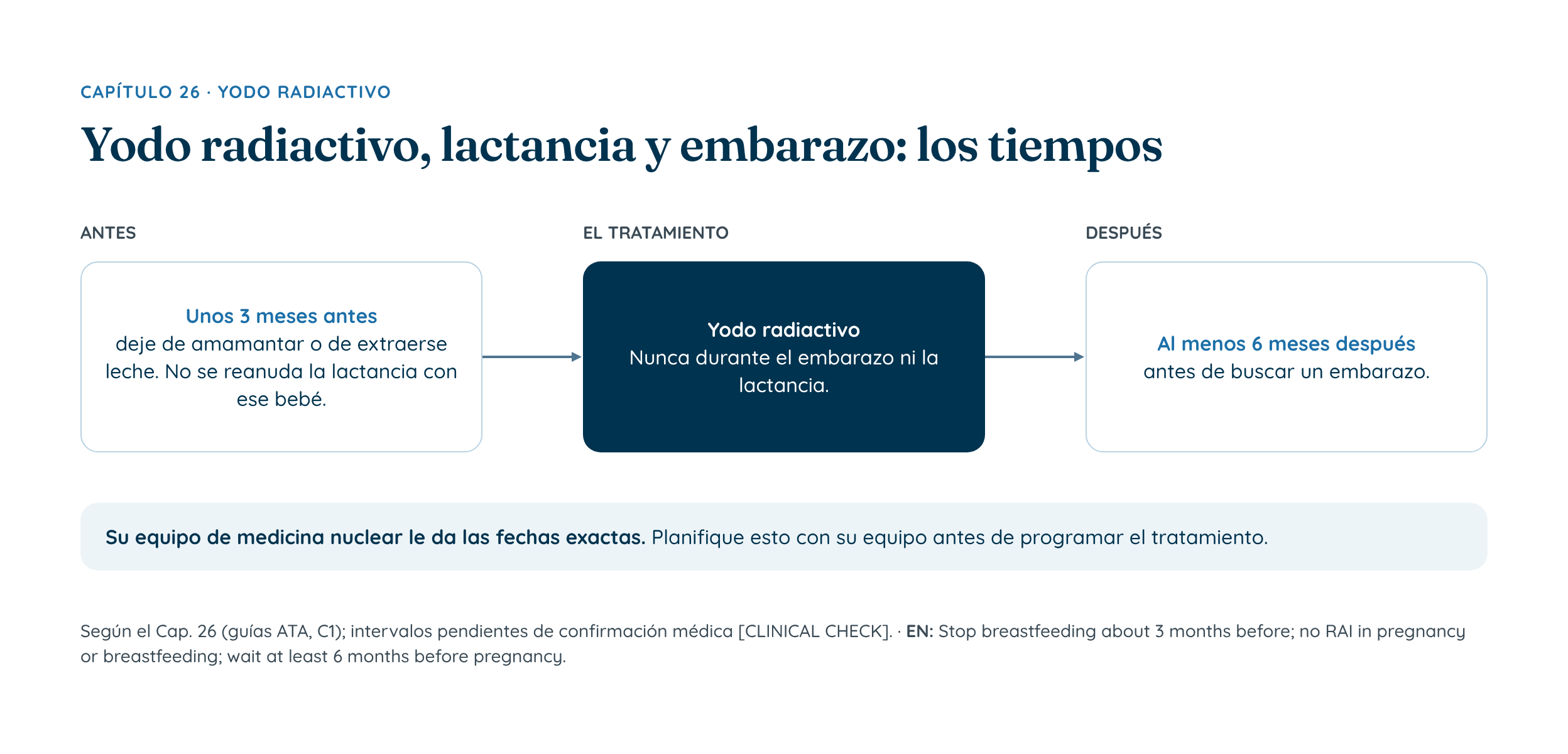
Radioactive iodine is never given during pregnancy or while breastfeeding. Pregnancy is postponed for a period after treatment, commonly at least 6 months. If you are breastfeeding or pumping, you will need to stop well before treatment, often about 3 months, and you cannot restart breastfeeding that baby afterward. Your nuclear medicine team will tell you the exact timing that applies to you [1]. Plan this with your team before scheduling treatment.
Questions to ask
- What is my risk category? Do I need radioactive iodine?
- If so, is it for ablation, adjuvant therapy or known disease?
- Can I prepare with recombinant TSH injections?
- What dose will I receive, and what precautions will I need at home?
Key points
- Radioactive iodine is not automatic after thyroid cancer surgery.
- Two randomized trials show many low-risk patients do just as well without it.
- It remains important for higher-risk cancers and for cancer that has spread.
- Dry mouth is the most common long-term side effect. Ask about ways to protect your salivary glands.
A head and neck surgeon experienced in thyroid and voice care can help.
Sources
- Ringel MD, et al. 2025 American Thyroid Association Management Guidelines for Adult Patients with Differentiated Thyroid Cancer. Thyroid. 2025;35(8):841-985. doi:10.1177/10507256251363120 PubMed PMID 40844370
- Praw SS, et al. Executive Summary of the 2025 American Thyroid Association Management Guidelines for Adult Patients with Differentiated Thyroid Cancer. Thyroid. 2025;35(11):1214-1220. doi:10.1177/10507256251390877 PubMed PMID 41173539
- Leboulleux S, et al. Thyroidectomy without radioiodine in patients with low-risk thyroid cancer: 5 years of follow-up of the prospective randomised ESTIMABL2 trial. Lancet Diabetes Endocrinol. 2025;13(1):38-46. doi:10.1016/S2213-8587(24)00276-6 PubMed PMID 39586309
- Mallick U, et al. Thyroidectomy with or without postoperative radioiodine for patients with low-risk differentiated thyroid cancer in the UK (IoN): a randomised, multicentre, non-inferiority trial. Lancet. 2025;406(10498):52-62. doi:10.1016/S0140-6736(25)00629-4 PubMed PMID 40543520
- Yang C, et al. Is radioiodine necessary for patients with low-risk differentiated thyroid cancer after thyroidectomy: a pooled analysis of ESTIMABL2 and IoN trials. Front Oncol. 2025;15:1670978. doi:10.3389/fonc.2025.1670978 PubMed PMID 41229489
- Bondet de La Bernardie S, et al. Salivary and lacrimal disorders in patients treated with radioiodine for differentiated thyroid cancer. Eur Thyroid J. 2026;15(3). doi:10.1530/ETJ-25-0402 PubMed PMID 42018484
- Sunavala-Dossabhoy G, Petti S. Effect of recombinant human thyroid stimulating hormone on long-term salivary gland dysfunction in thyroid cancer patients treated with radioactive iodine. A systematic review. Oral Oncol. 2023;136:106280. doi:10.1016/j.oraloncology.2022.106280 PubMed PMID 36525783
This guide is for general education only. It does not diagnose conditions or replace a medical evaluation. Talk with your own doctor about your situation. In an emergency, call 911 now (in Puerto Rico or the United States; elsewhere, your local emergency number).