Follow-up after thyroid cancer treatment
Case of a fictitious patient: Every six months, Daniela checked the patient portal the moment her lab results came in, her heart racing until she found the word “thyroglobulin.” Two years after surgery, her endocrinologist told her something that changed how she lived: “Your results have been excellent for a long time. We can space these out now.”
Follow-up after thyroid cancer is about catching any return early, without overtesting or overtreating people who are doing well. Here is what the tests mean.
The main follow-up tools
Thyroglobulin (Tg). A protein made only by thyroid cells, normal or cancerous. After a total thyroidectomy, especially with radioactive iodine, it should be very low or undetectable. A rising level can be an early sign that cancer has returned. After a lobectomy, half the thyroid remains, so thyroglobulin is less useful and the trend matters more than any single number. In every case, your doctor reads thyroglobulin together with the extent of your surgery, your antibody level, the trend over time and your ultrasound, not as a single number on its own.
Thyroglobulin antibodies (TgAb). Some people make antibodies that interfere with the thyroglobulin test. If you have them, your doctor follows the antibody level over time instead: falling is good, rising deserves a closer look [3].
Neck ultrasound. The best imaging test for checking the thyroid bed and lymph nodes. It is usually done periodically in the first years, then less often if everything stays normal.
TSH and thyroid hormone levels. These guide your levothyroxine dose (see below).
What your “response” category means
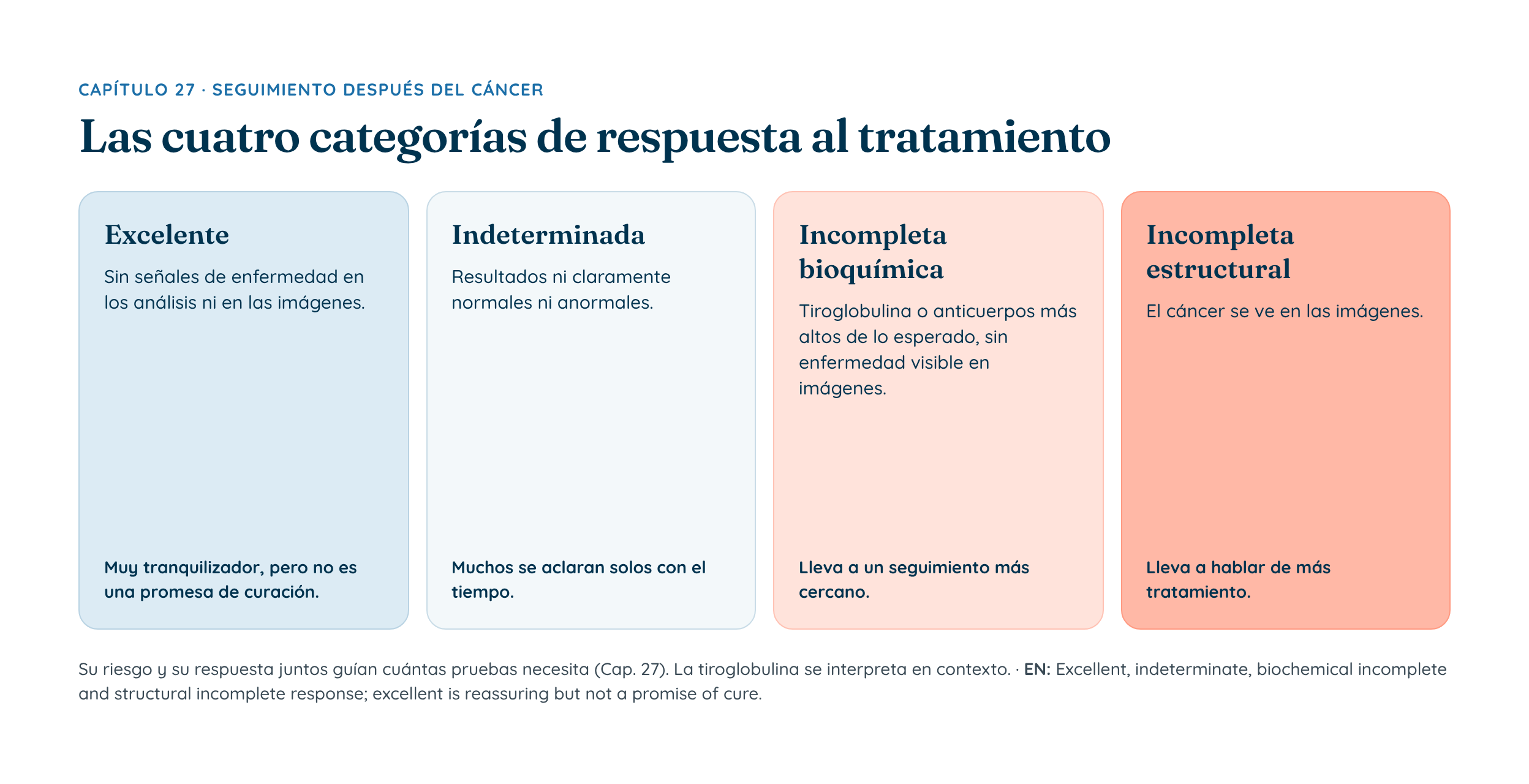
After treatment, doctors describe how well it worked using four categories. They are re-evaluated over time [1]:
- Excellent response: no sign of disease on blood tests or imaging. This is the most common result for low-risk patients. In one large study of low-risk patients treated without radioactive iodine, about 95% had an excellent response after about 4 years [3]. An excellent response is very reassuring and often allows lighter follow-up and less TSH suppression, but it is not a promise of cure; your risk and response together guide how much imaging and suppression you need.
- Indeterminate response: results that are not clearly normal or abnormal, such as a low but detectable thyroglobulin or a small nonspecific spot on ultrasound. Many of these resolve on their own over time [4].
- Biochemical incomplete response: thyroglobulin or antibodies are higher than expected, but no disease can be seen on imaging. This leads to closer monitoring.
- Structural incomplete response: cancer can be seen on imaging. This leads to discussion of further treatment.
Your category can change, often for the better. In one study, the share of patients with an excellent response rose from about half to more than 80% over two years [4].
Less follow-up when you are doing well
The 2025 guidelines introduce the idea of complete remission and recommend lighter surveillance for low-risk patients who are doing well [2]. Less testing means less anxiety, fewer costs and fewer false alarms.
TSH suppression: no longer for everyone
TSH can stimulate thyroid cancer cells to grow. For years, many patients were given extra levothyroxine to push TSH very low (“suppression”). We now know:
- Studies have not shown better outcomes from suppression, except in people with more advanced disease [5].
- Too much thyroid hormone can cause bone loss, fractures and heart rhythm problems such as atrial fibrillation [5][6]. In postmenopausal women, long-term suppression has been linked to worse heart-health scores, more osteoporosis and lower quality of life [7].
So TSH targets are now tailored to your risk and to how well you have responded. Most people doing well aim for a TSH in or near the normal range. Ask your doctor what your target is and why.
Living with follow-up
- Keep a simple record of your results and dates; trends matter more than any single number.
- Use the same laboratory for thyroglobulin when possible, since results vary between labs.
- Tell your doctor about palpitations, bone fractures or new neck lumps.
- If waiting for results makes you very anxious, say so. Support is available (see Chapter 39).
Key points
- Thyroglobulin, its antibodies and neck ultrasound are the main follow-up tools.
- Response categories guide how closely you are watched, and they often improve over time.
- People doing well need less testing under the 2025 guidelines.
- TSH suppression is now selective because of risks to bone and heart.
A head and neck surgeon experienced in thyroid and voice care can help.
Sources
- Ringel MD, et al. 2025 American Thyroid Association Management Guidelines for Adult Patients with Differentiated Thyroid Cancer. Thyroid. 2025;35(8):841-985. doi:10.1177/10507256251363120 PubMed PMID 40844370
- Praw SS, et al. Executive Summary of the 2025 American Thyroid Association Management Guidelines for Adult Patients with Differentiated Thyroid Cancer. Thyroid. 2025;35(11):1214-1220. doi:10.1177/10507256251390877 PubMed PMID 41173539
- Dong P, et al. A New Dynamic Response to Therapy Assessment in Postoperative Patients With Low-Risk Differentiated Thyroid Cancer Treated Without Radioactive Iodine. Front Oncol. 2021;11:764258. doi:10.3389/fonc.2021.764258 PubMed PMID 34912712
- Zhang X, et al. Response to Surgery Assessments for Sparing Radioiodine Remnant Ablation in Intermediate-Risk Papillary Thyroid Cancer. J Clin Endocrinol Metab. 2023;108(6):1330-1337. doi:10.1210/clinem/dgac745 PubMed PMID 36567646
- Biondi B, Cooper DS. Thyroid Hormone Suppression Therapy. Endocrinol Metab Clin North Am. 2019;48(1):227-237. doi:10.1016/j.ecl.2018.10.008 PubMed PMID 30717904
- Pishdad R, Ahmadi S. Thyroid-Stimulating Hormone Suppression Therapy in Thyroid Cancer: Balancing Benefits and Harms. Endocr Pract. 2026;32(3):401-405. doi:10.1016/j.eprac.2025.12.002 PubMed PMID 41407103
- Candemir B, et al. Menopause-Related Health Outcomes in Women with Differentiated Thyroid Carcinoma Receiving Long-Term TSH Suppression after Total Thyroidectomy. Thyroid. 2026;36(8):880-891. doi:10.1177/10507256261442839 PubMed PMID 41969134
This guide is for general education only. It does not diagnose conditions or replace a medical evaluation. Talk with your own doctor about your situation. In an emergency, call 911 now (in Puerto Rico or the United States; elsewhere, your local emergency number).