Your voice and your thyroid
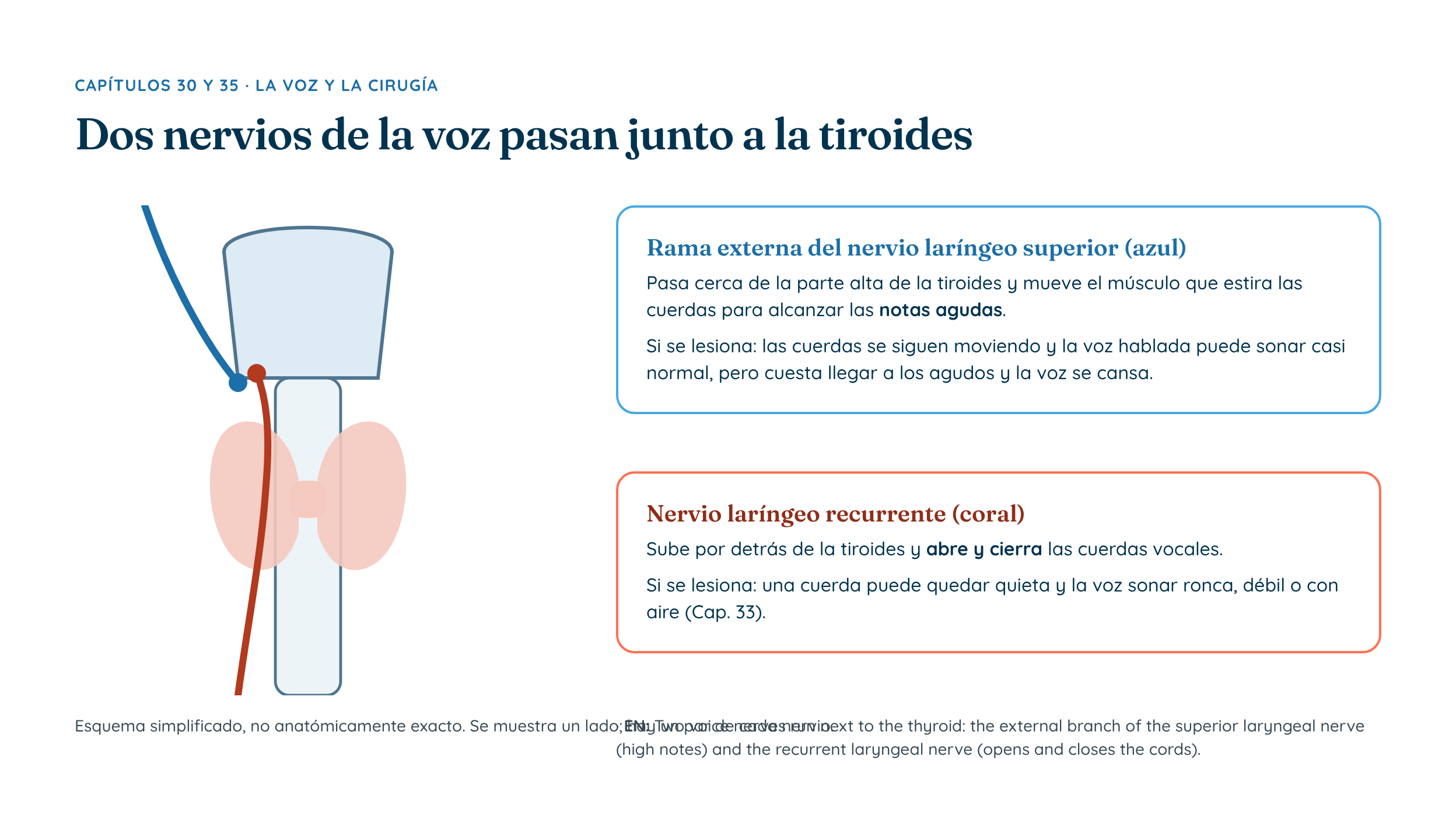
For many people, the biggest fear about thyroid surgery is losing their voice. That fear is understandable: the nerves that control the voice box run right next to the thyroid. But serious, lasting voice damage is uncommon, most voice changes after surgery improve, and when they don’t, effective treatments exist. This chapter explains how the voice and the thyroid are connected.
How your voice works
Your voice is made by two vocal cords inside the voice box (larynx), just above the windpipe. When you speak, they come together and vibrate as air passes between them. When you breathe, they open. Muscles move and tighten the vocal cords, and two nerves on each side control those muscles.
The two nerves that matter
The recurrent laryngeal nerve runs up behind the thyroid on each side. It controls almost all the muscles that open and close the vocal cords. If it is stretched, bruised or injured, the vocal cord on that side can become weak or stop moving. That causes a breathy, weak or hoarse voice, voice fatigue, and sometimes coughing when drinking thin liquids.
The external branch of the superior laryngeal nerve runs near the top of the thyroid. It tightens the vocal cords so you can reach high notes and project your voice [4]. When it is affected, speaking may sound almost normal, but the voice tires quickly and the high range and singing voice suffer. This matters especially to singers, teachers and other voice professionals (Chapter 35).
National guidelines call on surgeons to identify the recurrent laryngeal nerve and take steps to protect the superior laryngeal nerve during every thyroid operation [1].
How often does the voice change?
Honest numbers help put the risk in perspective:
- Temporary nerve weakness: about 1 in 10 patients, according to a 2013 national guideline; these are historical figures that vary with the population and with how carefully the vocal cords are examined [1]. In a large U.S. health system, temporary vocal cord paralysis occurred in about 4 of every 100 total thyroidectomies [2].
- Lasting voice problems: up to 1 in 25 patients [1]. Permanent vocal cord paralysis was about 1.7 in 100 total thyroidectomies in the same health system [2], and about 0.5 in 100 nerves at risk in randomized trials [3].
Risk is higher with large goiters, cancers that grow into the nerve, and repeat surgery. In the same health system, complication rates fell as surgeons’ yearly number of thyroid operations rose [2] (Chapter 16).
Not every voice change comes from the nerves. The breathing tube used during anesthesia can irritate the vocal cords, and rarely it can injure the voice box itself. It helps to keep three things apart: a voice that sounds different, a vocal cord that is confirmed not to move on exam, and a proven nerve injury. They are not the same, and the first is much more common than the last. Many people also notice voice fatigue for a few weeks with perfectly normal nerves (Chapter 32).
When both sides are affected
Rarely, both recurrent nerves are affected during a total thyroidectomy. Then both vocal cords may stay partly closed, which narrows the airway. The voice may sound fairly normal, but breathing is noisy or difficult, especially with effort.
The good news
Most nerve weakness after thyroid surgery is temporary and recovers over weeks to months. When it does not, voice therapy and office procedures can restore a strong voice for most people (Chapter 33). The key is to have your vocal cords examined if your voice is not back to normal within about two weeks (Chapter 31). The national guideline recommends checking for voice changes between 2 weeks and 2 months after surgery and examining the vocal cords if the voice has changed [1].
Key points
- Two nerves near the thyroid control the voice: the recurrent laryngeal nerve and the external branch of the superior laryngeal nerve.
- Temporary voice changes are fairly common; lasting nerve damage is uncommon.
- A changed voice, a vocal cord that does not move and a proven nerve injury are three different things.
- If your voice is not back to normal in about two weeks, ask to have your vocal cords examined.
A head and neck surgeon experienced in thyroid and voice care can help.
Sources
- Chandrasekhar SS, et al. Clinical practice guideline: improving voice outcomes after thyroid surgery. Otolaryngol Head Neck Surg. 2013;148(6 Suppl):S1-37. doi:10.1177/0194599813487301 PubMed PMID 23733893
- Meltzer C, et al. Association Between Annual Surgeon Total Thyroidectomy Volume and Transient and Permanent Complications. JAMA Otolaryngol Head Neck Surg. 2019;145(9):830-837. doi:10.1001/jamaoto.2019.1752 PubMed PMID 31343681
- Davey MG, et al. Intraoperative recurrent laryngeal nerve monitoring versus visualisation alone – A systematic review and meta-analysis of randomized controlled trials. Am J Surg. 2022;224(3):836-841. doi:10.1016/j.amjsurg.2022.03.036 PubMed PMID 35422329
- Singh K, et al. Incidence of Injury to External Branch of Superior Laryngeal Nerve as Diagnosed by Acoustic Voice Analysis After Thyroidectomy. Indian J Otolaryngol Head Neck Surg. 2025;77(3):1401-1409. doi:10.1007/s12070-025-05351-5 PubMed PMID 40093427
This guide is for general education only. It does not diagnose conditions or replace a medical evaluation. Talk with your own doctor about your situation. In an emergency, call 911 now (in Puerto Rico or the United States; elsewhere, your local emergency number).