Swallowing after thyroid surgery: what is normal and what is not
Case of a fictitious patient: Roberto had his thyroid removed for a large goiter. A week later his voice was fine, but every time he swallowed he felt as if a pill were stuck in his throat, and his neck felt tight when he looked down. “The surgeon said the nerves worked perfectly,” he said. “So why does it feel like this?”
What Roberto felt is one of the most common, and least talked about, experiences after thyroid surgery.
Why swallowing feels different
The thyroid sits on the front of the windpipe, right next to the muscles and the upper part of the esophagus that you use to swallow. During surgery these tissues are moved aside, and afterward they heal with swelling and some scar tissue. The small muscles in the front of the neck can also feel stiff. Research suggests that the muscle at the top of the esophagus (the upper esophageal sphincter) works a little differently for a while after surgery, even when there is no sign of nerve injury [3].
Common sensations include:
- A lump or “something stuck” feeling, especially with dry foods or pills
- Tightness or pulling when swallowing or when moving the neck
- Needing to swallow twice
- Mild discomfort or fatigue when eating a large meal
How common is it, and how long does it last?
Very common. Studies show swallowing complaints in many patients right after thyroidectomy, even when everything went well and both vocal cords move normally [1][2]. For most people the sensation fades over weeks and is back to how it was before surgery by about 2 to 3 months. A smaller group still notices some symptoms at one year [1].
These symptoms are real even if tests look normal. A normal exam does not mean you are imagining it. It means the problem is usually healing tissue, not damage [1].
If you had a large goiter that was pressing on your esophagus, there is good news. After the early healing period, swallowing often ends up better than before surgery, usually by about 6 months [4].
What helps
- Eat soft, moist foods for the first days or weeks. Take small bites, chew well, and sip liquids between bites.
- Take pills one at a time with plenty of water. Ask your pharmacist whether any large pills can be split or come in liquid form.
- Sit upright while eating and for 30 minutes afterward.
- Gentle neck movement. Once your surgeon clears you, gentle range-of-motion stretches can ease the tight, pulling feeling.
- Massage around the scar once the incision has fully healed (ask your surgeon when) may help soften stiffness.
Some surgeons place a material during surgery that is meant to reduce scar adhesions. A pooled analysis of randomized trials found it helped swallowing slightly in the first 1 to 3 months, but not afterward [5]. The type of approach can also matter a little. Remote-access operations (Chapter 22) showed lower swallowing-symptom scores than the standard incision in the first 3 months, though the evidence is limited [6].
When swallowing trouble means something else
Swallowing problems combined with a weak, breathy voice may mean a vocal cord is not moving. When the vocal cords cannot close fully, liquids can slip into the airway (aspiration). This shows up as coughing or choking with drinks. This needs an exam of the vocal cords [8]. Swallowing therapy and, sometimes, an injection that helps the cords close can protect the airway (Chapter 33) [7].
When to call
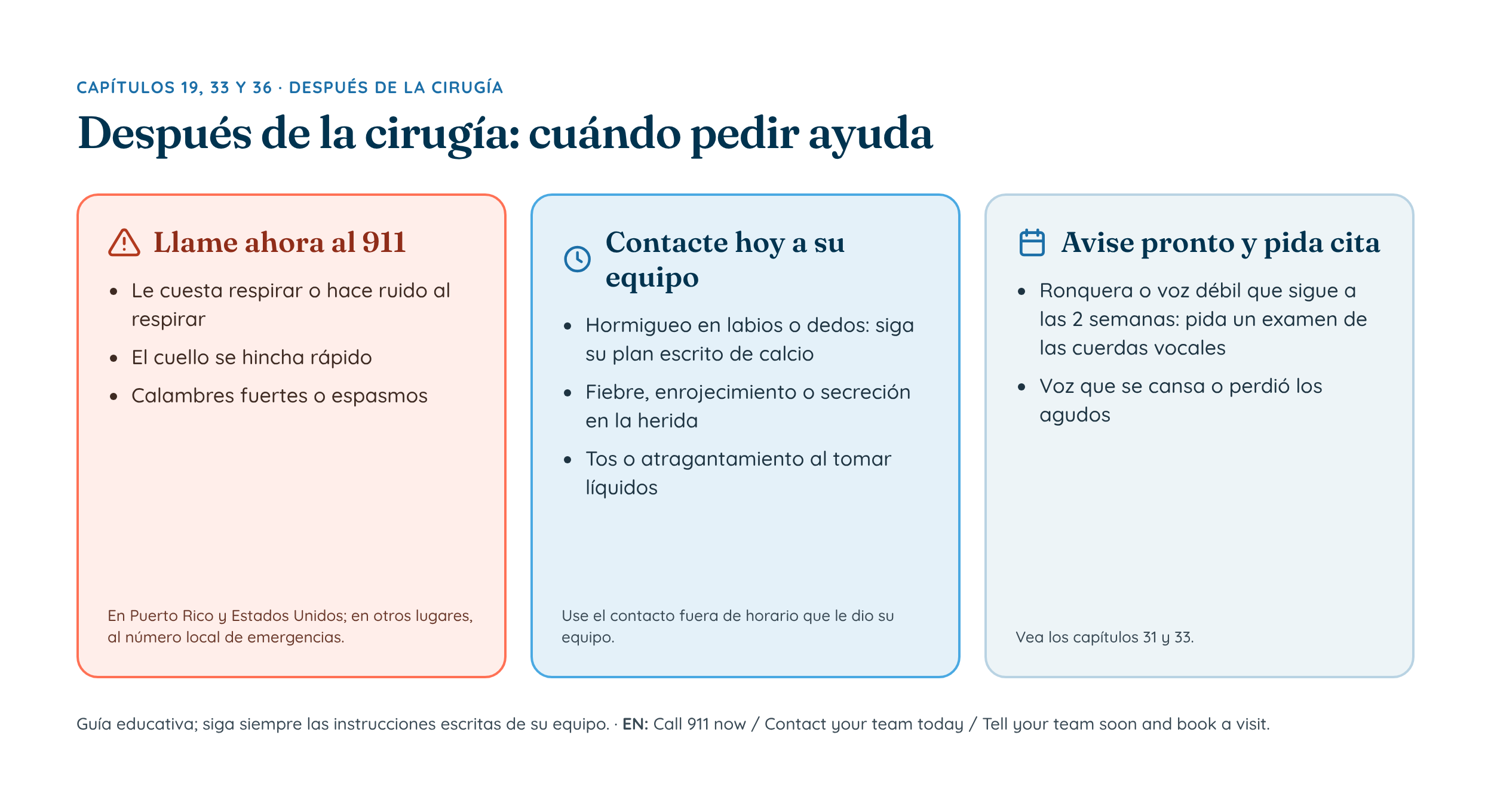
Contact your surgical team promptly (the same day or next day) if you have:
- Repeated coughing or choking with drinks or food, or a wet, gurgly voice after swallowing
- Fever, chest congestion or shortness of breath after eating (possible aspiration pneumonia)
- Signs of dehydration (very little urine, dizziness) because drinking is difficult
- Swallowing that is getting worse instead of better
Mention it at your follow-up visit if swallowing is mildly uncomfortable but steadily improving. That is usually part of normal healing; ask about it if it is not clearly better after 2 to 3 months.
If an evaluation is needed, your clinician will choose the right test: a scope exam of swallowing (FEES) or an X-ray swallow study (modified barium swallow). A speech-language pathologist can then teach exercises and strategies tailored to you; do not start special maneuvers or diets without that assessment.
Key points
- A lump-in-the-throat or tight feeling when swallowing is common after thyroid surgery, even when the nerves are fine.
- Most people return to normal within 2 to 3 months. Goiter patients often swallow better than before.
- Coughing with drinks or a breathy voice is different and needs an exam.
A head and neck surgeon experienced in thyroid and voice care can help.
Sources
- Vardaxi C, et al. Swallowing disorders after thyroidectomy: a systematic review and meta-analysis. Eur Arch Otorhinolaryngol. 2022;279(9):4213-4227. doi:10.1007/s00405-022-07386-8 PubMed PMID 35438344
- Sõber L, et al. Voice and Swallowing Disorders After Thyroid Surgery. J Voice. 2024;38(5):1254.e11-1254.e20. doi:10.1016/j.jvoice.2022.03.013 PubMed PMID 35410778
- Gunay M, et al. Influence of intraoperative electromyographic changes and surgical extent on post-thyroidectomy esophageal motility: a prospective cohort study. Front Endocrinol (Lausanne). 2025;16:1651936. doi:10.3389/fendo.2025.1651936 PubMed PMID 41122716
- Sorensen JR, et al. The Impact of Goiter and Thyroid Surgery on Goiter Related Esophageal Dysfunction. A Systematic Review. Front Endocrinol (Lausanne). 2018;9:679. doi:10.3389/fendo.2018.00679 PubMed PMID 30524374
- Ahmad Albarari SS, et al. Efficacy of Antiadhesion Barriers on Swallowing Function After Thyroidectomy: A Systematic Review and Meta-analysis. J Surg Res. 2026;321:531-542. doi:10.1016/j.jss.2026.03.013 PubMed PMID 41946022
- Nguyen VC, et al. Comparison of Voice and Swallowing Changes After Thyroidectomy Using the Gasless Transaxillary, Transoral, and Conventional Transcervical Approaches: A Network Meta-analysis. Ann Surg Oncol. 2025;32(7):5256-5268. doi:10.1245/s10434-025-17276-y PubMed PMID 40234337
- Pan S, Sadoughi B. Effectiveness of Injection Laryngoplasty for Aspiration in Acute Iatrogenic Vocal Fold Paralysis: A Systematic Review. Laryngoscope. 2022;132(4):813-821. doi:10.1002/lary.29326 PubMed PMID 33305851
- Chandrasekhar SS, et al. Clinical practice guideline: improving voice outcomes after thyroid surgery. Otolaryngol Head Neck Surg. 2013;148(6 Suppl):S1-37. doi:10.1177/0194599813487301 PubMed PMID 23733893
This guide is for general education only. It does not diagnose conditions or replace a medical evaluation. Talk with your own doctor about your situation. In an emergency, call 911 now (in Puerto Rico or the United States; elsewhere, your local emergency number).