Thyroid surgery when your voice is your career

Case of a fictitious patient: Andrea sings in a salsa orchestra four nights a week and teaches voice during the day. When a biopsy showed she needed thyroid surgery, her first fear was not the cancer. It was losing her high notes. “Everybody tells me the risk is small,” she said. “But small is not zero, and my voice pays the rent.”
If you sing, teach, preach, broadcast, sell, lead or argue for a living, your concerns about thyroid surgery are different, and they deserve a specific plan.
Two nerves, not one
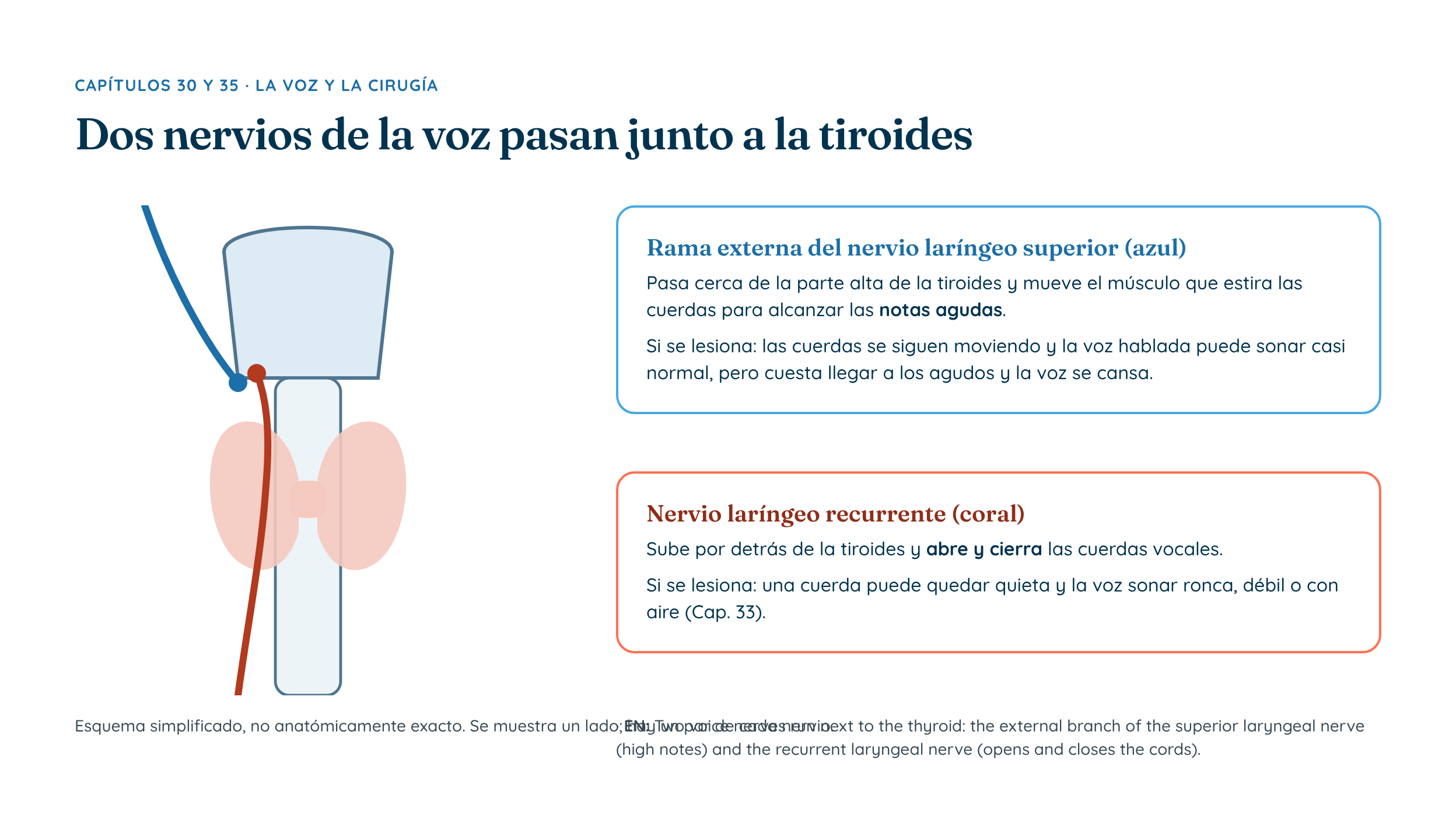
Most people have heard of the recurrent laryngeal nerve, which opens and closes the vocal cords (Chapters 30 and 33). Voice professionals need to know about a second one: the external branch of the superior laryngeal nerve. It runs near the top of the thyroid and powers the cricothyroid muscle, the muscle that stretches the vocal cords to reach high notes [2].
If this nerve is injured, the cords still move and the speaking voice can sound almost normal. But you may notice:
- Difficulty reaching or holding high notes, or a smaller range
- A voice that tires quickly
- Less power when projecting
- Trouble with pitch control and gliding between notes
Because the speaking voice often sounds fine, this injury is easy to miss unless someone specifically looks for it [2][3].
What protects your voice during surgery
Neuromonitoring. During surgery, a monitoring system can confirm that the nerves are working. In randomized trials, using it to find and protect the superior laryngeal nerve greatly increased how often the nerve was identified and reduced early voice changes and nerve injury [3][4]. Monitoring lowers the risk, but it cannot guarantee that your voice will be unchanged.
Surgeon experience. Surgeons who operate frequently on the thyroid and who routinely identify both nerves have lower complication rates (see Chapter 16).
Approach. Remote-access operations, which avoid a front-of-neck incision (Chapter 22), showed somewhat better short-term voice scores and preservation of high range in pooled studies, though the evidence is still limited [7].
Questions to ask your surgeon
- How many thyroid operations do you do each year?
- Do you use nerve monitoring, and do you monitor the superior laryngeal nerve as well as the recurrent nerve?
- Can I have a voice evaluation with a laryngologist before and after surgery?
- What should I expect for my voice in the first weeks, and when can I perform again?
- Who will I see if my voice is not recovering as expected?
Before surgery: get a baseline
A national guideline advises surgeons to document voice before surgery and to examine the larynx when there are concerns [5]. For a voice professional, a full baseline is worth it:
- A video exam of the vocal cords (laryngoscopy with stroboscopy)
- A recording of your speaking and singing voice, including your range
- Voice questionnaires (such as the Voice Handicap Index or singing-specific versions)
If something changes after surgery, this baseline makes it far easier to tell what is new, what was already there, and what to treat. That matters most for subtle changes, such as a slightly smaller range or earlier fatigue, which a singer may notice long before anyone else can hear them. A specialist exam can show whether a change like that has a cause that can be treated.
After surgery: a realistic timeline
The most detailed published data come from one small series of 27 professional singers and voice users, 60% of whom had surgery for thyroid cancer. They were a selected group treated by a very experienced team, so the results may not apply to everyone. Every one of them returned to performing, on average a little over 2 months after surgery. Their voice and singing questionnaire scores were the same after surgery as before [1].
During recovery, however, most of them noticed temporary vocal fatigue, reduced high range and pitch control, and less vocal strength [1]. That is normal healing, not failure.
A typical staged return, adjusted by your voice team, looks like this:
- First days: normal, gentle conversation. No shouting, whispering or singing.
- First 2–3 weeks: gradual increase in speaking. Hydrate well and rest the voice between calls or classes.
- When cleared: gentle warm-ups and singing exercises with a voice therapist or teacher, building range and stamina.
- Return to performance: when your laryngologist and voice therapist agree. Timing varies from person to person; in the series above the average was a little over 2 months.
If your voice is not recovering
If hoarseness, breathiness, loss of range or fatigue persists beyond a few weeks, ask for a vocal cord exam rather than waiting. Early voice therapy has been associated with faster recovery of pitch range and breath support [6]. If a vocal cord is weak or paralyzed, treatments are available (Chapter 33).
Key points
- Voice professionals should know about both nerves, especially the one that controls high pitch.
- Neuromonitoring and an experienced surgeon reduce risk, but cannot remove it.
- Get a baseline voice evaluation before surgery.
- Temporary fatigue and loss of range are common in recovery. In one small, selected series of professionals, all returned to performing.
A head and neck surgeon experienced in thyroid and voice care can help.
Sources
- Randolph GW, et al. Thyroidectomy in the professional singer-neural monitored surgical outcomes. Thyroid. 2015;25(6):665-671. doi:10.1089/thy.2014.0467 PubMed PMID 25790153
- Marchese-Ragona R, et al. The superior laryngeal nerve injury of a famous soprano, Amelita Galli-Curci. Acta Otorhinolaryngol Ital. 2013;33(1):67-71. PMC3631811 PubMed PMID 23620644
- Barczyński M, et al. Randomized controlled trial of visualization versus neuromonitoring of the external branch of the superior laryngeal nerve during thyroidectomy. World J Surg. 2012;36(6):1340-1347. doi:10.1007/s00268-012-1547-7 PubMed PMID 22402975
- Uludag M, et al. Contribution of intraoperative neural monitoring to preservation of the external branch of the superior laryngeal nerve: a randomized prospective clinical trial. Langenbecks Arch Surg. 2017;402(6):965-976. doi:10.1007/s00423-016-1544-7 PubMed PMID 28035477
- Chandrasekhar SS, et al. Clinical practice guideline: improving voice outcomes after thyroid surgery. Otolaryngol Head Neck Surg. 2013;148(6 Suppl):S1-37. doi:10.1177/0194599813487301 PubMed PMID 23733893
- Kim GJ, et al. The efficacy of early voice therapy in patients with vocal fold paralysis after thyroidectomy. Auris Nasus Larynx. 2025;52(3):263-271. doi:10.1016/j.anl.2025.04.008 PubMed PMID 40263007
- Nguyen VC, et al. Comparison of Voice and Swallowing Changes After Thyroidectomy Using the Gasless Transaxillary, Transoral, and Conventional Transcervical Approaches: A Network Meta-analysis. Ann Surg Oncol. 2025;32(7):5256-5268. doi:10.1245/s10434-025-17276-y PubMed PMID 40234337
This guide is for general education only. It does not diagnose conditions or replace a medical evaluation. Talk with your own doctor about your situation. In an emergency, call 911 now (in Puerto Rico or the United States; elsewhere, your local emergency number).