"Permanent hypoparathyroidism: living well when the parathyroids don't recover"
Case of a fictitious patient: Ana Lucía, 39, had a total thyroidectomy with a central neck dissection for papillary cancer. A year later she was still taking calcium tablets four times a day. “When does this end?” she asked. Her endocrinologist explained that her parathyroids had not recovered, and that the goal now was to live well with the condition.
When is it “permanent”?
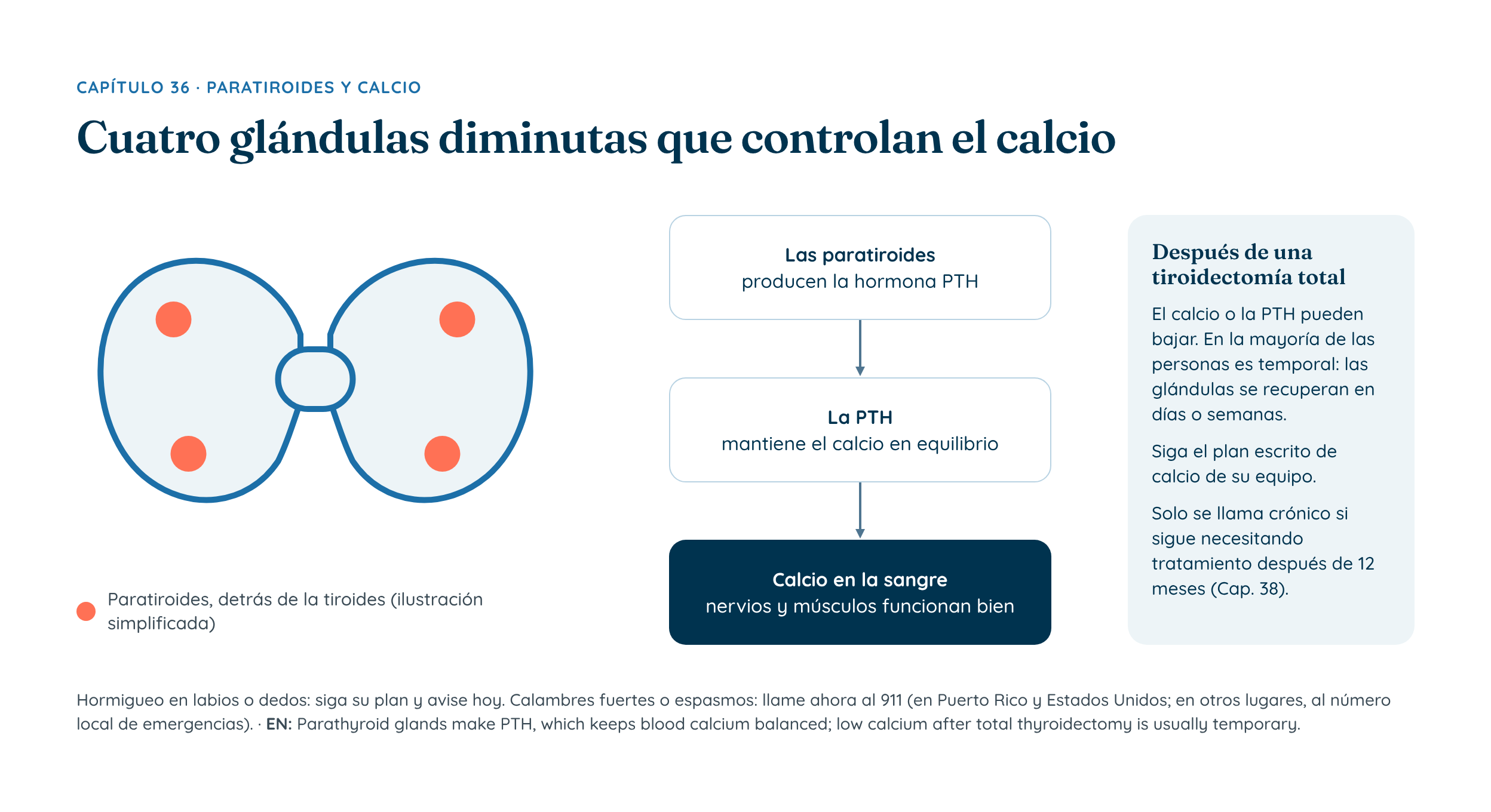
After thyroid surgery, low parathyroid function is usually temporary (Chapter 36). International guidelines say doctors may consider it permanent if it lasts more than 12 months after surgery, although some people still recover later [1][5]. In the guideline’s context, a PTH above 10 pg/mL measured 12 to 24 hours after total thyroidectomy means a low likelihood of long-term hypoparathyroidism [1]. Most cases of hypoparathyroidism are caused by neck surgery [2].
The ATA stresses that permanent hypoparathyroidism affects both physical health and well-being, which is why surgeons work hard to prevent it [4].
Why it matters over the long term
Without enough PTH, calcium tends to run low and phosphate high, and the kidneys lose more calcium in the urine [2]. Over years, the guideline lists possible complications such as calcium deposits and stones in the kidneys, reduced kidney function, cataracts, seizures, heart rhythm problems, depression and a higher risk of infections [1]. Careful monitoring is what keeps those risks down [1].
Standard treatment: calcium and active vitamin D
The first-line treatment is calcium tablets plus an active form of vitamin D (such as calcitriol) [1]. The aim is not a “perfect” calcium, but one that keeps you free of symptoms while protecting the kidneys. That is why doctors usually aim for a calcium level in the low-normal range, or slightly below normal, as long as you have no symptoms.
This treatment works, but it has drawbacks: calcium levels can swing up and down, many people take a lot of pills each day, and over time it may add to the kidney risks [2].
Monitoring
Expect regular blood tests for calcium, phosphate, magnesium and kidney function, and periodic 24-hour urine collections [1]. Kidney imaging is usually done as a baseline and repeated when there is a reason, such as high urine calcium or symptoms of a stone. How often each test is done is set by your treating doctor. Bring your medication list and any symptoms (tingling, cramps, unusual thirst or tiredness) to every visit.
PTH replacement: a newer option
When standard treatment is not working well, international guidelines say doctors can consider parathyroid hormone itself [1]. A long-acting PTH, palopegteriparatide, given as a daily injection with a pen, was approved by the U.S. FDA in 2024 for adults with hypoparathyroidism; it was not studied in the first weeks after surgery [2][6]. In its main trial, after two years most participants had normal calcium and no longer needed standard calcium and vitamin D therapy, their urine calcium normalized, and kidney function measurements improved [3]. These are trial measurements; they do not yet prove that it prevents kidney disease. That analysis was sponsored by the manufacturer, and long-term data are still growing. Access and insurance coverage vary.
Daily life
- Take doses at the times your team set; do not change them on your own.
- Keep a written plan for what to do if tingling or cramps appear.
- Tell every doctor, dentist and pharmacist you have hypoparathyroidism; some medications can affect calcium.
- If you are planning a pregnancy, tell your team early: calcium needs change.
Ana Lucía today
With her doses adjusted and a monitoring schedule, Ana Lucía’s tingling became rare. “I thought I’d feel like a patient forever,” she said. “Now it’s just part of my morning routine.” She and her endocrinologist are discussing whether PTH replacement is a good fit for her.
Questions to ask
- Is my hypoparathyroidism considered permanent?
- What calcium range are we aiming for?
- How often will my urine calcium and kidneys be checked?
- Am I a candidate for PTH replacement?
Key points
- Hypoparathyroidism is considered permanent when it lasts more than 12 months after surgery, though some people recover later.
- Calcium plus active vitamin D is the standard treatment; regular monitoring protects the kidneys.
- PTH replacement is an option when standard treatment is not enough.
- Severe symptoms need 911; milder ones follow your written plan.
A head and neck surgeon experienced in thyroid and voice care can help.
Sources
- Khan AA, et al. Evaluation and Management of Hypoparathyroidism Summary Statement and Guidelines from the Second International Workshop. J Bone Miner Res. 2022;37(12):2568-2585. doi:10.1002/jbmr.4691 PubMed PMID 36054621
- Khan S, Khan AA. Hypoparathyroidism: diagnosis, management and emerging therapies. Nat Rev Endocrinol. 2025;21(6):360-374. doi:10.1038/s41574-024-01075-8 PubMed PMID 39905273
- Rejnmark L, et al. Sustained improvement in renal function with palopegteriparatide in adults with chronic hypoparathyroidism: 2-year results from the phase 3 PaTHway-trial. J Bone Miner Res. 2026;41(9):922-933. doi:10.1093/jbmr/zjag085 PubMed PMID 42166177
- Orloff LA, et al. American Thyroid Association Statement on Postoperative Hypoparathyroidism: Diagnosis, Prevention, and Management in Adults. Thyroid. 2018;28(7):830-841. doi:10.1089/thy.2017.0309 PubMed PMID 29848235
- Bollerslev J, et al. Revised European Society of Endocrinology Clinical Practice Guideline: Treatment of Chronic Hypoparathyroidism in Adults. Eur J Endocrinol. 2025;193(5):G49-G78. doi:10.1093/ejendo/lvaf222 PubMed PMID 41231236
- U.S. Food and Drug Administration. FDA approves new drug for hypoparathyroidism, a rare disorder. August 2024. fda.gov
This guide is for general education only. It does not diagnose conditions or replace a medical evaluation. Talk with your own doctor about your situation. In an emergency, call 911 now (in Puerto Rico or the United States; elsewhere, your local emergency number).